Providing support to students at risk of failing to complete high school for such reasons as inadequate Japanese language ability has become an urgent task.
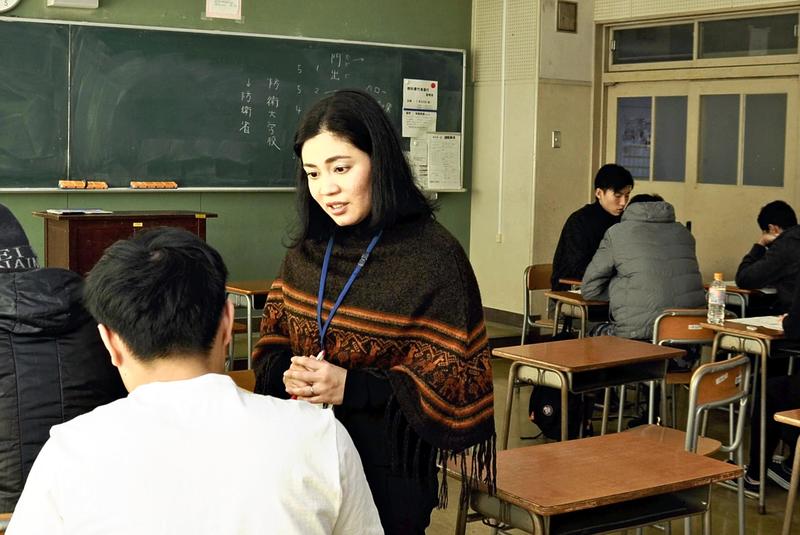
Kanagawa prefectural Sagami Koyokan High School is a part-time institution that teaches a four-year high-school course. (High school is usually three years in Japan.) In a class given in late January for students in need of supplementary Japanese language instruction, teachers gave such instructions as "Think about the expression 'Please do not,'" or "Try to turn the example into the passive form."
Students in their first through third years were divided into six groups according to their ability, tutored by part-time teachers and other instructors. Abilities can vary greatly depending on the amount of time the students have been in Japan and their educational backgrounds.
One group studied simple Japanese sentence patterns and expressions, while another took turns reading newspaper articles aloud to try to improve their comprehension.
About 20 percent of the school's about 1,000 students have foreign nationalities -- including Chinese, Filipino and Peruvian --or some connection to a foreign country, such as having one non-Japanese parent. About 80 students receive Japanese tutoring.
Two to four supplementary Japanese classes are held each week. With their future careers in mind, students in their fourth year are made to do such things as read university brochures to learn about entrance examination procedures and tuition. Students also look at job advertisements in class.
In addition to providing thorough Japanese language instruction, the school allows students to freely enter faculty rooms during after-school hours, creating an environment in which students feel comfortable seeking advice.
Chizuru Kitai, the school's vice principal, said, "We want to prevent students from becoming isolated and increase their motivation to learn."
According to the Education, Culture, Sports, Science and Technology Ministry, the overall drop-out rate for public high school students and others in the 2017 school year was 1.3 percent, while the rate among students requiring Japanese tutoring was 9.6 percent.
The ministry believes the latter rate is high because the students, as well as lacking Japanese language skills, have few friends or adults from whom they can seek advice, and also may lack role models.
Sagami Koyokan High School hired some foreign university students for the supplementary Japanese classes. Meanwhile, nonprofit organization Multicultural Education Network Kanagawa (ME-net) has introduced people from the local community to the school.
Its coordinator said, "Interacting with university students who can serve as role models will help students improve their Japanese skills, and may also help their future prospects."
In the 2018 school year, ME-net and the prefectural board of education dispatched 28 coordinators to 22 prefectural schools.
Teaching in another tongue
Some schools are teaching foreign students in their native languages as well as Japanese.
At Osaka prefectural Kadoma Namihaya High School, special part-time instructors are teaching using their native languages, including Russian, Persian and Nepali.
"Learning how to think logically in their native language may help them improve their Japanese skills and make their comprehension smoother," Vice Principal Koshiro Miyata, 55, said.
Yoshimi Kojima, an associate professor of multiculturalism in education at Aichi Shukutoku University, said: "The goal is not simply to improve Japanese skills, but also to develop students' abilities to make their own choices on whether to pursue higher education or enter employment. This leads to boosting their self-confidence and growth."
Read more from The Japan News at https://japannews.yomiuri.co.jp/