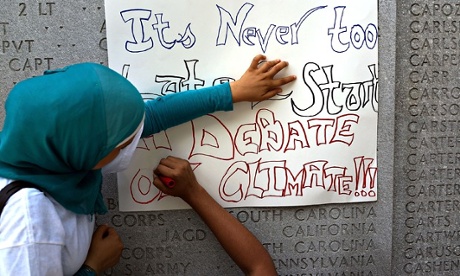
As global leaders gather at the UN climate summit in New York, we asked development students what single action they would propose to reduce the impact of climate change in developing countries. We received 21 submissions from 10 countries including India, Denmark, Germany, Chile and Australia. Suggestions included the redistribution of agricultural land, producing electronics with sustainable materials, investing in large-scale hydrogen and solar power, focusing on reforestation, and prioritising climate change-resistant water and sanitation facilities. Here are our five favourite responses.
Invest in social security
Opponents of action on climate change like to point out that it’s just too damn expensive to do anything. Since developing countries need to focus on climbing up the income ladder, they cannot devote significant resources to fighting the impacts of climate change at the same time. Or so the argument goes.
But what if sound economic and social policies are also smart climate change policies at the same time? If that were the case, synergies could be leveraged and complementary actions implemented.
One of the biggest areas where this applies is social security. While many middle-income countries have introduced a social safety net, the poorest have yet to usher in anything resembling social security provisions that would allow for their citizens to live productive lives without the ever-present danger of illnesses, old age and unemployment. Climate change is only compounding these problems. With more severe weather events, health issues are more likely to arise. The old are particularly vulnerable to climate change. Unemployment figures can be significantly ramped up by droughts, natural disasters and changing marine resource bases.
In this context, a serious, if minimal, social safety net can help to bridge these dangerous gaps ripped open by climate change. A little can go a long way. While European-style welfare states may be expensive, smart and targeted measures of the kind proposed here need not be. Even in the absence of climate change, these policies would represent sound social and economic investments in the future of every country’s citizens.
– Tim Pfefferle, Bonn University, Germany
Increase cooperation between developed and developing countries
For me, the answer to successful climate change mitigation and adaptation lies in multilateral cooperation and innovation. Merely handing out huge aid programmes are not enough, we need to foster long-term public-private partnerships between developed and developing nations in order to ensure technology transfer and the creation of innovative solutions arising as a result of entrepreneurial spirit.
This cooperation could be in the form of CCCPs (climate change collaborative platforms) that will serve as an umbrella body of initiatives that will to help reduce the impact of climate change in developing countries.
For example, in India (my country), breakthroughs in sustainable agricultural practices as a result of research in partner countries has been beneficial for small farmers and workers. Therefore, the need of the hour is to work together instead of bickering over who should take the first step!
– Riddhima Yadav, Yale University, US
Natural resources should no longer be seen as a production line for economic growth
The relationship between economic development and environmental issues is stronger than policymakers first credited. Many forms of development encouraged by international economic institutions such as the World Bank and the IMF encourage paths to development that have been seen to erode environmental resources.
This relationship means developing countries suffer a sharp duality of burden. Not only does their limited economic growth rely on unsustainable resources, but as they continue to strive towards economic development, states have been seen to suffer environmental degradation that continues to undermine their economic development.
Thus, I propose to the UN climate summit in New York action that will seek to change the current discourse in “sustainable development”. Currently, natural resources are protected and managed in order to better improve the production process in a capitalist economy. This cannot protect states from rising sea levels, floods, droughts and other climatic extremes.
Instead, providing infrastructure and specialised institutions to states that are seen to be suffering the effects of climate change should be integrated into international development policy ahead of the current IMF and World Bank economically driven “sustainable development” discourse and action. Natural resources should no longer be seen as the production line towards economic growth. Rather, UN and state policy needs to address these two interrelated development issues separately in order to safeguard the world’s most vulnerable from further economic and environmental suffering.
– Beatrix Neville, Monash University, Australia
Penalise countries for failing to meet emissions pledges
My proposal at the summit would be to enforce a law that would fine countries that do not meet their emissions pledges set in the 2009 Copenhagen accord. Bric countries will also be eligible for fines. This money would then go towards subsidising adaptation projects in developing countries, especially those which are or will be severely effected by the consequences of climate change.
For example, the Maldives, currently facing the prospect of people having to abandon the islands due to rising sea levels. The developing nations of the world are going to be hit hardest by climate change. This change largely stems from the actions of the established developed nations. Nations who fail to see this, and show disregard to their emissions pledges, must be shown that targets are meant to be met. At the same time, they have a moral duty to aid countries in adapting to the new climatic future – a future that has been largely created by developed nations.
The proposal would have two core benefits: it would help in protecting billions of people in the developing world who face an uncertain future, and should give developed nations an even greater incentive to continue to reduce their emissions and reach their targets.
– Joe Camish, East Anglia University, UK
Share agricultural production
I would propose a redistribution of agricultural land to the impoverished and landless. Large, privately owned plantations that focus on cash crops could be partially seized, and sections devoted to a “commons-like” setup – of which part would be devoted to organic/crop rotational techniques. The crop would be distributed to the families of the labourers and among the local population.
Such a transition of agricultural land utilisation would employ the unemployed, feed the hungry, cultivate native produce that would be consumed locally (cut crops being transported – minimises fossil fuel use), spread education and knowhow on sustainable farming practices, and drastically reduce deforestation.
A minuscule minority of the wealthy, landed elite would see diminished profits. However, the increases to employment, food security and local food consumption would promote civil peace. Meanwhile, the substantial decrease in fossil fuel use and deforestation would make massive reductions in the amount of greenhouse gases emitted into the atmosphere.
Practical challenges that may initially arise could include education and training on sustainable farming techniques, acquisition of tools and materials, and a just system of labour and produce distribution. However, such initial inevitable difficulties of such a societal shift are inconsequential growing pains when compared to the catastrophic events that will would ensue if such necessary change is not enacted to combat global warming and climate change.
– Patrick Rulong, Waterloo University, Canada