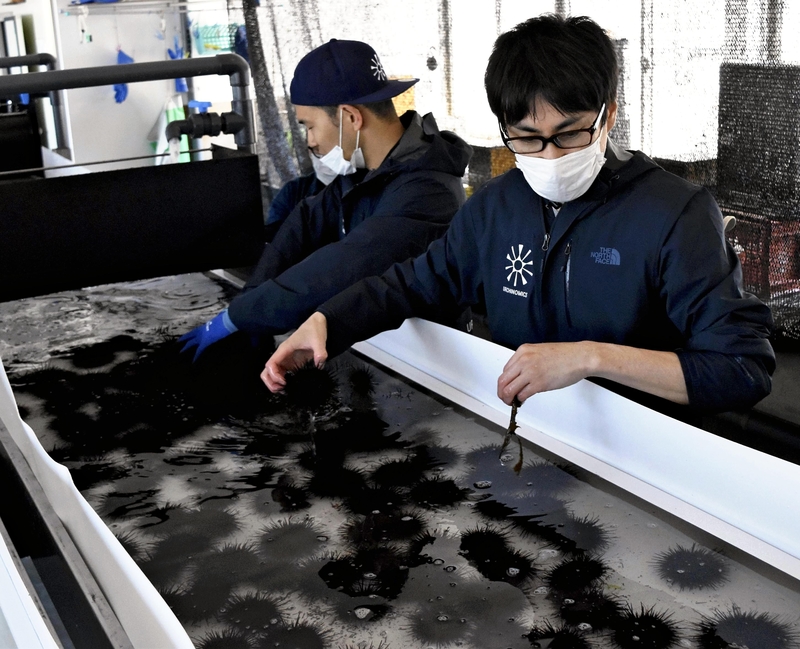
ISHINOMAKI, Miyagi -- A joint project to culture sea urchins on land has been launched by a fisherman training group in Ishinomaki, Miyagi Prefecture, and the branch office of the prefecture's fishery cooperative in the city among others.
The Ishinomaki Save the Ocean Project (ISOP) is aimed at preventing sea urchins from eating away seaweeds on the coast, a phenomenon called isoyake, and providing income support for young fishermen in the area. Trial sales of the land-cultured sea urchins are expected to start in mid-June.
In addition to the fisherman training group Fisherman Japan and the fishery cooperative's Ishinomaki branch office, the project is participated by Uninomics Kabushiki Kaisha, a Tokyo-based company proven for sea urchin cultivation at home and abroad; the Ishinomaki Senshu University; and a local ocean survey company. The project makes the use of subsidies for businesses regarding multifunctionality of fishery by the Fisheries Agency, the prefecture and the city.
Under the project, sea urchins are collected on the coasts at two places in Ishinomaki where seaweed reduction by sea urchins is serious: the Sasunohama district and Tashirojima, a remote island off the city. The collected sea urchins are then grown at a farm facility set up in Sasunohama. Once sea urchin roes inside the shells become fattened, they will be put on sale.
Part of the profits will be used for planting seaweeds, such as arame, according to the project operators. They are planning to entrust the project to young fishermen in the city in the future as their side business to support themselves before they become able to make living as a fisherman.
Members of the project gathered in Sasunohama on May 8 and collected about 400 kilograms of sea urchins with not much meat inside. The sea urchins were then thrown into aquariums developed by the Tokyo company. They are fed with kombu-based food, and their roes will be fat enough in six to eight weeks, according to the project operators.
"We want to create a system to grow seafood that profits fishermen while also protecting the marine environment," said Takuya Hasegawa, the head of the secretariat at Fisherman Japan.
Read more from The Japan News at https://japannews.yomiuri.co.jp/