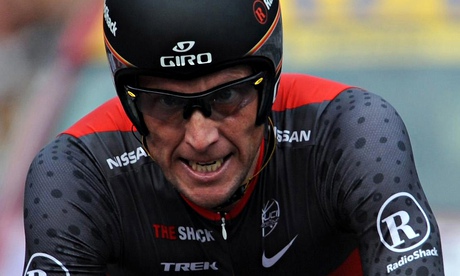
Not surprisingly Lance Armstrong’s trips to France spawn controversy. In 2006 when the Texan returned to the Tour de France after just under a year’s absence, the seven-times winner – which he still was back then, prior to his life ban for doping – was greeted with a headline in the tabloid France-Soir which read: “Welcome in France Trouduc,” the use of the slang abbreviation for trou du cul being a reference to the Texan’s comment that the French national football team had “all tested positive for being arseholes”.
It remains to be seen what sort of a welcome Armstrong receives this week when he is back on the Tour’s roads, riding the route of stages 13 and 14 of the race with the former England football international Geoff Thomas as part of his “Le Tour – one day ahead challenge”, in which Thomas and a group of 10 amateur cyclists are aiming to complete the race route riding 24 hours ahead of the peloton, in aid of the charity Cure Leukaemia.
It should be a warm welcome as this is a worthy venture, which aims to raise £1m for the blood cancer charity, but Armstrong’s presence has already caused unease. In March, when his participation was announced, the news led the president of the Union Cycliste Internationale, Brian Cookson, to warn: “Frankly I think that’s completely inappropriate and disrespectful to the Tour, disrespectful to the current riders and disrespectful to the UCI and the anti-doping community. I think Lance would be well-advised not to take part.” Given his combative nature, Armstrong responded by questioning the strength of Cookson’s leadership of the governing body.
“It will make a bit of a stir but I don’t have the impression that people are talking about it much just yet,” was the view of Philippe Bouvet, a senior cycling journalist at the newspaper L’Equipe, who reported on Armstrong’s years in the peloton. “If Armstrong is not at the Tour, that’s a sign of his complete failure. He won seven Tours but he’s not welcome at the race and that’s failure.”
For Bouvet, this underlines that Armstrong is on the margins but the writer feels he has been there for some time. “It depends on what use he is making of the venture but he’s already pillaged the Tour enough. He can’t be prevented from doing it. I remember when he had stopped back in 2006, I was at Alpe d’Huez and saw him riding up in a group of cyclists. I found it pathetic – he had won seven Tours and already he couldn’t come on the Tour.”
The prospect of Armstrong’s return to France, if not exactly to its Tour, has clearly raised the profile of Thomas’s charity, which can only be a good thing. It reflects Armstrong’s current status within the sport: umbilically joined to it yet apart from it; impossible to ignore yet bound to court controversy. Given the way he exploited his cancer charity Livestrong as a shield against accusations of doping, any link with any charitable venture now raises the suspicion that Armstrong is not doing the charity ride for purely altruistic reasons. Such is the toxic nature of his legacy.
The problem this week is this: if Armstrong is applauded along the way – given the ride’s charitable venture, all the participants should be – he will, perhaps, cite the cheers and handclaps as evidence that he is a redeemed character who has served his time in the wilderness.
Yet the visit raises an uncomfortable question: why, when other former notorious dopers are welcome at the Tour – Richard Virenque being a case in point – should Armstrong remain on the outside, and for how long?
This is a question the former Tour winner raises repeatedly perhaps without understanding that labouring a point can be counter-productive. The answer is a messy one: with human nature being what it is, with the nature of each case being so different, there is no one-size-fits-all formula for post-doping redemption.
But forgiveness usually comes when the offended party chooses to offer it, and it is prompted by contrition rather than confrontation.