What an Atoll Actually Is, and Why Lakshadweep Is the Only One India Has
An atoll is not a beach with coral nearby. It is a coral structure that built the land itself. The 36 islands of Lakshadweep sit on top of ancient reef platforms that grew upward from submerged volcanic seamounts over tens of thousands of years. As the seamounts slowly sank, the coral kept pace with the sea surface, leaving behind a ring of reef enclosing a shallow lagoon. India has 7,500 kilometres of coastline. Fringing reefs exist off the Andaman and Nicobar Islands, off Gulf of Mannar, off Palk Bay. But true atolls, where the island is the reef, exist only here, in the Arabian Sea, 200 to 440 kilometres off the Kerala coast.
The distinction matters biologically. Atoll lagoons are semi-enclosed, warm, and shallow. They function as nurseries in a way that open-water fringing reefs cannot. Juvenile reef fish, sea turtles, and invertebrates use the lagoon's calmer interior before moving to the outer reef slope. Remove the reef structure, and the lagoon loses its shelter function. The islands themselves, which sit at an average elevation of one to two metres above sea level, lose the physical buffer the living reef provides against wave energy.
The Species That Live Here and Nowhere Else in Indian Waters
The Zoological Survey of India has documented over 600 species of fish across Lakshadweep's reefs, along with more than 100 coral species from genera including Acropora, Porites, and Montipora. Several of these species have their only confirmed Indian Ocean breeding populations in this atoll chain.
The humphead wrasse (Cheilinus undulatus), listed as Endangered on the IUCN Red List, feeds here on hard corals and sea urchins, playing a direct role in controlling populations that would otherwise overgrow the reef. The reef's structural complexity, the three-dimensional architecture of branching Acropora corals in particular, supports this predator-prey balance. Green sea turtles nest on Lakshadweep's beaches and forage on the seagrass beds that the lagoon shelters. Spinner dolphins use the atoll channels as resting grounds between deep-water feeding runs.
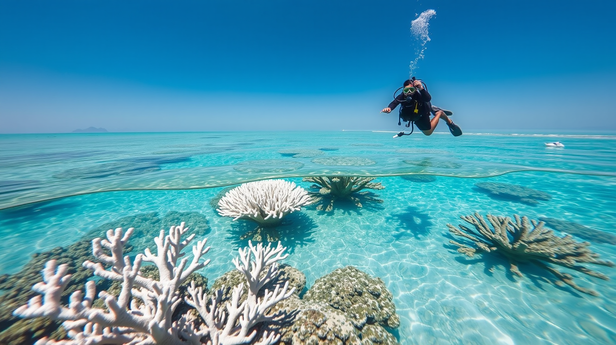
One biological fact that shapes everything else about these reefs: the coral animals themselves, polyps, are not the primary producers of the reef's energy. That role belongs to symbiotic algae called zooxanthellae living inside the polyp tissue. These algae photosynthesize and transfer up to 90 percent of their energy output to the coral host. When water temperature rises even one degree Celsius above the seasonal maximum for an extended period, the coral expels the algae. The coral turns white. Without the algae, it starves. This is bleaching, and it is the central threat to Lakshadweep's reefs right now.
The Bleaching Record and What the Numbers Say
Lakshadweep's reefs bleached severely in 1998, when an El Niño event pushed Arabian Sea temperatures well above normal. Surveys conducted by the National Centre for Sustainable Coastal Management found that some reefs lost over 70 percent of live coral cover in that single event. Recovery took roughly a decade in the healthier reef sections. Then 2010 brought another mass bleaching. Then 2016. The intervals between severe thermal stress events are compressing.
Research published in peer-reviewed literature on Indian Ocean coral systems has consistently found that reefs experiencing repeated bleaching within five to ten years cannot complete the full recovery cycle. New coral recruits, the larvae that settle and begin building the next generation of reef, need stable substrate and low algal competition to survive their first year. A reef that bleaches before its recruits mature produces fewer reproductive adults in the next cycle. The population shrinks from both ends.
The NCSCM's monitoring data for Lakshadweep shows live coral cover at several atolls declining from above 60 percent in the early 1990s to below 30 percent at some sites by the late 2010s. Agatti and Kavaratti, two of the more studied atolls, show this trajectory clearly. The outer reef slopes, which receive stronger currents and slightly cooler upwelled water, have fared better than the lagoon-facing reef flats, where thermal stress accumulates faster in shallow, enclosed water.
What Accelerates the Loss Beyond Temperature
Thermal stress is the primary driver, but it does not work alone. Crown-of-thorns starfish (Acanthaster planci) outbreaks, which occur when nutrient runoff from land disrupts the predator populations that control starfish larvae, can strip a reef of live coral cover within months. Lakshadweep's relative isolation has historically limited land-based nutrient pollution, but increased coastal construction on the islands changes that calculation.
Coral mining, the removal of dead and live coral for construction material, was practiced historically across the islands and reduced structural complexity on inshore reefs before legal protections were put in place. The physical damage from that period has not fully recovered.
Sedimentation from dredging activity, which increases around islands with expanding harbour infrastructure, smothers coral recruits before they can attach. A recruit that settles on a sedimented surface cannot feed or calcify normally. It dies within weeks. The reef does not register this loss visibly, the adults look intact, but the recruitment failure shows up five to ten years later when the adult population is not being replaced.
What Remains and Why It Still Matters
The reefs that have survived in the best condition are on the western and northwestern faces of the outer atolls, where Arabian Sea upwelling periodically delivers cooler, nutrient-rich water. These refugia, reef sections that experience less cumulative thermal stress, are the source populations for any future recovery. They are also the sections least protected by current zoning, because the protected area boundaries around Lakshadweep's marine national park and wildlife sanctuary cover the lagoon-facing sides more comprehensively than the outer slopes.
The biodiversity argument for protecting these reefs is straightforward: species like the humphead wrasse and the hawksbill turtle have no alternative Indian habitat if Lakshadweep's reefs collapse. The structural argument is more immediate for the islands' 65,000 residents. Living reef dissipates wave energy. A degraded reef with low coral cover and reduced structural complexity transmits more wave force to the shoreline. For islands averaging one to two metres in elevation, the reef is not scenery. It is the first line of coastal defence.
The coral that built these islands over thousands of years is now dying faster than it can grow back. Each bleaching year that passes without recovery time is a year the reef's capacity to rebuild shrinks. The atoll system and the islands it created are not separate things, and the distinction between losing a reef and losing a coastline is, at this rate, becoming a question of timing.