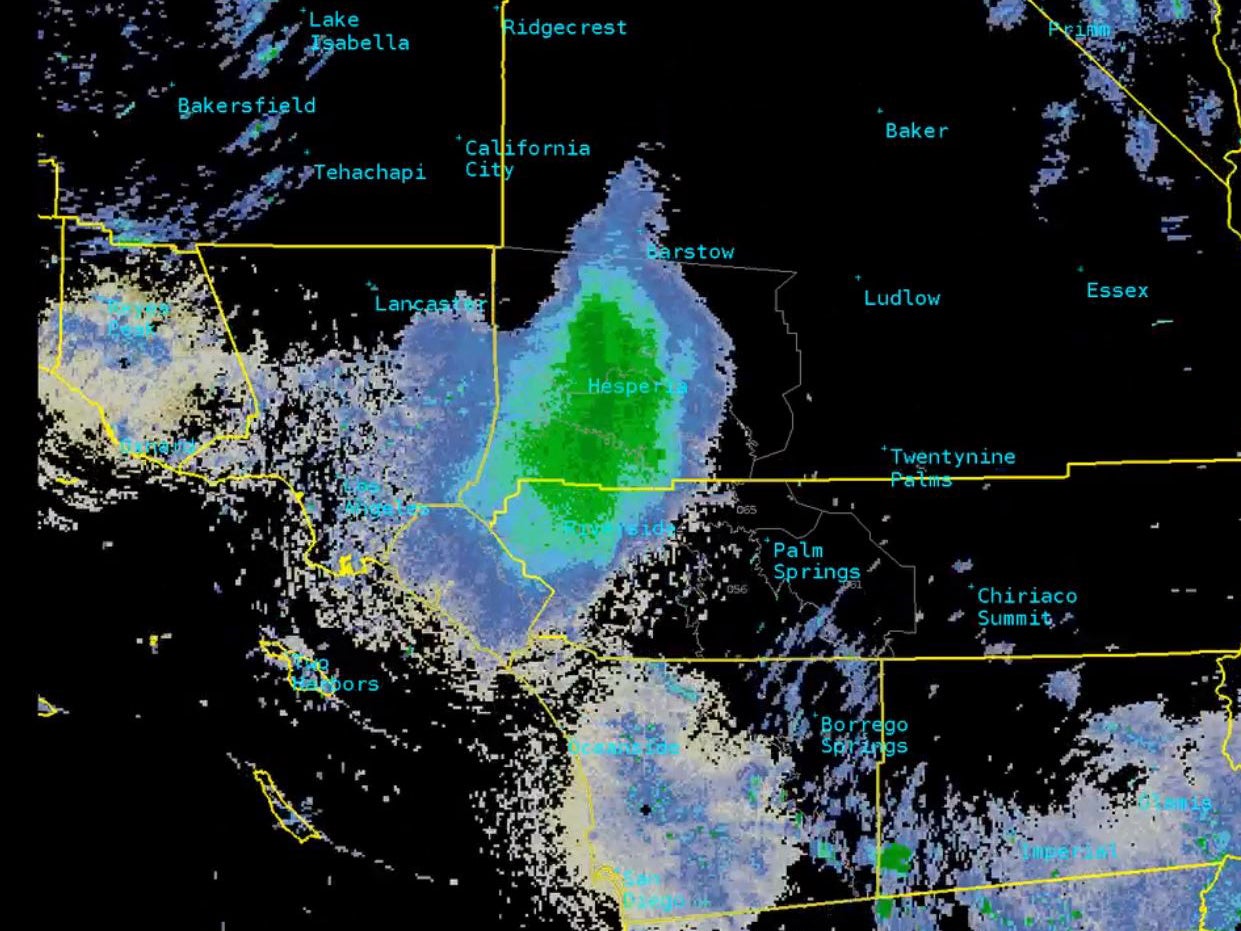
A swarm of ladybirds in California grew so large it appeared on weather radar screens.
Technicians reportedly had to call observers on the ground to find out the nature of the huge radar return moving across the south of the state.
“The large echo showing up on SoCal radar this evening is not precipitation, but actually a cloud of lady bugs termed a ‘bloom’,” the National Weather Service’s (NWS) San Diego station tweeted on Wednesday.
Joe Dandrea, a meteorologist in that office, saw the echo and called a spotter in the San Bernadino mountains for more information.
He told the LA Times: “The observer there said you could see little specks flying by. I don’t think they’re dense like a cloud.”
The bloom appeared to be some 80 miles across, Mr Dandrea told the paper, but added that the most concentrated part spanned about 10 miles.
The insects spotted using NEXRAD equipment – or next-generation radar – were flying at between 5,000ft and 9,000ft, he said.
“Well, better than locusts,” opined one social media user.
Radar returns created by insects or birds are termed “angels” in weather service lingo.
The US Geological Survey has been engaged in developing a machine-learning algorithm to decipher decades-worth of NEXRAD data to find information about migrating birds – which the technology is also capable of picking up.
But more basic methods do exist, the agency said in 2016.
“There are ‘goose chasers’ travelling throughout the Midwest who locate flocks of birds and record their precise latitude and longitude, measure their height above ground level using a digital rangefinder, and record the observation time to the nearest second.
“Scientists then download that specific data from the National Oceanic and Atmospheric Administration national climate data centre, knowing that it, in fact, has geese in it.”