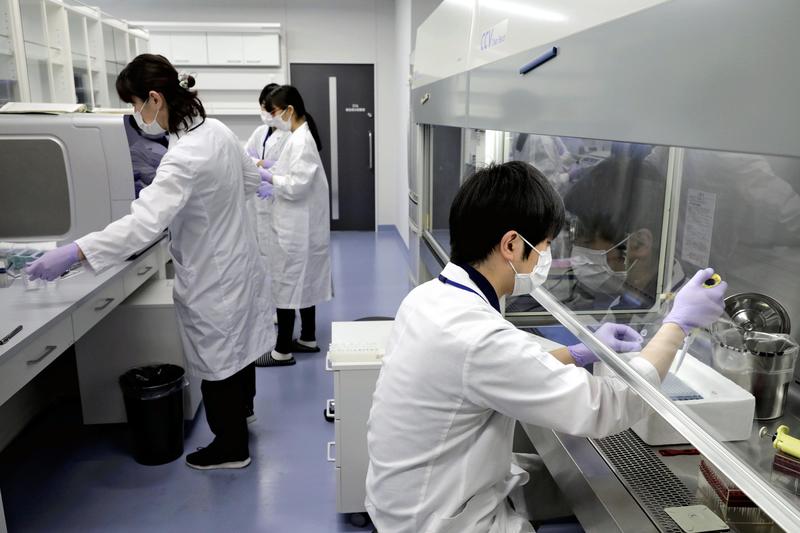
A smartphone-size plate was placed in a positive pressure chamber, where atmospheric pressure is raised to keep out dust, at the Nagoya City Public Health Research Institute (NCPHRI) on the outskirts of the city on May 13. On the plate were 96 small, 5-millimeter diameter, indented spots at 3-millimeter intervals. A staff member used a pipette to drip a liquid into each indentation. These liquid specimens were being used for PCR (polymerase chain reaction) tests to detect the novel coronavirus.
PCR testing reveals the presence of genetic material from the virus. If specimen samples are placed in the wrong spots, misidentification will result. If droplets are scattered into other spots, that will likewise skew the test results. In fact, there was a case in which negative specimens were judged positive in April at the Aichi Prefectural Institute of Public Health.
Shinichiro Shibata, head of the NCPHRI's microorganism division who supervises eight staffers, said that the PCR test "involves many manual operations and does not allow even a small mistake, which makes it nerve-racking work."
The plate was then set inside a special-purpose device and the specimens go through 45 repetitions of a process in which they are heated to 95 C and cooled to 60 C. If genetic material from the novel coronavirus is propagated, it reacts with reagents that emit light and the device detects the light to judge whether the specimens are positive.
The NCPHRI is one of the local public health research institutes established by prefectures and ordinance-designated major cities to study measures against infectious diseases and investigate food poisoning cases. The institute normally has the capacity to conduct up to 80 PCR tests a day. In March, it conducted about 130 PCR tests on some days by increasing staff and working overtime. As of May 23, 510 residents of Aichi Prefecture had been confirmed to be infected with the novel coronavirus. Since the state of emergency was lifted for the prefecture on May 14, the number of specimens sent to the NCPHRI each day has fallen back to less than 60.
Shibata, however, has not let his guard down, saying, "Tests are aimed at discovering newly infected people and preventing a resurgence of virus infections at an early stage."
Multiple private labs received in mid-April notifications from the Health, Labor and Welfare Ministry that said, "Private labs are called on to actively approach prefectures, cities and special wards where public health centers are located for business and other purposes."
The new coronavirus epidemic had expanded, with the daily number of confirmed new infections in the nation reaching 743 on April 11. The daily number of PCR tests, which stood at the 1,000 level in early March, had increased to about 9,000. But even some people who became seriously ill could not undergo a PCR test, sparking calls for expanding and improving the testing system.
Considering that requests for tests concentrated on local public health research institutes, the health ministry provided a list of private testing facilities for municipalities across the country, calling on the municipalities to utilize them and for the private bodies to make themselves available to the municipalities.
A ministry official in charge said, "We wanted to expand the availability of PCR tests by even a little."
The number of PCR tests, however, did not increase as had been expected.
"The number of infected people grew, but strangely enough the number of orders received for testing did not rise," said Naokazu Iwamoto, 57, sales project manager for Fukuoka-based clinical test consignment company CRC, moving his finger along graph showing the number of orders received.
The company was able to prepare reagents and other necessary materials in late March. After it ensured the capacity to test 46 specimens a day, Iwamoto phoned the Fukuoka prefectural and municipal governments in mid-April, but their typical answer was, "We don't need anything right now."
According to a questionnaire conducted around that time by the Fukuoka prefectural medical association, there were multiple cases in which public health centers declined "requests to test patients who were judged to require tests." A senior member of the association guessed the reason may have been that the public health centers were simply overwhelmed by too many requests.
The number of tests undertaken by the company began to increase at the end of April when the daily number of infected persons in the prefecture dropped below 20. Requests stand out from PCR centers, where specimens are taken by medical associations and other organizations, as well medical institutions that inspect patients before performing operations.
In Fukuoka Prefecture, where about 600 tests per day were conducted in early April, the number has recently remained below 200. The rate of positive results for 781 specimens tested on May 23 and the preceding six days stood at less than 0.6%.
The firm, which has secured reagents capable of reducing the number of hours needed to obtain test results, has the capacity to inspect 140 specimens a day.
"When a second or a third wave of the epidemic comes, we want to be part of a helping hand," Iwamoto said.
The Tokyo metropolitan government, whose Tokyo Metropolitan Institute of Public Health is capable of about 240 tests a day, has outsourced 300 tests a day to two private inspection companies since April.
Mitsuhiro Enomoto, 45, who heads a section for coordinating measures against infectious diseases at the metropolitan government, said, "The coronavirus crisis cannot be overcome without the help of the private sector."
Read more from The Japan News at https://japannews.yomiuri.co.jp/