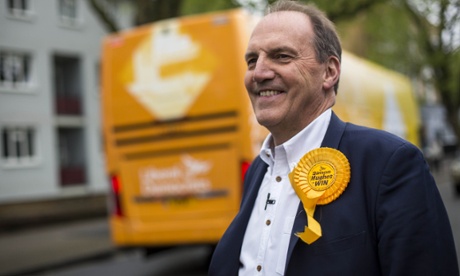
As he knocks on doors on a sprawling estate in south London, Simon Hughes puts a brave face on a battle that could end a parliamentary career that began more than three decades ago when he trounced Peter Tatchell, the gay activist, in a notoriously dirty election.
“The fact that it’s close motivates our people, and we are not taking a single vote for granted,” said Hughes, the deputy leader of the Liberal Democrats until last year, as he stuffed another leaflet through a letter box.
At the start of the campaign few thought Labour had a chance in seats such as Bermondsey and Old Southwark. Hughes got almost 50% of the vote in the constituency in 2010 with Labour a distant second.
But Labour in London appears to be on a roll, while the Lib Dems have imploded.
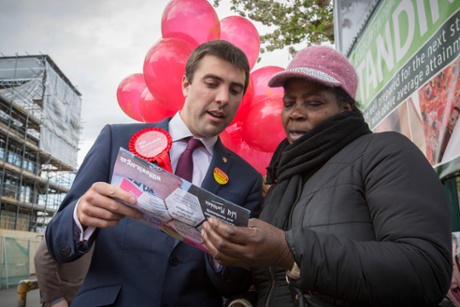
“Everything has changed since 2010,” said Bermondsey and Old Southwark Labour candidate, Neil Coyle, formerly policy director at the Disability Alliance. “[Hughes] is in an unpopular government and the housing crisis is felt day in, day out. The bedroom tax has really hurt people and we have 17,000 students who are upset by tuition fees.”
London will elect 73 of the 650 House of Commons MPs on 7 May. Labour currently has 38 MPs in the capital, the Tories 28 and the Lib Dems seven. Recent polls have put Labour between 12% and 14% in front of the Tories in the capital, which suggests it could pick up between six and 12 seats.
In the past few weeks these projections, combined with their own polling, have led Labour strategists to calculate that seats such as Bermondsey and Old Southwark, Finchley and Golders Green, and Battersea are now in contention – and Labour’s “ground war” has been intensified accordingly.
Sadiq Khan, shadow minister for London, who has masterminded the party’s campaign in the capital, said: “It would be an amazing coup if we were to win any of them, but it looks increasingly like it’s going to be very close. No one predicted we would be competitive in these seats, let alone have a real chance of winning them.”
In Bermondsey, Hughes remains defiant. He is putting faith in a two-prong strategy: claiming that the Lib Dems stopped the Tories from “doing horrible things” and blaming the Labour-dominated council for the lack of affordable housing in the area.
Hughes has the advantage of long incumbency. People recognise him as he walks down the street. One young man runs up to him to discuss the lack of parking space for the new leisure centre at Elephant and Castle. Satisfied with the MP’s response, he says: “Now I will vote for him.”
And despite the party’s challenge, a Labour activist admitted parts of the constituency still feel like Hughes’ domain. “When we stepped out of Bermondsey tube station, it felt like we’d entered enemy territory,” she said. “Across the road from the station is a block of flats, and every balcony on this block of flats was covered with a huge Simon Hughes banner – with a tiny little Lib Dem logo in the corner. Then on the walk to the market, the route was lined with Simon Hughes placards.”
However, Coyle believes that outside pockets of strong support Hughes is vulnerable. He says Labour has been building momentum, winning a majority in the council last year, while the Lib Dem machine has atrophied.
“He’s in denial about how much trouble he is in locally,” says Coyle as he climbs up and down the stairs at the Rockingham estate (where Tatchell lives) knocking on doors.
The polls seem to agree. A YouGov/Evening Standard poll classed the seat as too close to call.
And it may not be the only one. A few miles up river the Labour party is scenting another upset.
Last weekend 250 activists turned up to canvass across Tory-held Battersea when, according to their candidate Will Martindale, all but 10 streets in the constituency were canvassed.
“It has been an incredibly exciting campaign,” said Martindale, who is expecting 500 activists in the area on polling day. “We have got people out campaigning for us now who have never campaigned before … it is a genuinely mixed group of people who are working really, really hard … it is going to be incredibly tight.”
According to the latest London polls, the swing from Conservative to Labour is 5-6%. To win in Battersea would take a swing of 6.1% , although a recent poll from Lord Ashcroft put the Tories 12% clear.
Jane Ellison, Martindale’s Tory opponent, admits the Labour ground campaign has the numbers but is sceptical it will prove decisive come 7 May, pointing to an experienced Conservative team and what she says was a relatively strong performance in the local elections last year.
“There has been a lot of activity from the Labour party, but in the end selfies are fun but they don’t win elections.”
Ellison says people will ultimately vote for who is “best placed to run the country and keep the economic recovery going” adding that the response on the doorstep has been very positive.
“I am working very hard to make sure I am returned and that that helps return a Conservative government,” she said.
But whatever the final outcome in London the Tory campaign has led to private grumblings among some Conservatives.
A senior figure in another Tory/Labour marginal said Conservative Central Office would have questions to answer once the dust settles on 8 May about its lack of support for London MPs fighting in tight seats.
“They were warned about what Labour were up to, that they would be shipping in activists from all over the place, and were told that we had to up our game in London and that has not happened.”