Afternoon summary
-
Mark Carney, the governor of the Bank of England, has told MPs that the fall in oil prices represents a “negative shock” to the Scottish economy, but a boost for UK growth overall. He told the Treasury committee:
It is a negative shock to the Scottish economy but it is a negative shock substantially mitigated by the fiscal arrangements in the UK ... My personal view is that the net impact of the decline in the oil price at this stage is net positive for growth in the UK.
-
Charles Kennedy, the former Lib Dem leader, has said that David Cameron’s refusal to take part in televised debates could reinforce impressions that he is out of touch. He told the World at One.
Actually, I think this has got a Bullingdon Club dimension to it. I thought Labour were just silly and left-wing and student politics when they kept going on and on about that photograph of these posh toffs all in their hats and tails, behaving like idiots as undergraduates. And yet, you know, that contributed to this feeling which the pollsters have shown consistently ever since - this lot, Osborne, Cameron etc, ‘out of touch’, ‘toffs’ . I just wonder if this will contribute to ‘out of touch’, and also ‘running scared’.
-
Al Murray, the comedian, has announced that he will stand for parliament at the election in his guise as the Pub Landlord in South Thanet, against Nigel Farage. As the Press Association reports, the star - whose creation is famed for extolling the joys of all things British - plans to stand for his newly-formed Free United Kingdom Party. Explaining his decision to stand, Murray said: “It seem to me that the UK is ready for a bloke waving a pint around, offering common sense solutions.”
That’s all from me for today.
Thanks for the comments.
My colleague Libby Brooks has sent me more on the SNP position on leaders’ debates.
Nicola Sturgeon met the BBC director general last week to put the case for the SNP’s inclusion in the debates. She argued that, given a hung parliament seems likely, the electorate south of the border has the right to hear from a party which may well end up in a position of considerable influence in Westminster. The BBC reiterated to the SNP that they will not make a decision on their final proposal until new election guidelines are put in place in March.
Nick Clegg told Sky News that David Cameron should stop “ducking and weaving” and accept the proposed televised debates.
My message to David Cameron is just stop ducking and weaving, stop coming up with all these specious excuses. The broadcasters have made a proposal. The rest of us are prepared to go along with those proposals. The British public enjoyed the leaders’ debates last time, they want to see them happen again. I think this a time just to get on with it.
Last year, when the broadcasters first unveiled their plans for three debates - a four-way one with Clegg, David Cameron, Ed Miliband and Nigel Farage, and three-way one with Clegg, Cameron and Miliband and one just involving Cameron and Miliband - the Lib Dems said they would not accept this formula because they would not accept being excluded from one debate. Now, though, Clegg seems to saying that this is no longer an absolute red line.
Earlier I quoted the sections from the BBC editorial guidelines that suggest the BBC would be entitled to “empty chair” David Cameron if he refused to turn up for a debate. (See 9.40am and 9.42am.)
Ofcom, which regulates the commercial broadcasters, has its own broadcasting code. This does not specifically address the issue of what to do it a politician refuses to take part in a debate, but two principles are relevant. It says that broadcasters should be impartial. And it says that “due weight” must be given to the major parties in coverage.
Ofcom is not giving out guidance on what broadcasters should or should not do in the event of someone refusing to take part in a debate, but an industry source said the code would make it hard to justify a broadcaster “empty chairing” Cameron. However, if a broadcaster were to choose a proxy to speak on Cameron’s behalf, that would be acceptable, the source suggested. That would ensure the Conservative case was given “due weight”.
Al Murray to stand against Nigel Farage in South Thanet
Nigel Farage has some competition for the pub vote in South Thanet. Al Murray, the Pub Landlord comedian, has announced that he’s standing. He’s set out his programme on his website.
Will he affect the result? Celebrity candidates tend not to do very well in general elections; just look at Esther Rantzen, who got less than 2,000 votes in 2010 in a seat that, at one point, she had hoped to win. She was standing on an anti-sleaze ticket.
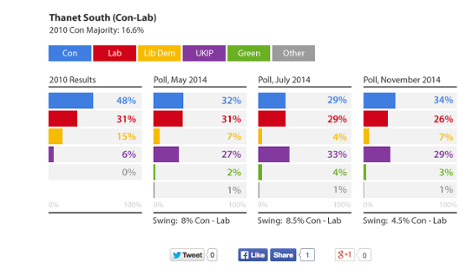
But in a tight contest that could make a difference. It’s a three-way marginal, and, of the three polls that have been conducted there this year, two have shown the Tories in the lead, and one Ukip.
Updated
Back to the TV debates, and the SNP is renewing its call for Nicola Sturgeon to be included. It says it has more members than the Lib Dems and Ukip combined, and that the identical Labour/Lib Dem/Ukip letter shows that Ukip is now a Westminster establishment party. This is from Stewart Hosie, the SNP’s deputy leader.
Ukip is now part of the Westminster establishment along with Labour and the Lib Dems, and this proves it. It’s quite astounding that Labour are prepared to work with Ukip on a debate format which excludes the SNP, Plaid Cymru and Greens. Yesterday Labour voted with the Tories on austerity, today they are working with UKIP on debates.
A recent YouGov poll shows that most people across the UK support Nicola Sturgeon being included on the televised leaders debates - we want these debates to happen, and they must include the SNP. The polls show that south of the border, and across the nations and regions of the UK, people rightly recognise the need to have fair representation in the televised debates.
With a larger membership than the Lib Dems and UKIP combined, and more elected MPs than UKIP, the case for including the SNP is unanswerable.The addition of the SNP, Plaid and the Greens with Nicola Sturgeon, Leanne Wood and Natalie Bennett will also rightly show that politics across the UK isn’t just an old boys club.
For reference, here are party membership figures.
Estimated memberships Lab 190,000 Cons 149,800 SNP 92,000 LibDems 44,576 Ukip 41,514 Green 40,879 Plaid 8,000 BNP 500 http://t.co/fKiLee0jYn
— Matthew Goodwin (@GoodwinMJ) January 14, 2015
Lunchtime summary
-
Theresa May, the home secretary, has claimed that the Paris attacks show the need for the communications data bill and that lives are being put at risk by parliament’s failure to pass it. In a statement to MPs, she said that it was “highly probable” that communications data was used to link the two attacks in Paris. (See 1.31pm.)
Every day that passes without the proposals in the Communications Data Bill, the capabilities of the people who keep us safe diminishes. And as those capabilities diminish, more people find themselves in danger and – yes – crimes will go unpunished and innocent lives put at risk.
She also said that Lib Dems claims that it amounted to a “snooper’s charter” were misleading. And she said the Conservatives would pass it if they won the elections, incorporating the safeguards recommended by the joint committee that considered the draft bill in 2012.
-
May has reaffirmed the Conservative party’s determination to ensure that the state can access all internet communications. Since David Cameron set this out as a goal on Monday, experts have dismissed it as unworkable. But May told MPs that, “as far as possible”, the Conservatives wanted to prevent terrorists having access to “safe spaces” on the internet.
We are determined that as far as possible there should be no safe spaces for terrorists to communicate. I would have thought that that should be a principle ... that could have been held by everybody, across all parties in this House of Commons. Certainly, as far as I’m concerned, as far as the Conservative party is concerned, our manifesto will make it clear that we will introduce legislation immediately to restore our declining communications data capability and that we will use all the legal powers available to us to make sure that, where appropriate, the police and security and intelligence agencies have the maximum ability to intercept the communications of suspects, while ensuring that such intrusive techniques are, of course, properly overseen.
She was responding to a question from the Lib Dem MP Julian Huppert who said the idea was foolish. He said Cameron wanted to stop online communications that could not be intercepted.
This would cause huge problems for anyone who relies on secure online transactions for their banking, for online shopping, or anything else, jeopardising Britain’s reputation as a good and safe place to do business. Is this genuinely what the home secretary wants to do? And does she really want to join the small group of countries, such as Iran, Belarus, Moldova and Kazakstan in trying to ban encryption.
-
Ed Miliband has accused David Cameron of making “pathetic excuses” to avoid taking part in televised leaders debates. Speaking at PMQs, the Labour leader ridiculed Cameron’s declaration that he would only take part if the Greens were included in multi-party debates. Miliband said:
It is frankly a pathetic excuse. It is not for him, it is not for me, it is not for any party leader to decide who is in the debate. It is up to the broadcasters, that is the country we live in. Is he really telling the people of Britain that he is going to seek to deny them the TV debate if he doesn’t get to choose who is in them?
Cameron claimed Miliband was frightened of debating with the Greens.
I’m all for these debates but you cannot have two minor parties without the third minor party. Why is he frightened of debating the Green Party?
Miliband said he was happy to debate with whoever the broadcasters invited. The exchanges came after Miliband, the Lib Dem leader Nick Clegg and the Ukip leader Nigel Farage wrote identical letters to Cameron saying the debates should go ahead without him if he refused to participate. During PMQs Clegg took the unusual step of heckling Cameron over this.
Rare moment: Nick Clegg barracks David Cameron over his reluctance to debate on TV without Greens. "Excuses, excuses", he says.
— James Landale (@BBCJLandale) January 14, 2015
- Cameron said that he would like to see the fall in wholesale oil prices passed on “further and faster” to consumers.
-
He said members of the BBC senior management should not refuse to give evidence to parliamentary committees. At PMQs Sir Roger Gale, a Conservative, claimed that Lord Hall, the BBC director general, was refusing to attend a select committee on the grounds he is a peer. Cameron replied:
The general rule should be that people involved in the senior management of the BBC, if they are summoned in front of select committee, should come. The BBC needs to be and is publicly accountable.
-
Hall has told BBC staff that the corporation will face “naked bullying” in the run-up to the election. As the Press Association reports, speaking to staff in central London, he said it was a moment of “high risk” for the corporation.
There may be some - I hope only a few - who try to use the impending charter review to influence our coverage of politics in this most sensitive of political years. We will never let that happen, because to do so would betray the public and the ideals of the BBC ...
It’s inevitable [the BBC will get things wrong] - and we will reflect and put things right where we have. But we will never confuse justifiable complaints with naked bullying.
May says it should be a matter of “deep concern” that surveys show that Jews feel uncomfortable living in the UK. We must be clear in our condemndation of anti-semitism, she says.
That’s it. The statement is over. I’ll post a summary soon.
Updated
Robert Halfon, a Conservative, says he used to be a civil libertarian on these issues. But he has now come to the conclusion that May is right.
Stephen Mosley, a Conservative, says he was on the joint committee looking at the draft communications data bill. It recommended various safeguards. Will the government accept them?
Yes, says May. She would accept the proposals from the committee.
Richard Graham, a Conservative, asks May for an assurance that a Conservative government would pass the communications data bill in the next parliament. She says she is very happy to give that assurance.
Theresa May's statement - and the key quote
Here is the full text of Theresa May’s statement about the Paris terror attacks.
And this is what she said about why they showed the need for the communications data bill (or the “snooper’s charter”, to use the term the Lib Dems and others use, but which May specifically rejects.)
Unfortunately, when it comes to communications data and the intercept of communications, there is no cross-party consensus and therefore no Parliamentary majority to pass the legislation to give the police and security services the capabilities they need. But let me be absolutely clear. Every day that passes without the proposals in the Communications Data Bill, the capabilities of the people who keep us safe diminishes. And as those capabilities diminish, more people find themselves in danger and – yes – crimes will go unpunished and innocent lives put at risk.
This is not – as I have heard it said – “letting the government snoop on your emails”. It is allowing the police and the security services, under a tightly regulated and controlled regime, to find out the “who, where, when and how” of a communication but not its content, so they can prove and disprove alibis, identify associations between suspects, and tie suspects and victims to specific locations. It is too soon to say for certain, but it is highly probable that communications data was used in the Paris attacks to locate the suspects and establish the links between the two attacks. Quite simply, Mr Speaker, if we want the police and the security services to protect the public and save lives, they need this capability.
May says it is not surprise to anyone in the Commons that she and Nick Clegg disagree on the communications data bill. It is not a snooper’s charter, she says.
Labour’s Anas Sarwar praises the Muslim police officer who died in Paris defending the right of people to mock his faith. He says freedom is about having the freedom to be wrong; it is not about having the freedom to do wrong.
May refuses to back Murdoch over his comments about Muslims
Labour’s Emily Thornberry asks May to decry what Rupert Murdoch said at the weekend about all Muslism being to blame. And does she also agree he should get a grip on Fox News, whose expert pundit offended Birmingham.
May says she agrees that this is not about Islam.
She also says freedom of the press means freedom of the press.
-
May refuses to back Rupert Murdoch over his comments about Muslims being responsible for extremism.
Tim Farron, the Lib Dem MP, asks May if she agrees that a “sober” response to the Paris attacks.
May says that is what she and Cameron have been doing.
Labour’s George Howarth asks if May will talk to the police about reviewing those who appear on the periphery of terror networks.
May says she has already taken this up with the agencies.
Michael Ellis, a Conservative, says having access to communications data will save lives. Is May worried that Labour have said they would not support this?
May says significant people have said how important this is. She hopes all MPs will accept the need to stop terrorists having safe spaces where they can communicate.
Henry Bellingham, a Conservative, says when the Prophet moved to Medina, he set up a multi-cultural society.
May says the attacks in Paris were not about Islam.
Angus Robertson, the SNP MP, asks how May will cooperate with the devolved administrations.
May says discussions have taken place. Cooperation with Scotland on these matters is very good, she says.
Sir Edward Leigh, a Conservative, says if one good thing has come from the last few days, it is evidence of the affection there is in the UK for France. May says she agrees.
Julian Huppert, the Lib Dem MP, says David Cameron said he wanted to stop internet communication that could not be accessed. Does he really want to ban encryption? This would be counter-productive. Only a few, repressive states do this.
May says Cameron and her party do want to ensure there are no dark spaces in the internet. But there should be proper safeguards, she says.
Labour’s Jack Straw, a former home secretary and foreign secretary, says the differences between Labour and the Conservatives on the communications data bill are very narrow.
May say the “snooper’s charter” terminology being used to describe the bill is misleading.
Sir Malcolm Rifkind, the chair of the intelligence and security committee, says Andrew Parker, the head of MI5, did not call for new powers for the security services in his speech last week, contrary to what was said in news report.
May says what matters is ensuring that the security services can maintain their capabilities.
My colleague Alan Travis says Theresa May is wrong to say the events in Paris show the need for the snooper’s charter.
May's implied claim use of comms data in Paris operation supports snooper's charter doesn't follow..some forms of comms data already stored
— Alan Travis (@alantravis40) January 14, 2015
May is responding to Cooper.
She says that, because she did not mention the Anderson review, that does not mean it is being sidelined.
The intelligence and security committee is also carrying out a review in this area, she says.
She says she hopes those reviews will be available when MPs take a look at these areas.
She says it is up to the security service to decide if someone should be on a Tpim.
She says it is necessary for the EU to look at the spread of firearms. The UK already has some of the toughest firearms legislation on this.
On the communications data bill, she says the government did respond to the joint committee, and offer revised proposals.
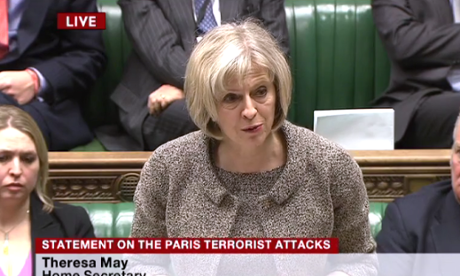
Yvette Cooper, the shadow home secretary, is responding to May.
She says it is important to protect our security, but to protect our freedoms too.
She says Cooper did not show her a copy of the statement until she arrived in the Commons.
Are the security services and the police reviewing the cases of people who have returned from Syria?
Cooper says the committee that reviewed the draft communications data bill said it was flawed. But May has not produced revised proposals.
Given the urgency May says there now is, why did May not produce revised proposals after the joint committee on it reported three years ago.
David Anderson QC, the government’s reviewer of terrorist legislation, is also looking at the law in this area. He is due to report before the election. But May did not mention this. Is she ignoring it?
She says the Conservatives and the Lib Dems should not set up a caricatured debate on this. We need security and liberty, she says.
She says the terrorist tried to silence us. But Paris showed that we will not be silenced. It was an attack on all of us, she says. “Je suis Charlie.”
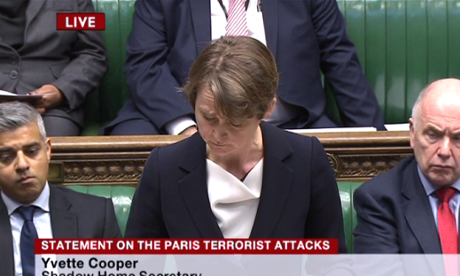
May says Paris attack shows need for 'snooper's charter' legislation
May says the Paris attacks involved assault weapons. Britain has some of the toughest drug laws. The use of these weapons in the UK is very rare, but not unknown.
She says the counter-terrorism bill will strengthen the government’s ability to stop people going abroad. And it will allow people on Tpims [terrorism prevention and investigation measures] to be relocated.
She says there is no support in parliament to give the security services the capabilities they need. But every day that goes past without the communications data bill being published, the powers of the security services are being weakened. Lives could be put at risk, she says.
This measure is not about giving the government the right to snoop on everyone, she says.
She says that it is highly probable that communications data was used to link the two terror attacks in Paris.
- May says Paris attacks show the need for her proposes “snooper’s charter” legislation.
Updated
May says the government has increased security at the UK border.
And it has offered the French government full assistance.
May says she held talks with her counterparts from Europe, the US and Canada on Sunday. There was support for new action to track the movement of terrorists, and to attack the terror ideology.
May says she and David Cameron held a meeting on Monday with security officials.
Plans have been in place for a long time to deal with a Mumbai-style attack, she says. There are teams in place to deal with a marauding gun attack.
Regular exercises are conducted, she says. Future exercises will include elements of the Paris attacks.
The police can also call on support from the army, she says.
Updated
Theresa May's statement on the Paris attacks
Theresa May, the home secretary, is now making a statement on the attacks in Paris.
Some 17 people died, she says.
In this country the security rating is severe. That means a terrorist attack is highly likely and could take place without warning.
Cameron says those organisations that can pay the living wage should pay the living wage. Doncaster council doesn’t pay it. Maybe Ed Miliband should start campaigning for it in his own back yard.
Labour’s Andrew Slaughter asks if axing the A&E at Charing Cross is a good idea.
Cameron says Slaughter is well known for spreading “disinformation campaign after disinformation campaign” about his local hospital on his leaflets.
David Rutley, a Conservative, asks what is worse: denying the deficit, forgetting it, or not having a plan for dealing with it.
Cameron says Labour has no plan for this.
Robert Halfon, a Conservative, asks Cameron if he agrees that “white van women” are the wheels of the long-term economic plan. He quotes an article in the Sun.
Cameron says “of course” he reads the Sun and he was interested in the article. If we had the same level of female entrepreneurship as in the US, we would almost wipe out unemployment, he says.
Labour’s Helen Goodman says the OBR says the government’s plans involve cutting 1m public sector jobs. Which jobs?
Cameron says all MPs who voted for the charter for budget responsibility last night have backed adjustments worth £30bn. The Tories have said how they would fund this. But Labour has told us “diddly-squat”.
Labour’s John Cryer says Cameron says the number of nurses in London is rising, but other figures show otherwise. Who’s right?
Cameron reads out some figures for Cryer’s Leyton and Wanstead constituency.
Alec Shelbrooke, a Conservative, asks about a dementia summit he is holding.
Cameron says this is a crisis that has been creeping up on the country. He did the same in his constituency, he says. People with dementia need help in every part of life, not just good healthcare.
Gregory Campbell, the DUP MP, asks what action the government will take to get fuel companies to pass on price cuts.
Cameron says the government will make sure it and the government do all it can to ensure price cuts are passed on.
Stephen Lloyd, a Lib Dem MP, asks Cameron to intervene in a case involving a dead child. Cameron says he will look into it.
Labour’s Toby Perkins says in East Anglia people have been dying waiting for ambulances to turn up.
Cameron says what happened in East Anglia was wrong. The trust reversed its policy. But a review found that no one had died as a result. We should conduct this debate in a spirit of decency. Everyone now knows Ed Miliband said he wanted to weaponise the NHS. If he had a shred of decency, he would apologise.
Cameron says the recovery is gathering pace, and providing jobs for people. We have to stick to the economic plan, and a key part of that is getting the deficit down.
Cameron says the NHS faces real challenges this winter. But, replying to Labour’s Meg Hillier, he says her local trust shows what can be done. Some 96% of patients are her local A&E were seen within four hours.
Snap PMQs verdict: Given that Cameron’s stance on the debates is implausible (and the polls seem to back that up), he did rather a good job at resisting Miliband’s withering onslaught, and it wasn’t quite the walk-over Miliband was perhaps expecting. A reminder how slick a communicator Cameron can be - even when he’s talking nonsense.
Updated

Miliband says there is only one person running scared of the debates. When Cameron says he wants to take part, no one believes him. What does Cameron think gives him the right to run away from the debates.
Cameron says you can either have a debate with all the national parties in the Commons, or the two people who might be prime minister. Why is Miliband afraid of the Greens.
Miliband says Cameron is “frit”.
Cameron says Miliband wants a debate about a debate. Miliband cannot talk about unemployment, or the economy, or his energy policy, which has turned into a joke. He says he would be happy to spent time in broadcast studios with Miliband. If Cameron has any serious questions, he should ask them.
Updated
Miliband turns to debates. Loud heckling starts. In May 2010 a party leader said it would have been feeble to find some excuse to back out. Who said that?
Cameron says he is all for these debates taking place. But you cannot have two minor parties - ie, he’s calling the Lib Dems a minor party - without the Greens.
Miliband says he will debate whoever the broadcasters invited. He mocks the idea that allowing the Greens to be included was his abiding passion. Is Cameron really saying these will not take place.
Cameron says Ukip and the Greens both beat the Lib Dems in teh European elections. You either have both of them, or none of them. Why is Miliband so chicken when it comes to the Greens.
Ed Miliband says the whole country felt a sense of solidarity with the people of France after last week’s attacks. Does Cameron agree that counter-terrorism efforts must stop being being drawn into terorrism? And should the Prevent programme be expanded to cover community-led programmes?
Cameron backs what Miliband said about the reaction to the Paris attacks. We have to prepare for any attack that might take place, and that means funding counter-terrorism. But there is also a need to confront the poisonous narrative of extremism. That is why the government is putting a duty on universities and other bodies to reject extremism.
Miliband asks if Cameron supports the idea of compulsory engagement with deradicalisation programmes for people returning from Syria.
Cameron says this should be considered in every case for people returning from Syria. A review from Lord Carlile recommended changes to the Prevent programme, he says. He says one or two people have referred to this as a zombie parliament. But the counter-terrorism bill is being debated now.
Cameron welcomes the news that the Scottish nurse with Ebola is out of critical care. Developing a vaccine is essential, he says.
Labour’s Gregg McClymont says David Cameron’s EU renegotiation is creating damaging uncertainty for business. Will Cameron rule out backing an out vote?
Cameron says inward investment has gone up since he announced his referendum policy.
Cameron at PMQs
Only 10 more PMQs before the general election.
Heading into Parliament for our Speakers' conference, only 10, yes 10, PMQs sessions left before the General Election! #thefinalcountdown...
— Lindsay Hoyle MP (@LindsayHoyle_MP) January 14, 2015
My colleague John Plunkett has been taking soundings amongst the broadcasters as to what they think about “empty chairing” David Cameron in the proposed debates. He’s sent me this.
Broadcasters have not ruled out “empty chairing” David Cameron in the proposed TV leader debates but are understood to be hopeful that the prime minister can be persuaded to take part.
There is nothing in the BBC or Ofcom rules governing election coverage that would prevent any channel broadcasting a pre-election debate without the Conservative Party leader present.
But it may be problematic, particularly for Channel 4 and Sky which, under the proposals published by broadcasters last year, would host a head to head debate featuring only Cameron and Labour leader Ed Miliband.
The BBC, under the plans, would host a debate with Cameron, Miliband and Liberal Democrat leader Nick Clegg, while on ITV the three of them would be joined by a fourth party leader, Ukip’s Nigel Farage.
TV executives are keen not to become publicly involved in the increasingly acrimonious dispute between Cameron and the other party leaders over his refusal to take part unless the Greens are included.
Privately, one broadcaster said: “We are still obviously very keen that David Cameron takes part. The whole point of the leaders’ debate is that we hear from the leaders of the main political parties.”
Another source close to the negotiations said: “There are conversations going on all the time but it would not help broadcasters to get involved in a public slanging match.
“It will take as long as it takes. We will keep talking and hope to reach some sort of resolution.”
Ofcom’s rules say “due weight must be given to the coverage of major parties during the election period”.
But the media regulator said which leaders are represented in any possible election debate was an editorial matter for broadcasters.
Labour is holding a debate on energy bills later. This polling suggests they’ve picked a good subject.
Energy bills are still the biggest household spending worry – only slightly reduced from 2013 http://t.co/sfn6ODdqpM pic.twitter.com/D4Gt7FtEyX
— YouGov (@YouGov) January 14, 2015
#UKGENERALELECTION2015 113 DAYS TO GO
— General Election (@UKELECTIONS2015) January 14, 2015
For the record, here are today’s YouGov GB polling figures.
Labour: 33% (no change from YouGov yesterday)
Conservatives: 32% (no change)
Ukip: 14% (down 3)
Lib Dems: 7% (up 1)
Greens: 7% (up 1)
Labour lead: 1 point (no change)
Government approval: -20 (up 4)
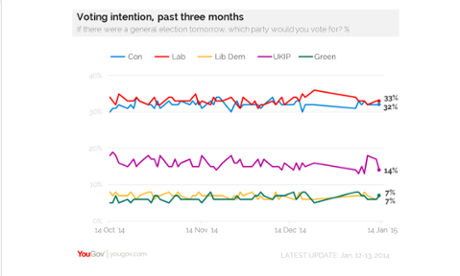
According to Electoral Calculus, this would give Labour a majority of 6.
And here are election predictions from a variety of organisations.
Elections Etc: Labour 297, Conservatives 294, Lib Dems 29.
Election Forecast: Labour 285, Conservatives 281, SNP 32, Lib Dems 27, Ukip 3.
Polling Observatory: Conservatives 33.8%, Labour 33.4%, Lib Dems 9.2%
(These are all academic forecasts, based on models that using current polling data and make allowance for how polls shift in the run up to an election.)
May 2015: Conservatives 284, Labour 269, Lib Dems 24, Ukip 4, SNP 46
(This is based on current polling, taking into account Lord Ashcroft’s seat by seat polling.)
Electoral Calculus: Labour 321, Conservatives 242, Lib Dems 19, Ukip 0, Nationalists 49
(This is just based on current polling.)
Theresa May, the home secretary, will make a statement in the Commons on the Paris terrorist attacks after PMQs. I’ll be covering it in detail.
There will now be an oral statement on 'Paris Terrorist Attacks' from Theresa May at 12.30.
— Labour Whips (@labourwhips) January 14, 2015
And here are two blogs on the subject that are worth reading.
The debate begins. Nick Clegg knows his only chance of surviving the election is to peel away some of the Lib Dem support that has defected to Labour. So he tears into Miliband from the Left. Miliband, because he knows his only chance of surviving the election is to somehow cement his 35 per cent strategy, knows he dare not be outflanked on the Left. So rather than duck the punch and position himself in the centre, he has to fight fire with fire, and pitch himself as a pound shop Karl Marx.
At which point the leader of the people’s army comes piling in. Nigel Farage knows he’s already squeezed as many votes as he can out of the Tories. So as Ed Miliband stands their proudly waving the red flag, Farage barrels into him from the right. Immigration. Welfare. The oppressed white van men of Kent. Farage is hitting all the classic Blue Labour notes and because there’s no David Cameron to distract him, he’s free to play them in the right order.
Then the debate ends, and the polling lines light up. Moments later, we have the result. Nigel Farage wins. He always wins. Nick Clegg is humiliated, again. Ed Miliband is humiliated, again.
How serious is this? Many polls show that Mr Cameron is still, electorally, the best thing about the Conservative Party. He’s generally seen as more decent and reasonable than his party. He’s seen as having done a solid job of leadership, standing up for Britain and speaking for the country at big moments. Hence a Conservative election strategy that casts the general election as a choice between decent, strong David Cameron and weak, weaselly Ed Miliband.
That narrative cannot coexist with the belief that Mr Cameron is running scared from public debates and inventing excuses to avoid them. Looking like a shifty coward could just do him more harm than taking part in debates that go badly for him.
Time to step up, Prime Minister, before those chicken feathers start to stick.
Updated
Here is some comment on the TV debates row from journalists and commentators.
From Andrew Hawkins, the ComRes chairman
Good arg from @Dannythefink against Cam taking part in #debates but world is different now, Cam himself let genie out of bottle in 2010
— Andrew Hawkins (@Andrew_ComRes) January 14, 2015
From Tim Montgomerie, the Times columnist and ConservativeHome founder
Best argument against debates: The last ones gave Clegg Churchillian ratings. Britain was fooled by him. TV performances tell us v little.
— Tim Montgomerie ن (@montie) January 14, 2015
@PCollinsTimes debates crowded out other election time forms of accountability that r superior to whether some1 looks straight into a camera
— Tim Montgomerie ن (@montie) January 14, 2015
From the New Statesman’s George Eaton
I recall some saying that Cameron's refusal to debate with Alex Salmond would hurt the Unionist side. Not much evidence that it did.
— George Eaton (@georgeeaton) January 14, 2015
From the Daily Mirror’s Jason Beattie
Slightly contrary view (regardless of Cameron's cowardice) but I am not convinced the election TV debates were good for newspapers.
— Jason Beattie (@JBeattieMirror) January 14, 2015
From the columnist Iain Martin
The SNP has more seats than UKIP and it could be involved in a pact with Labour in event of hung parliament. The SNP must be in TV debates.
— Iain Martin (@iainmartin1) January 14, 2015
From Sarah Childs, a professor of politics and gender
disappointing that male party leaders divided over exclusion of woman party leader &TV debates. A gender equal democracy wld incl greens
— Sarah Childs (@profsarahchilds) January 14, 2015
From Philip Cowley, the academic and co-author of the Nuffield guide to the 2010 election
Why debates are risky. From British General Election of 2010... pic.twitter.com/xwsnnpBZfd
— Philip Cowley (@philipjcowley) January 14, 2015
Broadcasting organisations have released a joint statement in response to the joint Labour/Lib Dem/Ukip letter about the debates. Here it is.
The broadcasters remain committed to providing election debates in the run up to the General Election. The debates played an important role in informing millions of our viewers in 2010 and we will continue to work with all the parties to ensure that they happen again in 2015.
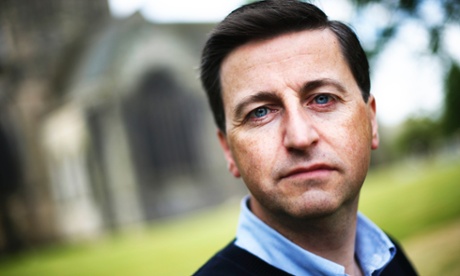
Douglas Alexander, Labour’s election strategy chair, has also been giving interviews about the TV debates. He used the best soundbite I’ve heard on the subject today, saying that David Cameron should not be allowed to skip the “job interview”.
It’s not for David Cameron to deny the British people what I think the British people now expect, which is a job interview at the time of choosing of the next prime minister and the next government of the country.
Alexander also said it was for the broadcasters, not Cameron, to decide how the debates went ahead.
Essentially what the Prime Minister tried to do last week was either bully the broadcasters or block the debates. Now, there’s actually quite an important principle at stake here, which is that it should be you, it should be the broadcasters who decide, consistent with your legal obligations under broadcasting regulation, what fair and balanced coverage during an election is.
And he said backed the decision by the broadcasters not to include the Greens, a decision buttressed by Ofcom’s proposal last week not to categorise the Greens as a major party.
You have to reach a difficult but necessary judgement, not on the basis of representations from one party but looking right across the piece and considering your legal obligations. That’s what Ofcom, the independent regulator, does; that’s what the BBC Trust does for the BBC. And frankly, it’s not for any one party – be it David Cameron and the Conservative party or anybody else – to gainsay the broadcasters’ judgement.
Incidentially, Daniel Finkelstein in the Times (paywall) (see 9.21am) is very good on the Ofcom decision. He says that politically it is “by far the most important thing to happen this year.” He explains:
This will have a significant impact on the outcome of the election. It imposes on broadcasters the responsibility to give Ukip due weight in their coverage. This guarantees that Ukip will be a substantial presence on the news throughout the campaign ...
Ofcom’s ruling means that Ukip now has the chance to help establish the big issues of the general election campaign, and ensures that it will feature prominently in it. The academic evidence strongly suggests that this will help Ukip. It certainly helped the Liberal Democrats in previous campaigns.
Updated
And here are the BBC’s draft election guidelines (pdf). They also allow “empty chairing”. This is what they say in the “Fairness to candidates” section.
Candidates or parties declining to take part in constituency/ward reports or debates cannot, by doing so, effectively exercise a veto over such coverage.
However, this does not weaken in any way the BBC’s obligations of fairness in ensuring the audience is informed of all main strands of argument.
On the Today programme Nigel Farage, the Ukip leader, said that David Cameron did not want to debate Europe and immigration with him.
In 2010, David Cameron did very badly in these debates and was seen to be the loser and I’ve noticed this week that he’s launched the six main priorities for the Conservative general election campaign and of course he’s completely ignored the issues of Europe and immigration. So I feel very strongly he would rather not debate these things with me on national television.
Farage also said that the BBC would be entitled to “empty chair” Cameron because its own editorial guidelines approve this.
He’s right. This is what the BBC’s editorial guidelines say about the refusal of people to take part in a broadcast.
Anyone has the right to refuse to contribute to our output and it is not always necessary to mention their refusal. However, the refusal of an individual or an organisation to make a contribution should not be allowed to act as a veto on the appearance of other contributors holding different views, or on the output itself.
When our audience might reasonably expect to hear counter arguments or where an individual, viewpoint or organisation is not represented it may be appropriate to explain the absence, particularly if it would be unfair to the missing contributor not to do so. This should be done in terms that are fair. We should consider whether we can represent the missing contributor’s views based on what we already know.
Daniel Finkelstein is on good form in the Times today (paywall) explaining why he thinks David Cameron should refuse to take part in television debates. Here’s an extract.
Sometime early on in the preparation for the 2010 debates, it began to dawn on the Tory team that they might have made a mistake by agreeing to have them. They were right to think that Gordon Brown couldn’t recover and that the debates would emphasise this. But they had forgotten Nick Clegg.
And as they practised they realised what a big mistake that had been. The outsider had all the best lines. It was almost impossible to hold him to account, and attacking him would seem absurd. Yet he could casually lob in things like “there the two of you go again” and emerge as the people’s champion against the Westminster insiders.
Even without taking into account his considerable skill at exploiting the opportunity he was given, the very structure gave Mr Clegg an advantage that could not be overcome.
If Mr Cameron agrees to a debate this time with four parties in it, the same thing will happen. Nigel Farage would win it. He would be able to do what Nick Clegg did in 2010, attacking the insiders on behalf of the viewers without being held to account himself.
If the Greens were also in the debate the structure and impact might be different. Without them, Mr Farage would have to himself the role of viewers’ champion. He has no record to defend and can pretty much say anything.
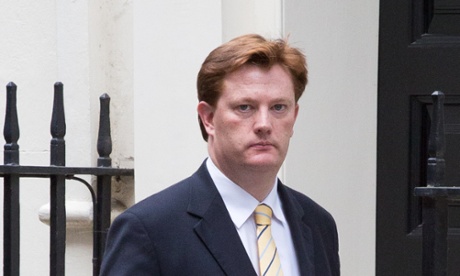
Danny Alexander, the Lib Dem chief secretary to the Treasury, told the Today programme David Cameron seemed to be “looking for any excuse” to avoid a TV debate.
I think that the initiative that Nick Clegg has taken today, and Ed Miliband and Nigel Farage likewise, is about saying that people in this country want to see their leaders debating with one another. David Cameron, if he wants to put the kibosh on these debates, he should pay a high political price for that.
I’ve taken the quote from PoliticsHome.
Some of Lord Ashdown’s assertions in his interview earlier (see 8.43am) strike the Evening Standard’s Joe Murphy as improbable.
Never play poker with @paddyashdown, who can say straight-faced that Gordon Brown did TV debates cuz "he understood it was his duty as PM"
— Joe Murphy (@JoeMurphyLondon) January 14, 2015
How did Paddy Ashdown keep a straight face when he claimed Margaret Thatcher would never have refused to take part in a TV debate?
— Joe Murphy (@JoeMurphyLondon) January 14, 2015
Downing Street is saying its position on the debates has not changed, and that, if Ukip are included, the Greens should be included too.
Miliband's letter to Cameron
Here’s the full text of Ed Miliband’s letter to David Cameron. Nick Clegg and Nigel Farage have written identical ones.
Dear David
In 2010 the televised leaders’ debates provided an unprecedented opportunity for voters to see the party leaders debate the critical issues facing our country. The debates were watched by more than 20 million people and enthusiastically endorsed by all those who took part, including yourself.
In recent days, you have announced that you are unwilling to take part in debates as proposed by the main broadcasters for the 2015 General Election. I believe it would be a major setback to our democratic processes if these debates were not repeated in 2015 because of one politician’s unwillingness to participate.
I hope you will agree that the decision as to who should take part in the televised debates should not be in the hands of any party leader, each of whom inevitably has their own political interests to defend. It must be a decision independently and objectively arrived at.
As you know, the broadcasters, who have strict obligations of political impartiality under the BBC Charter or their Ofcom licences, have together made such an objective determination. While each of the other parties invited to take part in the debates has their own views on the proposal and the levels of participation offered and will continue to make their case in this regard, we all accept the independence and impartiality of the broadcasters and have committed to take part in the debates.
It would be unacceptable if the political self-interest of one party leader were to deny the public the opportunity to see their leaders debate in public. Therefore, if you are unwilling to reconsider, the three party leaders who have committed to participate will ask the broadcasters to press ahead with the debates and provide an empty podium should you have a last minute change of heart.
These debates are not the property of the politicians and I do not believe the public will accept lightly the prospect of any politician seeking to block them.
Yours sincerely,
Ed Miliband MP
On Sunday Ed Miliband, the Labour leader, said that, if David Cameron refuses to take part in televised leaders’ debates, they should go ahead without him. Today Nick Clegg, the deputy prime minister and Lib Dem leader, and Nigel Farage, the Ukip leader, are also making the same argument. All three have written identical letters to Cameron saying that, if he continues to boycott the debates, they will ask the broadcasters to go ahead and stage them without him. Or “empty chair” him, as the saying goes.
Lord Ashdown, the former Lib Dem leader, has been taking to the airwaves this morning ridiculing Cameron for his stance.
What Mr Cameron is trying to do is hold us to ransom because it’s not in his interests to go ahead with the debate. The idea that it’s about the Greens is complete nonsense. I don’t think I’ve ever seen, since he asked us to turn up with the cameras to watch him driving huskies across the tundra, environmental issues – in which he’s completely uninterested – used so cynically for the Conservative interest.
Mrs Thatcher had a word for this: it’s [that] he’s frit and that’s exactly what it is. And can you imagine Mrs Thatcher refusing to go and debate and using the Greens as cover to do so? I mean, even Gordon Brown, who didn’t want to do this, in the end did it. So we can only draw the conclusion that Mr Cameron, frankly, has got less confident in his own ability to make his case than Gordon Brown had.
Farage has also been giving an interview too. I will post his words soon, and all the reaction to this latest development.
Otherwise, it is a relatively quiet day. Here’s the agenda.
9.30am: The Commons health committee takes evidence from expert witnesses on the A&E crisis.
12pm: Cameron faces Miliband at PMQs.
Around 12.40pm: MPs begin debating a Labour motion saying Ofgen should have the power to force energy companies to cut prices.
2.05pm: Mark Carne, the Network Rail chief executive, gives evidence to the transport committee about rail delay at Christmas.
2.15pm: Mark Carney, the governor of the Bank of England, gives evidence to the Commons Treasury committee.
As usual, I will be also covering all the breaking political news from Westminster, as well as bringing you the most interesting political comment and analysis from the web and from Twitter. I will post a summary at lunchtime and another in the afternoon.
If you want to follow me on Twitter, I’m on @AndrewSparrow.