If anyone thinks Labour does not privately care about the opinions of business, it is worth recalling what Douglas Alexander, the head of the Labour election campaign committee, said he had learned in the wake of the Scottish independence referendum.
After the no team had scored a clear but close victory, he told the Guardian: “Don’t discount the capacity of business still to have influence in the business square. It’s naive to think it does not matter at all.
“Economic credibility remains key. Business attitudes mattered in a way that some people had not fully expected before the campaign. The nationalists went into the campaign with an ill-thought through economic policy and currency policy, and it fell apart under the scrutiny of the electorate and business. Labour learned that lesson in 1992 and many elections prior to that so we will not be making that mistake next year.”
As if it knew the letter by business leaders in the Telegraph was bound to come early in the campaign – a business round-robin is a staple of any George Osborne-led election – Labour tried to woo business in the opening days of the campaign with its best business calling cards: opposition to an EU referendum and a cut in small business tax.
It points out that it supports the lowest corporation tax in the G7, and its opposition to corporation tax falling to 20p from 21p only reflects its belief that small business, not big, now needs the most relief.
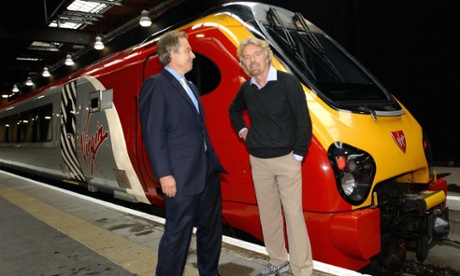
Labour argues that Tony Blair, prior to his election in 1997, did not have much business support. The then Labour leader assiduously wooed Richard Branson and managed to extract only an ambivalent photo opportunity alongside a Virgin train, but little explicit business support. Business instinctively gravitates towards power, but even when it was clear Blair was going to win, they did not rush openly to his banner.
The frustration in some Labour circles is that some of Ed Miliband’s predator/producer rhetoric belies an industrial policy that is more consensual than some in business are willing to recognise. Chuka Umunna and Ed Balls have conducted a long dialogue with business leaders to construct policies on infrastructure, apprenticeships and banking. The differences between the industrial activism of Vince Cable, the current business secretary, and Lord Adonis, Labour’s policy maker on industry, would make a slim volume of nitpicks.
Even in the ex-New Labour wing of the party represented best by the Policy Network thinktank funded by Lord Sainsbury, there is an acknowledgement that Blair was too tolerant to business and did not intervene enough. Writing in Progressive Capitalism in Britain, published last month, Labour thinkers Patrick Diamond and Lord Liddle said: “The Blair/Brown economic legacy was one of underinvestment in key infrastructure, notably transport and energy; a continuing decline in the share of manufacturing in the economy contributing to a structural balance of payments deficit exacerbated by an overvalued pound; an accelerating regional economic divide; and a speculative property and construction boom financing public and private consumption through high levels of government and household debt.”
Adonis, in his review of Labour industrial policy last summer, also urged business not to be complacent about the UK’s unbalanced economic performance now that the recovery is under way. He said: “Productivity – output per worker – is a fifth lower than the G7 average and remains below 2008 levels. Research and development investment in Britain is more than a quarter lower than the OECD average, both in the public and private sectors. Four-fifths of all net jobs created since 2010 are in London. Beyond London, only one of England’s large secondary cities is above national per capita GDP. Britain is rated 28th globally for infrastructure by the World Economic Forum. Since 2010 job creation in low-paid sectors has increased at twice the rate of the economy.”
As a result, many of Labour’s business-related proposals focus on changing the supply side of the UK economy – how the labour market, education and training system, and financial framework operate. They also emphasise the importance of increasing competition in industries, including banking. Issues such as low productivity may be a perennial point for seminar discussions, but it does not make it any less relevant. Indeed, it fills the pages of the Bank of England’s quarterly report. The French can work a day less per week than the English and produce as much as the English do in five days.
So a business community that simply wants to keep the status quo wants to keep the UK falling further behind.
Finally, there is the question of whether large corporations’ behaviour, the decline in living standards and the spread of a deregulated labour market amid booming executive pay has stopped business continuing to play the role of expert arbiters on what is good for the economy. After successive corporate scandals, the self-interest of businessmen and the national interest may no longer seem quite so synonymous.
After all it was Stuart Rose, not yet a Tory peer, who was among 35 businessmen in October 2010 who wrote supporting Osborne’s call for the deficit to be reduced in one parliament. “It has been suggested,” the businessmen wrote, “that the deficit reduction programme set out by George Osborne in his emergency budget should be watered down and spread over more than one parliament.
“We believe that this would be a mistake. Addressing the debt problem in a decisive way will improve business and consumer confidence. Reducing the deficit more slowly would mean additional borrowing every year, higher national debt, and therefore higher spending on interest payments.”
Rose largely burbled on the BBC’s Today programme when he was reminded that the deficit is now being reduced on the timetable proposed by Labour in 2010, and the policy he branded as a mistake in 2010 is now one he supports.
But that is not to say there is anything but risk in Labour being dragged into a war with the business community.