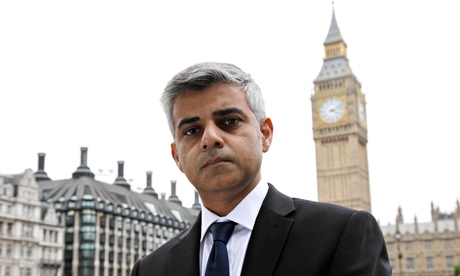
So Sadiq Khan MP, who has been charged by Labour’s election campaign manger Douglas Alexander to lead the fightback against Green gains in the opinion polls (Report, 15 October), thinks that Labour has changed and it shares Green values and “will be a government [Green supporters] can be proud of”. Really? Mr Khan is either delusional or very ill-informed on Green party policies. The Greens oppose all UK nuclear weapons worldwide and oppose replacing the £100bn Trident nuclear weapons system of mass destruction; the Greens oppose arms sales; the Greens oppose the EU-US Transatlantic Trade and Investment Partnership presently being cooked up by big business in their own interests; the Greens oppose fracking; and the Greens oppose nuclear energy, and particularly the building of the taxpayer-subsidised £34bn new nuclear reactors at Hinkley Point C (HPC).
Labour supports all of these. Indeed, on HPC, Tom Greatrex, Labour’s shadow energy minister, last week welcomed the European commission decision to permit massive subsidies for HPC, telling Business Green: “The commission’s decision emphasises the delivery of value for the consumer, and serves as a reminder to the government that transparency and accountability are important principles.”
Confusingly, Mr Greatrex subsequently wrote to the National Audit Office and parliament’s public accounts committee, requesting them to review the subsidies, stating: “We must ensure that consumers are getting the best possible deal in the construction of Hinkley Point C. The substantial changes brought about by the European commission raise questions about whether further scrutiny could lead to additional improvements.”
Labour’s position on HPC is as clear as mud. There are many deep green lines Labour has to cross before it has any chance of luring Green voters to switch. I am not holding my breath.
David Lowry
Stoneleigh, Surrey
• So, Sadiq Khan will be trying to persuade Green voters, rather than by scaring or intimidating them to vote Labour at the general election? If so, perhaps Khan could explain why Caroline Lucas’s seat in Brighton is one of Labour’s target seats. During the current parliament, Lucas is widely regarded as the most effective opposition MP. For many of us, she is the real leader of the opposition inside and outside parliament and puts Ed Miliband’s performances to shame. The reason for the “Green surge” is dissatisfaction with Labour’s merely being a negative alternative to the Con-Dem government. The Greens give the hope that Labour doesn’t.
David Melvin
Ashton under Lyne, Lancashire
• Given the findings of the 2014 annual Credit Suisse global wealth report which shows that the UK is the most unequal of all the G7 economies (Report, 15 October); and given that we know citizens of more economically equal societies enjoy happier and healthier and more fulfilling lives than those who live in highly unequal ones; that children from poor families are more likely to underachieve in schools than those from wealthier backgrounds; that the availability of good affordable housing – either to rent or to buy – is increasingly beyond the means of even middle-earners; and that substantial reductions in income and wealth differences are positively consequential for moves towards an environmentally sustainable way of life, why doesn’t the Labour leadership specify by how much it would like in government to redistribute income and wealth from the top 1% to the bottom 10% in order to promote greater equality, and how it would do so? Such a commitment, including proposals, would distinguish the Labour party from all the others in a graphic and electorally appealing fashion. It would also articulate well with the “One nation Labour” notion and Ed Miliband’s “togetherness” idea, not to mention the “democratic socialist” identity enshrined in the Labour’s constitution.
David Halpin
Bath
• It is not a question of immigration being a good or a bad thing for the UK (Letters, 14 October). It is far more complex. In economic terms, the fact is that the UK has never managed such a substantial unplanned rise in surplus labour as it has in the last 10 years. In recent times we’ve seen the re-emergence of the default tendency of many UK businesses to manage their operations with employees that can be easily laid off (or zero contracted) rather than take the risk of investing in new plant, machinery and technology. This is the explanation for why the number of people in employment has risen latterly while investment has remained stubbornly flat. Hence the UK’s much-vaunted labour flexibility and open borders are now actively contributing to the UK’s poorer productivity performance.
The UK economy derives so much of its activity from consumer spending that greater numbers of relatively low-paid people in work may boost overall GDP growth marginally but not increase GDP per capita, which is an arguably more important metric. As has been recently reported, the recent rise in employment in the UK has not led to an increase in income tax receipts to the HMRC, which entirely supports this thesis.
The reintroduction of immigration controls to limit the number of citizens entering the UK from anywhere, including other EU countries, is pretty much inevitable. This is not because immigration per se is a bad thing but because the uncontrolled movements of people may, at times, have unforeseen adverse effects. Until economists, university professors and politicians of different persuasions grasp this, Ukip will have a free ride in the immigration debate.
Andrew Harris
Wallingford, Oxfordshire
• Still in their own English rotten boroughs It is nice to know the spirit of Dame Shirley Porter lives on in Barnet council, when an estate will be redeveloped so that only the wealthy can afford the affordable housing (At yacht parties in Cannes, councils have been selling our homes from under us, 14 October). This will help turn West Hendon ward Tory and so in response, to an objector, Cllr Tom Davey naturally says: “Those are the people we want.” And yet, in the 50-year history of the borough, the Conservatives have only once won more the half the votes, but have misruled for all but eight years.
Labour must be regretting failing to introduce preference votes, like in Scotland, for local elections, now Ukip is on the rise in their own heartlands, having been able to ignore and sideline more moderate opinions. As the party base has withered away, the metropolitan elite has been able to parachute favoured candidates into safe parliamentary seats while taking their own activists for granted. The adoption of the single transferable vote, in lower-turnout local elections, would introduce some desperately needed stability with an injection of plurality and diversity without, like the list system used for the European parliament, giving lazy extremists an easy ride.
David Nowell
New Barnet, Hertfordshire
• The pattern of Ukip’s development has for some time been predictable to students of far-right interwar history: Ukip support will grow and result in a substantial bloc of MPs in 2015 – money is coming through (from whom?), defections have begun. Many Tories, half Eurosceptic already, would ally with Ukip, more will defect, Cameron is losing control. Labour, under Miliband and Balls, has been a singularly inept opposition. The only party consistently opposing Ukip and the suicidal proposals to exit from Europe and ditch human rights are the Lib Dems, with Nick Clegg the only leader openly to challenge Farage. Many are frightened of stating publicly the real danger Ukip presents – and that may drive more people into Ukip’s ranks. Democrats must speak out and actively campaign against the highly dangerous populism of Farage.
Peter Mullarky
Horsham, West Sussex