Labour has stretched its lead over the Tories to five-points but now lags further behind the Conservatives on the crucial issue of economic credibility, according to the latest Observer/Opinium poll.
The survey suggests that the Tories have not, overall, enjoyed a bounce from last week’s autumn statement in which chancellor George Osborne promised £2bn more a year for the NHS and a £15bn road-building programme.
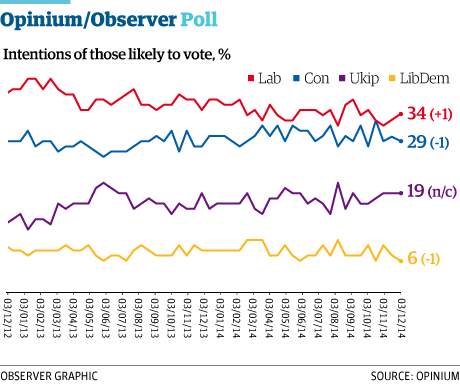
The poll, taken mainly after the Chancellor’s speech, puts Labour on 34% (up one point on a fortnight ago), the Conservatives on 29% (down one point), Ukip unchanged on 19%, the Liberal Democracts on 6% (down one point), and the Greens also on 6% (up two points).
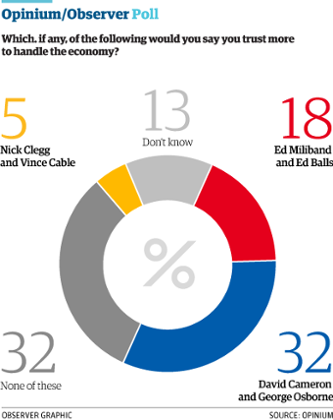
When asked which party they believed would handle the economy better, both the two main parties have seen a fall in backing.
The Tories – with David Cameron and Osborne in charge – have fallen from 35% when the question was last asked in September to 32%, while Labour has dropped from 23% to 18%.
The growth in economic optimism reflected in Opinium’s polls over the last 18 months appears to have petered out. Only 27% said they believed the economy was now in good shape with 38% saying the reverse. This compares with a more upbeat assesment in September when 31% thought it was in a good state against 35% who thought the reverse.
Opinium asked respondents whether they believed a series of promises made last week by Osborne were believable or not. Most of the tax cuts he promised, including changes to stamp duty, the plan to further raise the personal tax allowance, and plans to raise the 40p tax threshold to 50p, were regarded as believable by a clear majority of respondents.
There was more scepticism, however, over plans to boost NHS spending and inject billions more into road building. 48% believed the pledges on NHS funding against 41% who did not, while 47% believed the roads pledge against 40% who did not.
Opinium Research carried out an online survey of 1,940 GB adults aged 18+ from 3rd to 4th December. Results have been weighted to nationally representative criteria.