Afternoon summary
-
Eric Pickles, the communities secretary, has announced that he intends to take control of Rotherham council following the publication of a reporting saying it was more concerned about protecting its own reputation than its most vulnerable citizens. Subject to consultation, Pickles will appoint commissioners to take over the council. He will also order all-out elections for Rotherham in 2016. He told MPs:
The crimes committed against children are so appalling, and the council’s remedy so utterly inadequate, that the government cannot in good conscience turn a blind eye.
These exceptional circumstances justify Whitehall intervention, so we can make the council address its failings and prevent it from ever happening again ...
The intervention package I am proposing is broad and wide ranging.
It would be justified only in the most exceptional case.
Rotherham is I believe such a case, a truly rare case where the children of Rotherham have so badly been let down by those elected to serve them.
I am afraid that the head of Boots lost quite a lot of moral authority once it was discovered he was lecturing political parties from the standpoint of paying his tax in Monaco.
-
Labour’s general election campaign chairman, Douglas Alexander, and the Liberal Democrats’ economics spokesman, Danny Alexander, could be two of the most high-profile projected casualties in Scotland at the general election, according to polling research by Lord Ashcroft. Commenting on the findings, Jim Murphy, the Scottish Labour leader, said:
These polls show that Scottish Labour is well behind and has a big gap to close. But in the end the only people who will benefit from these polls are David Cameron and the Tories. It is a simple fact that the single biggest party gets to form the next government. The more seats the SNP get from Labour, the more likely it is the Tories will be the biggest party and David Cameron will get into government through the back door. That would be a terrible outcome for Scotland but it’s what might happen if Scotland votes SNP.
That’s all from us for today.
Thanks for the comments. AS
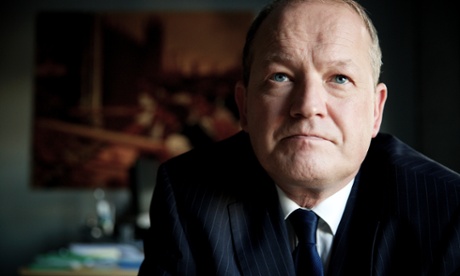
Simon Danczuk, the Labour MP and leading child abuse campaigner, has welcomed Justice Lowell Goddard’s appointment as head of the abuse inquiry. He put out this statement.
This has been a long and difficult process for survivors of abuse, and I know they will share my relief that we can finally get underway and that the Inquiry will begin before the general election.
I had a productive meeting with the home secretary this morning, and I have confidence in the process she has gone through in order to find a new chair. It is obvious that the home secretary has cast the net far and wide in order to find an appropriate person and I applaud her for doing so.
I particularly welcome the fact that the Inquiry will have the statutory powers that are needed and that I and others have been calling for. I also believe it is the right decision to reconstitute the panel and to broaden the terms of reference so that there is no cut-off date for evidence.
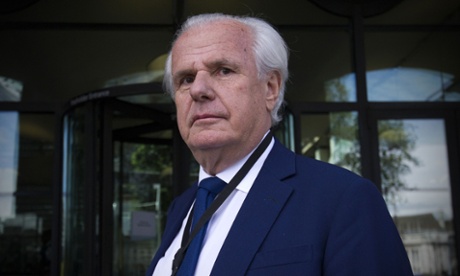
Lord Myners, a former chairman of Marks & Spencer (and of the Guardian Media Group) and a Treasury minister in Gordon Brown’s government, has said that Labour is pro-business. He said:
Labour is pro responsible business. It will promote an environment that is consistent with effective competition; it will challenge abusive monopoly behaviour, take steps to promote competition where customers are being disadvantaged - for instance in retail banking - and promoting long term investment rather than casino capitalism that has disadvantaged the UK’s economy and social cohesion.
But he also said it needed to “talk in a language that business understands”
It needs to make clear that a successful economy is a critical condition to a fair and just society.
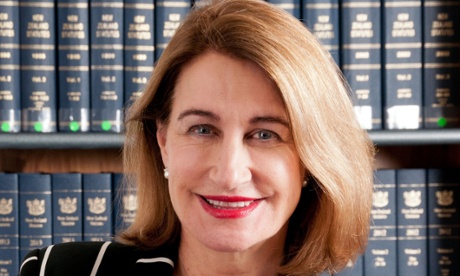
Justice Lowell Goddard - Profile
The Press Association has filed a mini profile of Justice Lowell Goddard, the new chair of the child abuse inquiry.
The new chair of the troubled child abuse inquiry is Lowell Goddard, a New Zealand High Court judge and mother-of-four.
Aged 66, Justice Goddard is younger than both her predecessors, Fiona Woolf (also 66) and Baroness Butler-Sloss (81).
The new incumbent is described as “a highly respected member of the judiciary” at the forefront of criminal law and procedure in her home country for several years.
She was the first woman to be appointed to the Queen’s Counsel, along with a colleague, in 1988, and was also the first woman of Maori descent to have been appointed to the New Zealand High Court bench, in 1995.
Justice Goddard helped establish police support networks for sexual abuse victims, and was chair of the Independent Police Conduct Authority report into police handling of child abuse cases.
Last year, she was appointed Dame Companion of the New Zealand Order of Merit services to law.
The Auckland-born judge is married with three step-children, as well as a daughter from her first marriage.
Her interests are listed as gardening, her family and equestrian sport.
The judge breeds and races horses, and supports various charities including Amnesty International, as well as those caring for animals and disabled children.
There’s precious little gratitude in politics. Ed Miliband gave the “Blue Labour” academic Maurice Glasman peerage (which was particularly useful to Glasman because he was skint, and the Lords attendance allowance made a big difference, according to Rowenna Davis in Tangled Up In Blue, her book about Blue Labour).
And what did Glasman say when, in an interview with the Holyrood magazine, he was asked if Miliband was up to the job of leading the Labour party? It was hardly a ringing endorsement. Here’s the reply.
He’s the leader we’ve got. I’ve said a lot of things about this and I don’t intend to say too much more but I still think that there is a sense that people don’t quite know where we’re at. I said three years ago that we needed a strategy. He supported local organising – something that Jim Murphy was really strongly for and that I identify with – which is the leadership development of core people in the constituencies we represent but we seem to have lost the energy of that.
We could talk about leadership and the effect of that but I think that Labour, certainly in England, has got a huge amount of work to do to reconnect with the realities of the values of people within their everyday lives and to stop talking in abstract and general terms and managerial terms and start realising that it’s a political party and not an administrative party, and that requires bold leadership.
Privately Labour figures acknowledge that Lord Ashcroft’s polling has dire implications for the party. (See 9.20am.) My colleague Rowena Mason has sent me this quote, from a senior Labour aide.
There is a stark reality shown by the polls and a simple mathematical conclusion to be drawn. What people need to realise that for every one Labour MP lost in Scotland there is a direct increase in the chance of a Tory government. We do recognise these polls show Labour is behind but the person who is going to benefit from this is David Cameron.
We are not going to duck away from the idea there is a strong message in these polls. That strong message is that we have a big gap to close and the only people that will benefit from these sorts of numbers are Cameron and the Tories. Cameron’s last best hope of staying in government is to split the centre-left vote in Scotland.
We are going to make sure people understand that and hear it. The reality is of the way this place works is that the biggest party gets the first shot at forming a government. The fewer Labour MPs there are the bigger, the chance of the Conservatives being the largest party.
Here is some reaction to the Rotherham report.
From Karen Froggatt from Victim Support
Six months ago, when the horrific extent of the child abuse in Rotherham was revealed, we said ‘never again’. As a charity that is supporting the survivors of that abuse, I am shocked this new report says children in Rotherham are still at risk because the council is not ‘fit for purpose’.
From Anne Longfield, chief executive of 4Children
This shocking report is a welcome step towards recognising the myriad of past and present failures and ensuring this sort of abuse can never happen again.
From Birmingham council chief executive Mark Rogers, who is the president of Solace, which represents 1,300 chief executives and senior strategic managers working in the public sector
Today’s report makes upsetting and troubling reading. For too long, key agencies in Rotherham did not properly safeguard vulnerable children in the borough. Abuse was not tackled and concerns were ignored or even suppressed.
More from the Louise Casey report on Rotherham. This is what she says about how the council deals with whistleblowers.
Inspectors have concluded that [Rotherham council] goes to some lengths to cover up information, and silence whistle-blowers.
It has created an unhealthy climate where people fear to speak out because they have seen the consequences of doing so for others”.
Staff in [Rotherham council] have spoken to inspectors of being afraid to speak out, told to keep quiet, instructed to cover up, and of a culture where ‘if you want to keep your job, you keep your head down and your mouth shut’.
A significant number of people we interviewed were clearly afraid of what might happen to them if they spoke out.
Here is some Twitter comment Justice Lowell Goddard, the new chair of the child abuse inquiry.
From the BBC’s Danny Shaw
It's understood Theresa May personally interviewed Lowell Goddard by video-link before deciding to appoint her as #CSAinquiry chair
— Danny Shaw (@DannyShawBBC) February 4, 2015
From the Guardian’s Josh Halliday
Justice Goddard might think she's seen it all. In 2013, she jailed a multi-millionaire dominatrix meth dealer http://t.co/oiX2oToh52
— Josh Halliday (@JoshHalliday) February 4, 2015
The appointment of a new chair of the child abuse inquiry has revived the debate about whether the Kincora Boys Home in Northern Ireland should be included. My colleague Henry McDonald has sent me this.
East Belfast MP Naomi Long has asked Theresa May and Justice Lowell Goddard to incorporate the Kincora Boys Home scandal into the Westminster paedophile inquiry.
The home secretary said it is her view that Kincora ought not to be part of this inquiry; however she undertook to discuss this matter with the new inquiry chair.
Long, who represents the constituency where the home used to be, said: “The home secretary said it is her view that Kincora ought not to be part of this inquiry; however she undertook to discuss this matter with the new inquiry chair.
“Whilst I accept in part her argument that recommendations for institutions would deal with different structures in England and Northern Ireland, she fails to acknowledge with respect to Kincora this has already happened. The crucial element is in respect of the alleged involvement of the intelligence services in covering up abuse and recommendations in this regard would be best handled with similar allegations being investigated as part of the new inquiry.”
Eric Pickles on Rotherham
And this is what Eric Pickles said about Rotherham. It is an extract from his Commons statement where he summarises the findings of the Casey report.
Let me outline some of the reports conclusions.
• Poor governance is deeply seated throughout the council.
• There is a pervading culture of bullying, sexism, suppression and misplaced political correctness which has cemented the council’s failures.
• Both members and officers lack the confidence to tackle difficult issues for fear of being seen as racist or upsetting community cohesion.
• The council is currently incapable of tackling its weaknesses, without a sustained intervention.
• The council lacks political leadership.
• It is directionless and is not clear what kind of organisation it wants to be, and how it will get there.
• It is clear that the political leadership of the council is unable to hold officers to account, and there is an inability of all members to properly represent the interests of local people and businesses.
Some councillors, have not lived up to the high standards expected of those in public life or their positions of responsibility. For example the council goes to lengths to cover up and silence whistle-blowers.
It has created an unhealthy climate where people fear to speak out because they have seen the consequences of doing so.
• Management is ineffective.
• There is no cohesive senior leadership team and no permanent chief executive.
• There is a poorly directed tier of middle managers, some of whom do not demonstrate that they have the skills, drive and ability necessary to turn the organisation around.
• There is a history of poor performance and a tolerance of failure in Children’s Services.
Strategies and action plans sit on the shelf and don’t get translated into change.
In short, the report concludes
- Rotherham Council has failed its citizens.
- is failing to comply with the statutory best value duty.
- it needs a fresh start.
Here are some more extracts from Louise Casey’s report into Rotherham.
-
Casey said most Rotherham councillors did not accept the findings of Professor Alexis Jay’s report which found that more than 1,400 children had been subjected to rape, violence and trafficking by gangs of mainly Asian men in the town between 1997 and 2013.
When inspectors commenced work in Rotherham, we were struck by the overwhelming denial of what Professor Jay set out in her report. This attitude was so prevalent that we had to go back through many of the aspects of her work in order to satisfy ourselves that the council had no grounds upon which further action could be delayed.”
When asked, 70% of the current Rotherham councillors we spoke to [including those in the Cabinet] disputed Professor Jay’s findings.
-
Casey said the 1,400 figure could be an understatement.
We have concluded that the 1,400 figure is a conservative one and that [Rotherham council] and South Yorkshire Police (where some also dispute the figures) would do better to concentrate on taking effective action rather than seeking to continue a debate about the numbers.
-
She said the council “could not deal sensibly” with the issue of race.
Frontline staff were clearly anxious about being branded racist.
Whether there was an element of self-censorship or otherwise, the impact of this was clear. The council was not dealing with a serious problem right before its eyes.
Certainly, this was not limited to frontline officers. There was also a clear perception among senior officers that the ethnic dimension of[child sexual exploitation] in Rotherham was taboo.
Rotherham’s suppression of these uncomfortable issues and its fear of being branded racist has done a disservice to the Pakistani heritage community as well as the wider community. It has prevented discussion and effective action to tackle the problem.
This has allowed perpetrators to remain at large, has let victims down and, perversely, has allowed the far right to try and exploit the situation.
These may have been unintended consequences but the impact remains the same and reaches into the present day.
-
She was highly critical of South Yorkshire police.
There were numerous occasions in which girls were not believed.
They were threatened with wasting police time, they were told they had consented to sex and, on occasion, they were arrested at the scene of a crime, rather than the perpetrators.
Police did not understand the terror which many victims lived in and their consequent fear of testifying and their anxiety over whether police could protect them. Some of the crimes we were made aware of included rape with a broken bottle and girls being ordered to kiss perpetrators’ feet at gunpoint.
This is from Matthew Reed, chief executive of the Children’s Society, on the Rotherham report.
Louise Casey’s report on abuses in Rotherham underlines again the complete failure of a range of authorities to protect vulnerable children. It’s important to understand that child sexual abuse and exploitation aren’t unique to Rotherham – it’s happening across the country. All local authorities, as well as national government, must stop at nothing to prevent a repeat of this scandal.
In the Commons Mark Reckless, the Ukip MP, said these problems arose when Labour had total control of the council. The situation only changed when Ukip started to challenge Labour, he said.
Pickles said it was not appropriate to seek to exploit this for party political reasons.
Later the Labour MP Liz McInnes made a similar point.
Mark Reckless in disgraceful attempt to score political points during the report on child abuse in Rotherham. Shameful.
— Liz McInnes (@LizMcInnesMP) February 4, 2015
The Commons statement is now over. I will post a summary of Pickles’ statement shortly. AS
National Crime Agency launches criminal investigation following Rotherham report
The National Crime Agency has announced it is launching a criminal investigation into some of the matters arising from the Rotherham report. Here’s its statement.
Operation Stovewood, the National Crime Agency’s independent investigation examining criminal allegations of non-familial child sexual exploitation in Rotherham, is to examine a number of potentially criminal matters identified during a recent inspection of Rotherham Metropolitan Borough Council.
Communities and Local Government Minister Eric Pickles today informed Parliament of the outcome of an inspection conducted by a team led by Louise Casey. A number of matters have been referred to Operation Stovewood as they potentially fall within its terms of reference.
It would not be appropriate to comment in detail about the matters referred until investigators have an opportunity to analyse the information, which they will do as part of phase one of the investigation.
The NCA can confirm that the matters referred are allegations of potential criminal behaviour. Operation Stovewood is not investigating any misconduct matters.
Matters of potential misconduct will be referred to the appropriate body. For policing, potential misconduct matters will be reported to the Deputy Chief Constable of South Yorkshire Police, who will determine arrangements for investigation in liaison with the IPCC where appropriate.
What Louise Casey says about Rotherham
Here’s Helen Pidd’s story about the Rotherham report.
And here’s an extract from the report, by Louise Casey.
Terrible things happened in Rotherham and on a significant scale. Children were sexually exploited by men who came largely from the Pakistani heritage community. Not enough was done to acknowledge this, to stop it happening, to protect children, to support victims and to apprehend perpetrators.
Upon arriving in Rotherham, these I thought were the uncontested facts. My job was to conduct an inspection and decide whether the council was now fit for purpose.
However, this was not the situation I encountered when I reached Rotherham. Instead, I found a council in denial. They denied that there had been a problem, or if there had been, that it was as big as was said. If there was a problem they certainly were not told – it was someone else’s job. They were no worse than anyone else. They had won awards. The media were out to get them.
I want to be clear that the responsibility for the abuse that took place in Rotherham lies firmly with the vile perpetrators, many of whom have not yet faced justice for what they have done. I hope that this will shortly be rectified. But in its actions, the conclusion that I have reluctantly reached is that both today and in the past, Rotherham has at times taken more care of its reputation than it has its of its most needy ...
The council’s culture is unhealthy: bullying, sexism, suppression and misplaced ‘political correctness’ have cemented its failures. The council is currently incapable of tackling its weaknesses without a sustained intervention.
Pickles says he does not regard this as a political issue.
This is about a failure of government.
He could point to lots of Conservative councils where this would never happen. But he could also point to many Labour councils where this would never happen, he says.
Pickles says there is now a good opportunity in Rotherham. He is determined to get the best candidates to take the council forward.
Pickles says, as someone who used to be involved in a council, having to take today’s decision is heart-breaking.
Rotherham council cabinet's resignation statement
Here is the statement from Rotherham council.
Louise Casey’s report on her inspection in Rotherham has been published.
The author clearly has no confidence in the current political leadership of Rotherham borough council.
As a cabinet, whatever the details, as the political leadership of the council we must take responsibility.
We therefore announce our intention to resign our positions as soon as transitional arrangements can be put in place.
Labour supports Pickles' decision to take Rotherham under Whitehall control
Hilary Benn, the shadow communities secretary, is responding to Pickles.
He says the Casey report is “damning”. The council has not shown that it has accepted the truth of the situation, he says. He supports the action Pickles is taking.
Pickles says there will be five commissioners. They will report to him.
He says he will end “taxpayer-funded reward for failure”, and will stop payments to councillors while the commissioners are in charge.
He says he needs to consult.
If, following the consultation, he decides to intervene, he will act using his powers.
It is with “a real heavy heart” that he is having to resort to this.
The government is committed to decentralisation, he says. But the voice of the victims must be heard.
Councils generally have a good record, he says.
He says he wants to restore good governance to Rotherham.
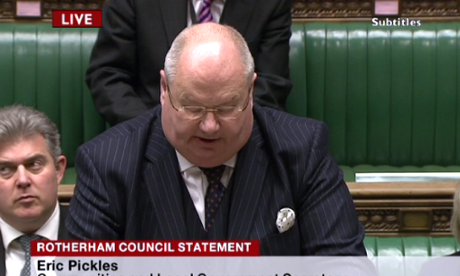
Eric Pickles announces Whitehall takeover of Rotherham council
Eric Pickles, the communities secretary, is now making his statement on the Rotherham report.
He quotes from the report’s conclusions. And he says it confirms a “complete failure” of officer and councillor leadership on the council, he says.
The council lacks direction. Its leadership cannot hold officers to account, and it cannot represent local people, he says.
Some councillors have not lived up to their responsibilities, he says.
The council has acted against whistleblowers.
There is a history of poor performance and tolerance of failure with children’s services, he says.
The council has failed its citizens, the report concludes. It needs a fresh start.
Pickles says the council is failing to abide by its best value duty.
He will consider using his powers of intervention to secure compliance with this duty.
Using powers under the Local Government Act, he is writing to the council with a proposed intervention package.
He is seeking to make an order under the Local Government Act to order all-out elections in 2016, and every four years after.
- Pickles says he is proposing to appoint commissioners to take over the Rotherham council cabinet’s duty.
- He is going to order all-out elections in 2016.
Pickles says the council’s taxi licensing duties are not being properly carried out. The commissioners will take over these duties.
He says he hopes to restore Rotherham to democratic control as quickly as possible.
Louise Casey, the government’s lead on troubled families, has published her report on Rotherham council’s handling of child sexual exploitation – and it concludes the council is not fit for purpose and was more concerned about protecting its own reputation than its most vulnerable citizens.
You can read the report here (pdf).
Helen Pidd has written a story about the report here.
Casey’s report concludes:
The council’s culture is unhealthy: bullying, sexism, suppression and misplaced ‘political correctness’ have cemented its failures. The council is currently incapable of tackling its weaknesses, without a sustained intervention.
Communities secretary Eric Pickles is due to make a statement to the Commons on the report shortly.

Rotherham council's cabinet to resign
We’re about to get a statement from Eric Pickes on the Louise Casey report severely criticising Rotherham council for its handling of child abuse cases.
This news has just come through.
Rotherham Borough Council’s cabinet is to resign in the wake of Louise Casey’s damning report “as soon as transitional arrangements can be put in place”, the council said.
Theresa May's statement - Summary
Here are the key points from May’s statement.
-
May explained why she was winding up the current inquiry and setting up a new statutory inquiry. She had previously said she would give the inquiry statutory powers, but had not specified how she would achieve this. She considered three options: converting the current inquiry into a statutory one; setting up a royal commission; and setting up a new statutory inquiry.
Having taken in-depth legal advice and having discussed the option with survivors, I have concluded a Royal Commission would not have the same robustness, in law, as a statutory inquiry. In particular, it would not have the same clarity over its powers to compel witnesses to give evidence.
I have decided not to convert the current inquiry because doing so would not address the concerns of survivors about the degree of transparency in the original appointments process.
I have therefore decided upon the third option of establishing a new statutory inquiry with a panel.
-
She announced that Justice Lowell Goddard, a New Zealand judge, would chair the inquiry and she explained why.
Justice Goddard is a judge of the High Court of New Zealand and is a highly respected member of the judiciary who has been at the forefront of criminal law and procedure. As chairman of the Independent Police Complaints Association of New Zealand she conducted an inquiry into the policing of child abuse in New Zealand and she is also a member of the United Nations Subcommittee on Prevention of Torture.
She will bring a wealth of expertise to the role of chairman and crucially she will be as removed as possible from the organisations and institutions that might become the focus of the inquiry.
-
May said the abuse uncovered so far was “only the tip of the iceberg”.
I have said before, and I shall say again, that what we have seen so far – in Rotherham, Oxford, and Greater Manchester and elsewhere – is only the tip of the iceberg.
This afternoon, my Rt Hon Friend, the Secretary of State for Communities and Local Government will give a statement on Louise Casey’s report into Rotherham Borough Council which will contain further evidence of their failure to protect vulnerable children.
With every passing day, every new revelation, it is clear that the sexual abuse of children has taken place – and is still taking place – on a scale that we still cannot fully comprehend.
- She said she was asking the current inquiry to produce a report on its work so far.
- She said she hoped existing members of the inquiry panel would apply to be members of the new panel.
- She said she would consider changing the inquiry’s terms of reference, so that it goes back beyond 1970, but that there were “good reasons” for confining it to England and Wales.
- She said the Official Secrets Act would not stop people giving evidence to the inquiry.
-
She said that she was now satisfied that child abuse was covered up in the past and that she was “more determined than ever” to expose this.
Throughout those meetings [May’s meetings with survivors], for every person who told their story, there was one common goal - to save others from the abuse they had suffered. So let me be clear, I am now more determined than ever to expose the people behind these despicable crimes and the people and institutions that knew about abuse but didn’t act, that failed to help when it was their duty - sometimes their very purpose - to do so, and the people and institutions that - in some cases - positively covered up evidence of abuse.
-
She said Simon Bailey, the national police lead for child protection, had been put in charge of ensuring all evidence about abuse presented to the inquiry gets followed up by the police.
I can confirm that there will be a co-ordinated national policing response that will link directly into the inquiry, and will be able to follow up any lead the inquiry uncovers
This will be led by Simon Bailey, the National Policing Lead for Child Protection and Abuse Investigations as part of Operation Hydrant, which will co-ordinate all child abuse investigations concerning people of public prominence or those offences which took place in institutional settings.
The Hydrant team will be responsible for the recording of all referrals from the inquiry that relate to potentially criminal abuse and failures to act. It will also oversee the quality of responses from police forces to any requests for information from the panel.
-
She said more money was available for groups helping survivors.
In December, I announced a £2 million fund available to non-statutory organisations that had seen an increase in demand as a direct result of the announcement of the Child Abuse Inquiry. A further £2.85 million fund for non- statutory organisations providing support across England and Wales was also announced. I am pleased to announce that these funds are now available and organisations can now bid for them.
Going forwards, further support will be needed for those who wish to give evidence to the inquiry and the many thousands of people who may be affected by its work. It
I expect appropriate government funding to be made available at the next Spending Review.
-
She said the Cabinet Office had identified “a small number of files” that should have been submitted to the Wanless/Whittam review into missing government documents covering abuse.
Caroline Lucas, the Green MP, thanks May for using the word “survivor” and urges the press to carry on using this term, not “victim”. Every time people are called victims, that adds to the hurt.
May says Lucas is absolutely right about that. It is important that we use the language of survivors, or sometimes victims and survivors, she says.
And, for those involved, these are not historic matters. They still live with the consequences.
PMQs – Twitter reaction
Apart from Nick Robinson of the BBC’s interesting analysis, there was not much support for Ed Miliband’s performance at PMQs this week on Twitter, although John Rentoul of the Independent on Sunday did manage this:
I didn't understand EdM's question, but I know Cameron didn't answer it. #PMQs
— John Rentoul (@JohnRentoul) February 4, 2015
Others came down more firmly on David Cameron’s side:
A lot of the time you can work out what Ed's plan was even if it didn't come off. Not sure what the aim was this time. #pmqs
— Stephen Bush (@stephenkb) February 4, 2015
Cameron win - even Labour MPs don't look convinced by this strategy #PMQs
— Andy Bell (@andybell5news) February 4, 2015
Miliband simply slaughtered in #pmqs.
— Pete Wishart (@PeteWishart) February 4, 2015
A win for Cameron in narrow House of Commons terms. But this shouty #PMQs might as well be happening on another planet.
— Iain Martin (@iainmartin1) February 4, 2015
Many other tweeters decried the overall tone of the debate, including Labour’s Chris Bryant.
I wonder whether we in the Commons ever think about what our constituents think of this childishness. Like demented hyenas. #pmqs
— Chris Bryant (@ChrisBryantMP) February 4, 2015
Somebody screams "Goodbye!" as #PMQs ends. #Westmonster
— Bonnie Greer (@Bonn1eGreer) February 4, 2015
Only six more dreadful #PMQs until the election.
— Iain Martin (@iainmartin1) February 4, 2015
Or to put it another way:
Imagine a head-to-head Cam v Ed TV debate #pmqs
— Alex Wickham (@WikiGuido) February 4, 2015
And things might get worse from here, some feared:
Confirmation of how ugly this election is going to be. Spouses now considered fair game at PMQs
— James Forsyth (@JGForsyth) February 4, 2015
Tom Blenkinsop attacks Cameron on his wife's employer moving to Luxembourg for tax #PMQs
— Isabel Hardman (@IsabelHardman) February 4, 2015
Tom Blenkinsop just broke the glass marked "SamCam" #pmqs
— Jane Merrick (@janemerrick23) February 4, 2015
There was much criticism from Labour MPs for Cameron’s comment that he had promised to halve the deficit by 2015.
PM claims he promised to get deficit down by half - actually he promised to eliminate it #PMQs #Camnesia
— Angela Eagle (@angelaeagle) February 4, 2015
Cameron rewriting history at #PMQs responding to @SteveRotheramMP he said he'd halve deficit by 2015. Truth is he pledged to eliminate it!
— Chris Williamson (@ChriswMP) February 4, 2015
Wow Cameron has a very creative memory - he said they'd eradicate the deficit in this parliament, not cut it in half.... #pmqs
— Luciana Berger (@lucianaberger) February 4, 2015
Cameron’s joke about “Bill Somebody” proved popular among commentators:
Good line "bill somebody is not a person, bill somebody is Labour's policy" #pmqs
— Isabel Hardman (@IsabelHardman) February 4, 2015
V good zinger from Cameron:"Bill Somebody is not a person, it's Labour's policy"..Ouch. Give that PMQs team a rise.
— Paul Waugh (@paulwaugh) February 4, 2015
Genuine laugh from me for David Cameron's #PMQs jibe after Ed Balls' gaffe: "Bill Somebody isn't a person, it's a Labour policy".
— HannahJane Parkinson (@ladyhaja) February 4, 2015
"Bill Somebody's not a person; bill somebody's Labour policy." Rare funny line at PMQs as Cameron mocks Ed Balls.
— Joe Churcher (@JoeChurcher) February 4, 2015
Although the PM’s mention of the Chuckle Brothers prompted some bemusement.
The Chuckle Brothers have been referenced in #pmqs Just think about that for a moment
— Graeme Demianyk (@GraemeDemianyk) February 4, 2015
And his mention of Professor Brian Cox’s recent comments about not letting today’s Labour party use his band D:Ream’s song Things Can Only Get Better - famously Tony Blair’s 1997 theme song - was also noted.
Cameron weaponises Brian Cox at #PMQs: "No wonder the person who wrote that Things Can Only Get Better says it no longer applies to Labour."
— David Singleton (@singersz) February 4, 2015
And some commentators noted the respectful silence in which Labour rising star Dan Jarvis was heard, perhaps due to MPs wanting to form a view about a man sometimes named as a future Labour leader.
Rare silence as rising Labour star Dan Jarvis speaks. #PMQs
— George Eaton (@georgeeaton) February 4, 2015
Good question from @DanJarvisMP - Tories not jeering him. @jameskirkup right that Jarvis could be next Labour leader. #PMQs
— Iain Martin (@iainmartin1) February 4, 2015
PO
John Hemming, the Lib Dem MP, asks if the inquiry will cover abuse on Jersey and St Helena.
May says she does not favour that. She thinks it should cover England and Wales only. There is already an inquiry into abuse in Jersey, she says.
May says new inquiry should set itself a deadline
Labour’s David Winnick says he hopes the new inquiry does not last as long as the Iraq inquiry. He suggests it should take just 12 months.
May says it will take longer than 12 months, but that she does not want it to go on endlessly.
She says she thinks it should set itself a deadline, even if more work needs to be done after that point.
And it should keep people informed about the progress it is making, she says.
-
May says new inquiry should set itself a deadline.
May is responding to Cooper.
She thanks her for the tone of her statement. She says she knows that it is important to survivors to know this is a cross-party.
She says she wants to ensure that the panel is informed by the voice of survivors.
She says she and Goddard are going to explore how they can get the best input from survivors.
It will be an inquiry panel, she says.
The staff will be independent of the Home Office, she says.
She says she cannot say there has been no cover up in the past. It will be for the inquiry to decide if there was a cover up, she says.
She says she has made it clear to the police and the security services that, if they have information relevant to the inquiry, they should present it.
Cooper says the police don’t have the resources they need, she says. Yet in Rotherham the police had the resources, but did not investigate, she says.
Yvette Cooper, the shadow home secretary, is responding now for Labour.
She welcomes the fact that May has now met survivors. Will the level of support for them be kept under review?
Will they have an ongoing voice in the inquiry?
Making the inquiry statutory is a good thing, she says. Were the staff appointed by the Home Office, or the chair?
Will the panel include survivors?
Is this a panel inquiry? Or an inquiry advised by a panel?
Will the Goddard inquiry be able to look at top secret information?
What is being done to ensure the police and social services have the resources they need to deal with this?
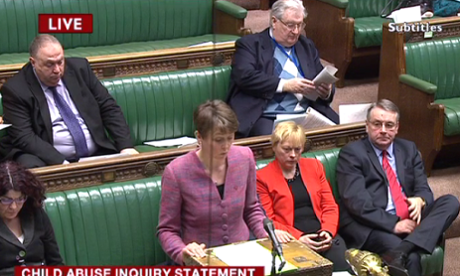
May says abuse uncovered so far is only “the tip of the iceberg”
May says what we have seen in Rotherham, Manchester and elsewhere is “only the tip of the iceberg”. Abuse took place on a scale that is hard to comprehend, she says.
-
May says abuse uncovered so far is only “the tip of the iceberg”.
May says all government departments have been told to make documents available to the inquiry.
May says government departments have been asked to search their records.
A Cabinet Office file was not submitted to the Wanless and Whittam review. It partly duplicated another file the Wanless and Whittam review considered. Peter Wanless has said the contents of that file would not have affected his conclusions.
Here’s a picture of Lowell Goddard.
NZ judge Lowell Goddard named as head of UK inquiry into historical child abuse http://t.co/uCkP7TDJRK pic.twitter.com/lXnnPXPKsL
— BBC Breaking News (@BBCBreaking) February 4, 2015
May says last year she announced a £2m fund for organisations dealing with increased demands because people have come forward following the launch of the inquiry. A separate fund worth £2.8m is also available. Those funds are now up and running, she says.
May says current inquiry panel being replaced with new statutory inquiry
May says she has decided against setting up a royal commission.
And she has decided against converting the current inquiry into a statutory one.
Instead, she says will set up a new statutory inquiry, with a panel.
- May says current inquiry panel being wound up, and a new statutory inquiry panel is being set up.
- Existing panel members will be free to apply.
- Ben Emmerson QC, counsel to the current inquiry, will stay on as counsel to the new one.
-
May to consider extending the inquiry’s remit to the period before 1970s.
May names New Zealand judge as child abuse inquiry chair
May says she will appoint Justice Lowell Goddard, a New Zealand judge.
She has conducted an inquiry into abuse in New Zealand.
And she has been on a UN panel on torture.
- May names New Zealand judge, Justice Lowell Goddard, as new chair of abuse inquiry.
May says the home affairs committee will hold a confirmation hearing on 11 February.
May says the Home Office has considered 150 names for the post of chair.
Due diligence was carried out on some names, and a shortlist was prepared, she says.
May says she spoke to a small group of survivors, representing thousands more.
May says she has held meetings with abuse survivors.
She is “more determined than ever” to expose abusers, and to expose those who did not act. In some cases people positively covered up evidence of abuse, she says.
This is from the BBC’s Danny Shaw.
A New Zealand judge has been appointed to chair Child Sex Abuse inquiry #CSAinquiry
— Danny Shaw (@DannyShawBBC) February 4, 2015
May says MPs know the inquiry was established to investigate whether insitutions took their duty of care seriously.
Theresa May's statement on the new child abuse inquiry chair
Theresa May, the home secretary, is about to make her statement on the child abuse inquiry chair.
Cameron says he is determined to ensure the south west has strong road and rail networks.
Labour’s Grahame Morris asks why companies based offshore were allowed to benefit from the government’s loan guarantee scheme.
Cameron says the banks decided the terms of that scheme.
This is from the BBC’s Nick Robinson.
Q- Why did @Ed_Miliband walk into gunfire on Lab & business at #PMQs? A - Believes voters back his attacks on Tory tax avoiding "predators"
— Nick Robinson (@bbcnickrobinson) February 4, 2015
And this is from the Spectator’s Isabel Hardman.
We cannot take photos in the Commons, which is a shame as it would be useful to show how fed up Labour benches look #PMQs
— Isabel Hardman (@IsabelHardman) February 4, 2015
Mike Freer, a Conservative, says there are 120 faith buildings at risk of terrorism attack. Will the government consider setting up a security fund to protect them?
Cameron says he has met Jewish leaders to discuss this problem. He wants British Jews to feel safe and secure, he says.
Cameron says schools that have converted to academy status have seen their standards improve faster than other schools. It is interesting that Labour, that started the academy programme, has given up on it, he says.
Labour’s Tom Blenkinsop asks if Cameron knows a UK company headquarter in Luxembourg to minimise its tax. He is talking about Smythson, the company Cameron’s wife works for.
Cameron says he wants to see more firms paying tax in the UK.
Updated
Cameron says the Chinese market represents an enormous opportunity for the UK.
Labour’s Steve Rotheram says Cameron has broken his promises on issues like immigration and the deficit. He should go, he says.
Cameron says he said he would turn the country around, and he has done so.
At the next election, it’s a choice between competence on this said, and chaos on the other, he says.
Charlie Elphicke, a Conservative, asks if the government will take action to help Dover deal with disruption in the Channel Tunnel.
Cameron says a report is looking into this. The government will consider its recommendations.
Cameron says Ed Balls confirmed yesterday that debt would be higher under Labour.
Cameron says he is going to recommend a new medal for people who have worked overseas dealing with issues like Ebola.
Labour’s Joan Walley asks Cameron to publish a report into the NHS in Stafford.
Cameron says he will look into this. He complains that Ed Miliband went to Stafford and said the hospital was on the road to closure. That is what he means by weaponising the NHS. It is not true, he says.
Craig Whittaker, a Conservative, asks about a constituent arrested because he was mistaken for someone else.
Cameron says he will look into this. The constituent could complain to the IPPC.
Dan Jarvis, the Labour MP, says about support for a solar panel business in his constituency.
Cameron says he understands the government is offering support. He will see if more can be done.
Adrian Sanders, a Lib Dem, says, if Cameron says the coalition’s long-term plan is succeessful, why does he want to change it after 2015.
Cameron says by 2018 the government should be using the surplus to pay down debt. Only the Conservatives are promising that, he says.
Snap PMQs Verdict: A brave try from Miliband, who raised a good issue, but he was effectively monstered by Cameron. The only consolation for Miliband is that, although Cameron won in the chamber easily, sceptical viewers won’t have been so impressed, and might have concluded that Miliband had a point about the hedge funds.
Miliband says the Tories have had money from Lord Laidlaw, a tax exile. He mentions another donor based in Jersey. The hedge funds are avoiding tax worth hundreds of millions of pounds.
Cameron says Labour did not address this. And Andrew Rosenfeld, a Labour fund raiser, used to be a tax exile. Miliband is only raising this because he cannot talk about other issues. No wonder the person who wrote “Thing can only get better” says it no longer applies to Labour.
Miliband says Cameron cannot answer the question. The Tories are the party of Mayfair hedge funds.
Cameron says Labour’s economic policy has collapsed. Labour is anti-enterprise and anti-business. It offers chaos.
Miliband tries the hedge fund question again.
Cameron criticises Labour over the NHS. And he says the Chuckle Brothers have complained about being compared to the Ed Miliband and Ed Balls.
Miliband says everyone pays stamp duty on their share transactions except for hedge funds. This could raise hundreds of millions of pounds. Why won’t the government act?
Cameron says the government has acted on stamp duty. Labour’s biggest donor, John Mills, gave money to Labour in shares to minimise tax. Has Labour given the money back yet?
Updated
Ed Miliband also condemns the Isis killings.
Hedge funds don’t pay stamp duty on share transactions. Why isn’t the government doing anyhing about this?
Cameron says Labour did nothing about this, even though Miliband was in the Treasury for much of that time. He is glad Miliband has raised the economy on the day after Ed Balls could not name a single business supporter.
Miliband says Cameron did not answer the question. He tries again. The Tories are not acting because they get £47m from hedge funds, he says.
Cameron says, when the coalition came in, foreigners did not pay stamp duty on property. And executives paid lower tax than their cleaners. Going back to Balls, Cameon says Balls said the backer was “Bill somebody”. But “bill somebody” is Labour’s policy.
Updated
David Willetts, the Conservative former universities minister, says cutting tuition fees would not help universities or students generally. It would only help wealthy students. How can it be called progressive?
Cameron says Labour told us four years ago they would get rid of tuition fees. Now they have nothing to say.
Labour’s Phil Wilson asks about a constituent being mistreated by an employer.
Cameron says he wants to help low-income workers by taking them out of income tax.
David Cameron starts by condemning the murders in Syria of the Japanese journalist and the Jordanian pilot. We will not stop until the murderous Isis extremists are eradicated, he says.
Cameron at PMQs
PMQs is about to start.
Coming up at noon the 7th last DC/EM #pmqs before #GE2015
— Adam Boulton (@adamboultonSKY) February 4, 2015
Sir John Chilcot's evidence - Summary
Here are the main points from Sir John Chilcot’s evidence. It is often claimed that the report will be an establishment whitewash. But, if Chilcot’s evidence is to be believed, it will be a landmark moment in Whitehall openness. AS
-
Chilcot said that it had taken more than a year to get Whitehall to allow the inquiry to publish details of Tony Blair’s notes to President Bush. Gus O’Donnell, the former cabinet secretary, originally refused point-blank, he said. But eventually Sir Jeremy Heywood, O’Donnell’s successor, conceded that this material could be published. Chilcot said that, until he knew what evidence he could publish, he could not firm up the report’s conclusions, because he did not want to publish judgments without the evidence to back them up.
The initial view, taken by the previous cabinet secretary, was that the notes, for example, that Mr Blair had sent to President Bush were not disclosable. There was a strong convention that interchanges of that sort should not be disclosed in public. As we went through, point by point with the current cabinet secretary, it became increasingly clear that, on the balance of argument, he would agree that a certain passage or point could be disclosed because of the essential nature of our inquiry, which related to the workings of our central government. That came to the point where it was no longer possible to sustain a doctrine that these documents as a category could not be disclosed. But it took a long time to get to that point.
Chilcot did not directly criticise civil servants for holding up the process, but he did not sound happy about it.
Chilcot took much of blame for delays onto the Iraq inquiry's shoulders but he's still bitter about how long Blair-Bush notes took to clear
— Mark Urban (@MarkUrban01) February 4, 2015
- Chilcot said that there were now whole classes of government information that were previously kept secret that were now being published as a result of pressure from the inquiry.
- He said some material was still being declassified for publication.
-
He revealed that Sir Martin Gilbert, a member of the inquiry panel, died last night. He paid this tribute to him.
Martin was an extraordinarily eminent historian and I and my colleagues, like so many others, benefitted from the wisdom and insights that he was able to offer us from his long and distinguished career. He was also a kind and generous colleague, and it was a privilege to have known and worked with him.
Gilbert’s illness did not hold up the work of the inquiry, he said.
-
Chilcot said there was “no evidence” witnesses were trying to hold up the report by delaying their response to the Maxwellisation letters.
As of today, I have no reason to think that anyone in the Maxwellisation process is seeking to spin out time, but I also said, we are not going to give people an indefinite amount of time.
-
He would not say when the report would be published.
My committee and I want, and intend, to deliver our report to the prime minister as soon as we possibly can. But as I said to the prime minister, I see no realistic prospect of doing so before the general election ...
Until it’s finished – and you can’t put an absolutely firm deadline on it at this point when it’s ongoing – it’s really not possible to say [when the report will be published].
And I think the risk of arousing either false hopes or false expectations either way outweighs, for me, meeting the powerful appetite there is, for all sorts of often good reasons from people, to know when the report is likely to become available.
Updated

Margaret Hodge, the popular Labour scourge of tax-avoiding big business who heads the Commons public accounts committee, has used an interview with the London Evening Standard to rule herself out of the race to replace Boris Johnson as the capital’s mayor.
“It is a positive decision that I want to stay here,” she told the Standard from what the paper called “her splendid Commons office”.
Hodge said she thought it was time London had a “non-white mayor”: “London is a diverse city but we are poor at representation,” she said.
Of the leading candidates for Labour’s nomination, former minister David Lammy was “a really important symbol” of modern London and had “an important back-story to tell”, while shadow justice secretary Sadiq Khan was “an assertive fighter” who also had “a good story to tell”.
She was less positive about leftwinger Diane Abbott, who was a “feisty woman, but I think she is the most distant from my own politics”.
Tessa Jowell, the ex-Olympics minister, who is white, had been “incredibly successful at delivering the Olympics” and would be a “good consensual advocate for London”, she said.
Labour will hold a primary to choose its mayoral candidate, with non-members able to vote for a £3 fee. PO
Nice gag from Michael Deacon.
Government dossier: Chilcot capable of launching Iraq report "within 45 years"
— Michael Deacon (@MichaelPDeacon) February 4, 2015
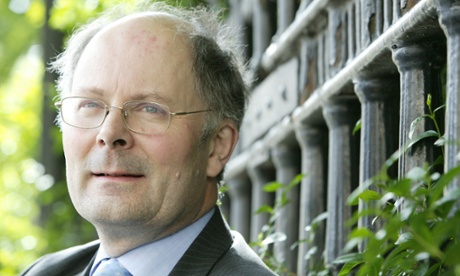
My colleague Libby Brooks has been speaking to Scotland’s leading polling analyst, professor of politics at the University of Strathclyde John Curtice, about the Ashcroft poll findings.
Curtice says that the results are as he had expected. “What is striking is how even the movement is. The SNP vote is up by almost exactly the same across the piece, which suggests that the national polls are right.”
With regards to Labour’s apparently monolithic majorities in Glasgow, Curtice adds: “My response to all these questions is: remember that the SNP won five-sevenths [of the vote] in the first past the post system in [the Holyrood elections of] 2011. Once the SNP are well ahead they go walkies.
“The nature of the political debate is different on the two sides of the border. I didn’t learn anything about why we are where we are that I didn’t know already. It simply demonstrates to people that yes indeed this is happening in every constituency. Hey guys, wake up and smell the coffee.”
The SNP’s general election campaign director, Angus Robertson MP, welcomed the “excellent” results, but stressed that the party would be taking nothing for granted in the run-up to May’s vote.
He said: “People can only make Scotland’s priorities Westminster’s priorities by voting SNP in May. While all the recent polls and our council byelection win in Gordon Brown’s seat indicate the potential SNP vote, they act as a spur to the entire party to work harder than ever before so that we can do better than ever before.”
Robertson added: “Scotland needs and wants an alternative to austerity cuts, cancellation of the horrendously expensive Trident renewal, the powers of real home rule, protection for our oil and gas industry, and a safeguard for our place in Europe by ensuring that all four UK nations would have to vote for EU withdrawal before the UK could exit. And we are prepared to vote for a bill to restore the NHS in England to the public service, publicly accountable, it was always meant to be - which will help safeguard Scotland’s budget.
“These are objectives which the people of Scotland can achieve - and can only achieve - by voting for a strong team of SNP MPs to hold the balance of power at Westminster.”
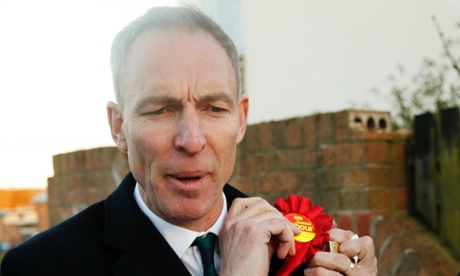
Jim Murphy, the Scottish Labour leader, has also responded to the polls. He said: “These polls show that Scottish Labour is well behind and has a big gap to close. But in the end the only people who will benefit from these polls are David Cameron and the Tories.”
He added: “It is a simple fact that the single biggest party gets to form the next government. The more seats the SNP get from Labour, the more likely it is the Tories will be the biggest party and David Cameron will get into government through the back door. That would be a terrible outcome for Scotland but it’s what might happen if Scotland votes SNP.”
Ashcroft, now apparently known as the “Pollfather”, is currently enjoying teasing David Cameron, Robert Booth reports in a profile of the former Tory deputy chairman.
In what could be seen as his second political career as a pollster, he is enjoying more praise and admiration for his work. Fellow pollsters recognise the rigour of his polling and its ability to transform the way the election campaign is understood by voters and political strategists alike. The impression is of a man re-invigorated, who believes he can have more influence outside his party than from within.
PO
The Institue for Fiscal Studies has predicted £50bn of spending cuts if the Tories win the next election, my colleague Heather Stewart reports. Labour’s plans would require far less stringent cuts than the Tories’, according to the IFS.
Earlier this month Paul Johnson, the director of the IFS, had put the two cuts figures at £33bn and £7bn, adding: “Lest there be any doubt, there is a big difference between £7bn of cuts and £33bn of cuts.” PO
Sir Richard Ottaway says that’s it.
Q: Is there anything else you want to say?
Chilcot says his mind is still troubled by the news of Sir Martin Gilbert.
And that’s it.
I’ll post a summary soon.
In the meantime, my colleague Paul Owen will be helping out, and posting more on some of this morning’s other political developments.
John Baron goes next.
Q: Are you satisfied you have got what you want to produce an authoritative report?
Chilcot says he does not think there has been an unreasonable refusal to release information at this point. But because a delay might be reasonable, that does not mean it is welcome.
Nadhim Zahawi, a Conservative, goes next.
Q: How long did it take you to win your argument with the cabinet secretary about what could be published?
Chilcot disputes the term “win”. They reached agreement.
They started this process in August 2013. They reached agreement in September 2014.
Originally it was argued that, as a class of document, the notes from Blair to Bush could not be published. But he “nibbled away” at that argument, and eventually it became clear that that argument could not be sustained.
Sir Menzies Campbell, the former Lib Dem leader, goes next.
Q: Would it have been better to have had legal counsel?
No, says Chilcot. The process they followed was investigative, not adversarial. If you have an adversarial process, you might get less information from witnessses.
Q: Will your report offer views on how inquiries like this should be conducted in the future?
Chilcot says he is not planning that.
Q: If you were starting the inquiry again, what would you do differently?
Chilcot says the big issue is whether it should have gone through all the documentary evidence before starting the public hearings.
But there would have been “public angst” if the public hearings had not started quickly.
Some inquiries have “gone to bed for years” before starting public hearings, he says.
Sir John Stanley, a Conservative, goes next.
Q: Are there any people who are taking an unreasonable amount of time to respond to the Maxwellisation process?
Chilcot says, “as of today”, he does not think anyone is trying to spin it out.
Q: Will you publish original documents, with redacted material apparent? Or will you rewrite classified material, giving no indication of what has been redacted?
Not the latter, says Chilcot.
Redactions will be apparent on the face of documents being published.
But, with other categories of document, the inquiry may use quotation from a long document, without publishing the whole document.
And, on other occasions, it will publish “the gist” of what is said in a document. It will be apparent when this is done, and why.
Chilcot says to publish a narrative account, without the analysis, would be misleading. It would be open to different interpretations. It is very important to publish it all together, he says.
John Baron goes next.
Q: Can you say the delays caused by Whitehall departments have not been unreasonable?
Chilcot says Whitehall departments have taken substantial amounts of time.
Q: What can you say to members of the public who think that inconvenient evidence will not see the light of day?
Chilcot says the main job of the inquiry is to provide a reliable narrative of what happened, backed by evidence. That is not subject to Maxwellisation.
Maxwellisation only covers the judgment the inquiry is making about the decisions taken.
Q: Is the Maxwellisation process still appropriate for today?
Chilcot says the Maxwellisation process is similar to what is set out in the Inquiries Act 2005. Nothing less would be appropriate, he says.
Q: Have you set a deadline for the Maxwellisation process?
Chilcot says he is not allowing people an indefinite amount of time. But people are being given a “proper and reasonable” amount of time. It would be different if someone had to respond to a few paragraphs, rather than hundreds of pages.
Q: Do you ever regret taking this on?
Chilcot says he has tried not to regret that.
But he wants to ensure that the work is carried out properly.
Q: Did Sir Martin Gilbert’s illness affect the timing?
Not the timing, says Chilcot. But his loss is immense.
Q: How many people have got Maxwellisation letters?
Chilcot says he has thought carefully about what he can say. All he can say is that none have gone to people who did not give evidence. Since 150 people gave evidence, that is the upper limit.
Q: There are claims one witness was sent material running to several hundred pages.
Chilcot says he cannot comment on this without breaching the confidentiality of the process.
Chilcot says there is no evidence that witnesses trying to hold up inquiry report
Chilcot says, “as matters stand today”, there is no evidence to support the claim that people are using the Maxwellisation process to delay the report.
-
Chilcot says there is no evidence that witnesses are using the Maxwellisation process to delay the report.
Here’s the start of the Press Assocation’s story from the opening of the inquiry.
The task of providing those most deeply affected by the Iraq War with “the answers they deserve” must not be rushed, the chair of the Iraq Inquiry told MPs as he defended further delays to its publication.
Sir John Chilcot said the panel wanted to deliver its findings “as soon as we possibly can” but renewed his assertion that he saw “no realistic prospect” of it being finished before May’s general election.
He said he had accepted a summons to explain the hold-ups because he recognised the “exceptionally high level of parliamentary and public interest in our progress”.
But in an opening statement to a grilling by the Commons foreign affairs committee, he hit back at calls for immediate publication.
“My committee and I want, and intend, to deliver our report to the prime minister as soon as we possibly can,” he said.
“But as I said to the prime minister ... I see no realistic prospect of doing so before the general election.
“We have to maintain the principles by which we have operated throughout: fairness, thoroughness and impartiality.
“It is our duty to deliver a report which gives the government, parliament, the public, and particularly all those who have been deeply affected by events in Iraq, the answers they deserve.”
Q: You have held meeting abroad, including in Iraq, the US and in France.
Yes, says Chilcot.
Q: Is there a list of who you have met?
Chilcot says it is not in the public domain yet. But it will be included in the report.
Q: What input have you had from other governments?
Chilcot says he has not had direct representations.
Mike Gapes, a Labour MP, goes next.
Q: Are the 150,000 documents all UK government documents?
Yes, says Chilcot.
Q: Will you publish documents from other governments?
Only if the UK government approves, says Chilcot.
Q: What about documents in the public domain?
Chilcot says the inquiry will use what’s in the public domain.
John Baron, a Conservative, goes next. He declared that he met Chilcot in private as part of the inquiry.
Q: You say declassification is still ongoing? Why?
Chilcot says it is party because the government has taken time to get back to the inquiry.
But, if a witness comes back during the Maxwellisation process with a new piece of documentary evidence, the inquiry then has to see if it can declassify that.
He says the inquiry is near to the end of the declassification process.
Q: Do you accept the delay is not entirely the inquiry’s fault?
Chilcot says it is not necessarily delay if a department enters a long debate about what can and cannot be declassified.
He says there are whole categories of information where the inquiry has been able to overturn long-standing objections to publication.
-
Chilcot says the inquiry has persuaded Whitehall to publish categories of document that were previously kept secret.
Chilcot says Margaret Aldred, the secretary to the inquiry, was not involved in crucial decision about the Iraq war. She was in charge of foreign and defence policy at the Cabinet Office, but only from 2004.
Labour’s Sandra Osborne is asking questions now.
Q: It seemed to take a long time to reach agreement with the Cabinet Office. Are you saying that was not obstruction?
Chilcot says it was a very challenging process.
The previous cabinet secetary (Gus O’Donnell) said notes between Blair and Bush could not be disclosed.
But, as they argued, the current cabinet secretary, Sir Jeremy Heywood, accepted that some excerpts could be diclosed.
And then it became clear that there was no principled objection to publishing this category of document.
- Chilcot says that Gus O’Donnell, the former cabinet secretary, tried to block any publication of the notes from Tony Blair to George Bush, but that Sir Jeremy Heywood, the current cabinet secretary, gave way.
Chilcot says the inquiry has not experienced obstruction from government.
But it has placed huge demands on government departments. They have found it difficult to respond as quickly as the inquiry wanted.
He says, until he knew what he could publish from Tony Blair’s communications with George Bush, he could not finalise his report. He needed to know what evidence he could publish to back up his claims.
Chilcot says the inquiry has more than 200 minutes from cabinet. It has 30 notes from Tony Blair to George Bush. It also has records of conversations between Blair and Bush, and between other cabinet ministers and their US counterparts.
It has legal advice, policy advice, intelligence assessments, and telegrams from ambassadors, as well as reports from people working in the field.
Updated
Chilcot says 150,000 is the number of documents the inquiry has seen so far. Documents are still coming in, he says.
The inquiry also wants to quote from 7,000 of them, he says.
And it will want to publish some in full.
He says the inquiry got to see all the documents it wanted.
Updated
Labour’s Ann Clwyd goes next.
Q: Should you have published an interim report?
Chilcot says the inquiry thought about this, and decided not to publish one.
If they had done this, they would have had to go through the Maxwellisation process twice over.
Q: What about splitting the report into policy pre-war, during the war, and post-war?
Chilcot says the inquiry did not consider that.
It did very seriously consider diving the report into two issues: the decision to go to war, and what happened after.
But they decided that the two issues were too closely connected.
As an example, he cites the impact on the civilian population of Iraq.
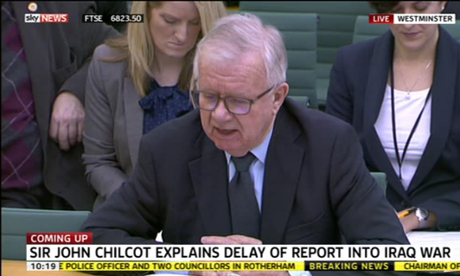
Labour’s Frank Roy goes next.
Q: Was Sir Jeremy Heywood right to say the inquiry is in sole charge of the timing of its report?
Yes, says Chilcot, although he says the inquiry is dependent on the government to supply it with documents.
Q: Can people delay the report through the Maxwellisation process?
Chilcot says the inquiry is giving witnesses a reasonable amount of time to respond, but not an indefinite amount of time.
Q: Does the inquiry need more resources?
Chilcot says it has the staff it needs at the moment. As it gets closer to publication, it might need more help. But it will ask for it and get it.
Chilcot says until the Maxwellisation process is complete, he doesn’t think he will be able to say anything useful about when the report can be published.
Q: But the uncertainty is painful to relatives of soldiers who died?
Chilcot says he does not want to to take the risk of arising false hopes or false expectations.
Q: So you are not prevented from publishing in March by pre-election purdah? It is just the Maxwellisation process?
Yes, says Chilcot.
Chilcot says he does not have a view as to whether it would have been best to publish before the election.
Chilcot has finished his opening statement. Sir Richard Ottaway is now asking questions.
Chilcot says the decision to take evidence in public, which was what parliament demanded (but not what was originally planned) meant the inquiry would take longer than originally expected.
Q: Is it impossible to have a time limit on an inquiry like this?
Chilcot says it is worth giving thought to this when the inquiry is over.
Q: Where you given a chance to discuss the scope of the inquiry before you accepted the task?
No, says Chilcot.
Q: Were you happy with this?
Chilcot says, having served on the Butler inquiry, he could see the case for having an inquiry with a wider remit.
Chilcot says he had hoped to start the Maxwellisation process (showing people what criticisms will be made of them in the report) in October 2013.
But he could not start this process before he knew what material he would be able to publish.
Agreement on what sensitive material would be published was only reached in May 2014.
And it was not until the end of September that the inquiry had resolved all the details of what would be published and that the Maxwellisation process could begin.
Chilcot says he underestimated how long it would take to assess 150,000 documents
Chilcot is now making a more general opening statement.
He asks people to judge the inquiry on its report.
The inquiry covered some very serious issues. The war sparked some of the biggest protests the UK has seen.
He says the inquiry did not just cover one incident, like other inquiries, but the whole war.
Parliament wanted a reliable account of what happened. Constructing that reliable account is a massive task, he says.
And the decisions covered a web of factors.
The inquiry heard eveidence from more than 150 witnesses, and held 130 evidence sessions.
Chilcot says he underestimated how much time it would take to assess more than 150,000 documents.
When you read documents, they throw up more questions, he says.
- Chilcot says the inquiry has looked at more than 150,000 documents, and that he underestimated how much time this would take.
Chilcot says Sir Martin Gilbert has died
Sir John Chilcot is giving evidence now.
He says Sir Martin Gilbert, the historian, Churchill biographer and member of the inquiry panel, died last night. He was a kind and generous colleague, and it was a privilege to work with him, he says.
- Sir Martin Gilbert, the historian and member of the Inquiry inquiry, died last night, MPs have been told. He had been ill for a while.
Sir John Chilcot is about to give evidence to the Commons foreign affairs committee about why it is taking so long to publish his Iraq inquiry report.
On the Today programme, Sir Richard Ottaway, the committee chairman, explained what the MPs would be asking him.
Really this is an opportunity for Sir John Chilcot to set out the reasons for the delay. We want him to have a look at the overall time frame that he has been operating under or not operating under, we want to pose some questions to him about the evidence and the publication of evidence and I think, as far as we can, I’d like to probe the Maxwellisation process, which seems to be holding up the whole inquiry.
I’ve taken the quote from PoliticsHome.
Ashcroft polling - Verdict from the Twitter commentariat
Here are some Twitter comments on the Ashcroft polling (see 9.20am) from journalists and commentators.
The Ashcroft polls in Scotland are cataclysmic for Labour, maybe the story of a revolution. For Westminster? Grand instability.
— James Naughtie (@naughtiej) February 4, 2015
This assessment of Jim Murphy's task was written before the Ashcroft polls, but holds even more true now. http://t.co/JfOHKek88S
— Patrick Wintour (@patrickwintour) February 4, 2015
Key feature of Scottish polls, might be overlooked: total collapse in LibDem vote in Lab-SNP fights. LDs got 19% in 2010 vs 20% for SNP
— Faisal Islam (@faisalislam) February 4, 2015
One thing you probably won't hear mentioned today is that this result doesn't really help the Tories. Still no majority for them.
— Helen Lewis (@helenlewis) February 4, 2015
And the Tories can't face a "wipeout" in their Scottish seats because, er, they only have one. (Less than the number of pandas in Scotland.)
— Helen Lewis (@helenlewis) February 4, 2015
Plus the only viable coalition/supply arrangement that would yield a working majority is Labour-SNP. LibCon 2.0 is off the table.
— Helen Lewis (@helenlewis) February 4, 2015
From Ashcroft numbers, Labour's problem in Scotland seems more cultural than political. A v.different challenge to positioning/campaigning.
— Anthony Painter (@anthonypainter) February 4, 2015
Ashcroft's poll will make VERY happy reading for SNP - look at Scotland turn yellow. http://t.co/yXhDaWzgQZ pic.twitter.com/7dZTzZXFt6
— Helen Lewis (@helenlewis) February 4, 2015
Good (or less bad) news for LAB from Ashcroft is swing higher in seats polled than most other Scots polling. Could be better elsewhere
— Mike Smithson (@MSmithsonPB) February 4, 2015
Ashcroft gives new details about what headline polls have suggested: the #indyref isn't over; it's being fought again via party proxies.
— John McDermott (@johnpmcdermott) February 4, 2015
Ashcroft Scotland poll pretty jaw-dropping: in Labour-held seats, only 60% of those who voted for the party in 2010 said they would this yr
— Ian Katz (@iankatz1000) February 4, 2015
Important point from Ashcroft polls: personal popularity of MPs, or 'incumbency', isn't saving Lib Dems or Labour. http://t.co/iE7EJogDC1
— May2015 (@May2015NS) February 4, 2015
Difference between SNP winning 20 seats or 40 could be decided by small margin, matter of 2/3 percentage points. http://t.co/3skms1skAL
— Ewen MacAskill (@ewenmacaskill) February 4, 2015
A mixture of Sturgeon in TV debates, impressive SNP candidates and continued focus on constitution will make these polls v tough to move.
— David Clegg (@davieclegg) February 4, 2015
Can't help but feel the SNP surge isn't really about the SNP. It's a huge FUCK YOU to Westminster and its ways. And they can't cope.
— Chris Deerin (@chrisdeerin) February 4, 2015
Got to write something about the Ashcroft Scotland poll this morning, but it’s hard not to just write “fucking hell” over and over
— Mark Ferguson (@Markfergusonuk) February 4, 2015
Worth remembering that IF we assume SNP will do deal only with Lab then SNP surge actually hurts Con govt chances all else being equal
— Rob Ford (Britain) (@robfordmancs) February 4, 2015
This is from my colleague Libby Brooks.
Re @LordAshcroft polling, John Curtice tells me the message - esp to Westminster - is: wake up and smell the coffee
— Libby Brooks (@libby_brooks) February 4, 2015
Here’s Patrick Wintour’s story about the Ashcroft polling from Scottish constituencies. And here’s how it starts.
Labour’s general election campaign chairman, Douglas Alexander, and the Liberal Democrats’ economics spokesman, Danny Alexander, are two of the most high-profile projected casualties in Scotland at the general election, according to polling research by Lord Ashcroft that was prematurely released on Tuesday night.
The long-awaited polling in 16 constituencies in Scotland suggests a 21% swing from Labour to the Scottish National party (SNP). If the results were replicated across Scotland on 7 May, Labour would lose 35 of its 41 seats, making the prospect of an overall Labour majority at Westminster much more unlikely, and close to impossible.
Here is the polling data in detail (pdf). Here is Lord Ashcroft’s commentary on it. And here’s an extract.
In the Labour-held seats only just under four in ten (38 per cent) said they were dissatisfied with David Cameron and would rather have Ed Miliband as Prime Minister. Meanwhile 44 per cent said either that they were satisfied with Cameron (18 per cent) or that they were dissatisfied but preferred him to Miliband (26 per cent). Just over half (59 per cent) of Labour voters said they would rather see Miliband as Prime Minister, as did just under half (49 per cent) of Labour-SNP switchers.
Despite this, the single most popular general election outcome in these seats was a coalition involving Labour and the SNP – a result favoured by 39 per cent of voters overall, including 62 per cent of SNP supporters and 79 per cent of Labour-SNP switchers. Around one in seven SNP voters (14 per cent) hoped for the unlikely prospect of a coalition between the SNP and the Tories.
What are the implications for the wider general election battleground? If a swing to the SNP of 21%, the smallest in this range, were to be repeated across the board next May it would endanger 35 of Labour’s 41 seats in Scotland.
But we cannot assume such a uniform swing. Most of the seats in this survey are in areas which returned a particularly strong yes vote in September, where the SNP attraction will naturally be greater; in future rounds of research we may find a different pattern where support for independence was lower.
And these are the MPs who would lose their seats if people were to vote in line with the polling
Labour
Pamela Nash
Tom Clarke
Gregg McClymont
Jim McGovern
Anas Sarwar
Margaret Curran
Ann McKechin
John Robertson
Tom Harris
Ian Davidson
Frank Roy
Douglas Alexander
Gemma Doyle
Lib Dems
Danny Alexander
Sir Malcolm Bruce (standing down anyway)
And here is the Ashcroft chart.
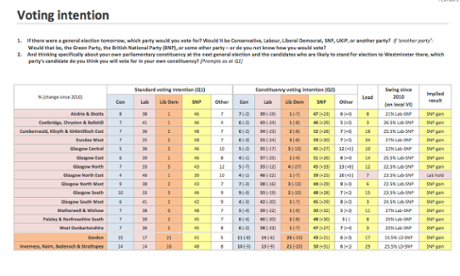
#UKGENERALELECTION2015 92 DAYS TO GO
— General Election (@UKELECTIONS2015) February 4, 2015
Newsnight also had an interview with Simon Woodroffe, the founder of the restaurant chain Yo! Sushi and a former Labour supporter, who said he was worried by the party was now attacking “fat cats”.
Actually, I think the fat cats, generally, sometimes it annoys me, but they pay their taxes, you know. Actually, they are paying over 50% a lot of the time with this new cap on national insurance. The world is right as it is. And we need to get on as a country, UK PLC, and make lots of money, be very successful ...
You know, it scares me. I was a Labour Party supporter during the Blair-Brown thing and I was a supporter because I am a believer that politics needs to make money, that UK PLC needs to be a profitable business, and I thought they were a good management team.
So, that’s what I’m looking for. Now, I’m not from the homelands of Labour, I’m not even from the homelands of the Conservatives. But I want somebody who really appreciates that business has got to succeed first before we can share out the money.
And this morning the Today programme had an interview with Digby Jones, the former CBI director general who served as a trade minister in Gordon Brown’s government (although he refused to join the Labour party). Asked if Ed Balls’ memory lapse (see 8.52am) mattered, Jones said it did.
It’s a much bigger problem with businesses. I think they are scraping the bottom of the barrel with due respect to a former non-exec director [Bill Thomas]. I think they haven’t got the support that New Labour used to have years ago.
The reason being that business wants the mood music of this nation to be in favour of creating wealth. It’s not about a personal policy about whether the tax is 50%, it is not about the mansion tax, it’s about this concept that at the moment, you are not hearing Ed Miliband or Ed Balls or the others standing up to stay creating wealth is a good thing.
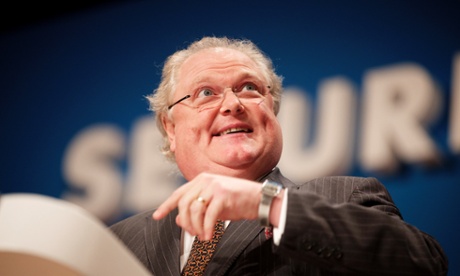
Here’s the Ed Balls quote from Newsnight last night. Asked about business support for Labour, he said he had just come from a dinner with “a number” of business figures who backed Labour.
Asked who was there, Mr Balls said: “Bill ... the former chief executive of EDS, whom I was talking to just a few moments ago ... he is a big supporter of ours.”
Pressed on his name, he said:
To be honest his surname has just gone from my head, which is a bit annoying at this time of night.
Later Balls tweeted:
I know, I know. Bill Thomas, our Small Business Taskforce Chair, will never forgive me. It's an age thing! @Newsnight
— Ed Balls (@edballsmp) February 3, 2015
Updated
It would be nice if news arrived in a smooth flow. But it doesn’t, and instead today we’ve got about a tsunami of political news arriving all at once.
Here’s the agenda for the day. I’ll be focusing on Sir John Chilcot, PMQs, and Theresa May’s statement, as well as trying to mop up the other stuff.
9.30am: Iain Duncan Smith, the work and pensions secretary, gives a speech on welfare.
9.30am: Esther McVey, the welfare minister, gives evidence to the Commons work and pensions committee on benefit sanctions.
10am: Rachel Reeves, the shadow work and pensions secretary, gives a speech on the cost of Tory welfare policies.
10am: Sir John Chilcot gives evidence to the foreign affairs committee about the delays in the publication of his Iraq inquiry report.
12pm: David Cameron and Ed Miliband face each other at PMQs.
12.30pm: Theresa May, the home secretary, makes a Commons statement on the new chair of the child abuse inquiry.
First, though, I’ll be looking at two unwelcome developments for Labour.
- Labour has come under fresh attack from business figures after Ed Balls on Newsnight last night mentioned a business figure who was supporting Labour but then forget his surname. You can watch it here. The relevant section starts at 5.50 minutes in.
I’ll post more on both of these stories soon.
As usual, I will be also covering all the breaking political news from Westminster, as well as bringing you the most interesting political comment and analysis from the web and from Twitter. I will post a summary at lunchtime and another in the afternoon.
If you want to follow me on Twitter, I’m on @AndrewSparrow
Updated