Afternoon summary
-
Lord Kerslake, the former head of the civil service and former permanent secretary at the Department for Communities, has described the failure to build enough homes as “one of the biggest public policy failure of the last 50 years”. Kerslake is going to chair a commission on affordable housing in London for the IPPR thinktank and, in a statement announcing this, he said:
The failure to build enough homes to meet this country’s needs has been one of the biggest public policy failures of the last 50 years. This failure has been most acutely felt in London, which is building less than half of the homes in needs to sustain its growing population. As a result, Londoners are missing out on opportunities that previous generations took for granted: delaying having families, relying on a very uneven private rented sector and often being locked out of home ownership completely. The knock on consequence is that London is being held back and London’s competitiveness as the most successful global city is under threat. There are also major knock-on impacts on the rest of Britain’s economy and a distorting effect on other housing markers outside the capital.
- The Labour MP Kate Hoey has said that her party is perceived as “extremely unpatriotic” by working class voters. In a New Statesman interview she said:
They feel very strongly about their country and we have been extremely unpatriotic as a party to our country. There’s just a feeling that we’re half-hearted about being British, we’re half-hearted about the monarchy, we’re half-hearted about the way we see our country in the world. I’m very proud of being British and I think the United Kingdom is a force for good in the world and we seem to feel all the time that we have to put ourselves down because somehow that might upset people”.
That’s all from me for now.
I will be covering the Labour leadership hustings later on a separate blog. The hustings start at 7pm, and I will launch the blog at around 6pm.
Thanks for the comments.
Updated
Here’s an afternoon reading list. It has only got one item, but it’s long, and well worth reading.
-
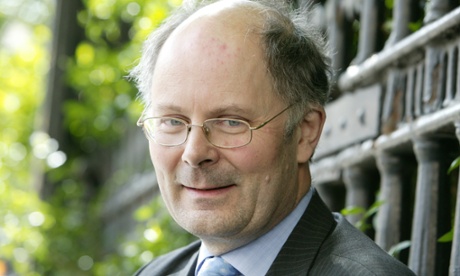
John Curtice, in an article for the IPPR’s Juncture magazine, looks at the reasons Labour lost the election. He says the party is not paying enough attention to why it lost in Scotland.
Of these two outcomes, easily the more catastrophic as far as Labour is concerned was the one in Scotland – yet it also appears to be the one that is at risk of being ignored. Because the results north of the border mean that the parliamentary Labour party is all but denuded of Scottish voices, the initial manoeuvres in the party leadership contest are being played out exclusively among MPs from England and Wales, many of who are relatively unfamiliar with the party’s difficulties north of the border.
He says Tony Blair’s claim that the main problem was that Labour abandoned the centre ground was too simplistic.
Data from the British Election Study shows that those who voted Labour in 2010 but subsequently switched their support to the SNP after the referendum were both disproportionately in favour of a more equal society and more likely to regard the SNP as the party that shared that view. No less than 74 per cent of these lost voters supported the redistribution of income (compared with 59 per cent of Scots generally), and although 48 per cent of them thought that Labour backed that position, 75 per cent reckoned that the SNP did.
This evidence must caution against any idea that the solution to Labour’s problems is simply for the party to reclaim the centre ground of British politics that was supposedly vacated during Ed Miliband’s tenure as leader. The complaint about the party north of the border has been that its voice has not been sufficiently radical, or at least distinctive – an impression that fighting a referendum campaign in alliance with the Conservatives certainly did nothing to dispel.
He says Labour did not lose ground amongst middle class voters.
The level of support for Labour in each class was much the same as it had been five years previously. There is, in truth, no strong evidence here of Labour particularly losing touch with its more middle class supporters. Rather, what is notable about the party’s performance is that what had been an especially marked drop in its support among C2 and DE supporters between 2005 and 2010 was not reversed this time around. Perhaps not least of the reasons for this – and for the Conservatives’ own loss of support among working class voters – is the fact that support for Ukip among C2 and DE voters was at 19 per cent and 17 per cent respectively, markedly higher than among AB (8 per cent) and C1 voters (11 per cent).
And he says that competence is crucial - but that this is not the same as taking a conservative approach.
There can be little doubt that one of Labour’s key failures in the last five years was its inability to restore its reputation for economic competence. On that, all wings of the party can probably agree. But restoring that reputation need not necessarily be synonymous with embracing a conservative approach to handling the nation’s finances or the economy more generally. What Labour has to ask itself is not only why it failed to attract the support of voters who were concerned about the deficit, but also why it often struggled to secure the support of those who were doubtful about the way in which the deficit and the economy were being handled in the first place. Many of the latter were working-class voters among whom Labour suffered a sharp loss of support in 2010 which they failed to reverse in 2015. Labour needs to convince the electorate not only that it can run the economy well, but that it is capable of creating a more attractive economy. Then, perhaps, voters not just in England and Wales but in Scotland too would be willing to look at the party afresh once more.

David Cameron has been in Milan today for a meeting with the Italian prime minister, Matteo Renzi. Here is some Twitter coverage of the trip.
From Sky’s Faisal Islam
"For us, EU without UK is impossible” - Italian PM Matteo Renzi after meeting @David_Cameron
— Faisal Islam (@faisalislam) June 17, 2015
Cameron after meeting Italian PM Renzi: "on reform & change in Europe ..we do have some common perspective & ideas…need for competitiveness"
— Faisal Islam (@faisalislam) June 17, 2015
PM with renzi on med crisis: "absolutely recognised this is something where all of Europe is to work together, Britain is playing its part"
— Faisal Islam (@faisalislam) June 17, 2015
"Britain playing its part" on Med crisis said PM was not taking migrants, but bulwark saving them, anti-trafficking by NCA officers & aid
— Faisal Islam (@faisalislam) June 17, 2015
Basically PM and Renzi seemed to have as much if not more of a discussion about Med crisis as UKS renegotiation.. Quick chat on Greece too
— Faisal Islam (@faisalislam) June 17, 2015
Italian journalists saying discussions were about Med migrant crisis, not UK situ. when I asked about treaty change, they presumed Dublin.
— Faisal Islam (@faisalislam) June 17, 2015
From the Telegraph’s Matthew Holehouse
Cameron, looking like he feels the heat, has arrived at the British pavilion on the Milan Expo, in Renzi's Lancia Therma limousine.
— Matthew Holehouse (@mattholehouse) June 17, 2015
Italian pensioners cheer as Cameron tours stand with his counterpart: "Renzi! Renzi!"
— Matthew Holehouse (@mattholehouse) June 17, 2015


Here’s a Guardian video showing George Osborne and Hilary Benn at PMQs.
This is very good on the Labour leadership nominations.
Another genius chart by @JJ_159, cross-listing all Labour MPs by nominations for leader and deputy pic.twitter.com/ZoxoTkpCz3
— John Rentoul (@JohnRentoul) June 17, 2015
Lunchtime summary
-
Stella Creasy, Angela Eagle and Ben Bradshaw have all secured enough nominations to make it on to the ballot for the Labour deputy leadership. They join Tom Watson and Caroline Flint, who already had the support of more than 35 MPs. Creasy, Eagle and Bradshaw only made it at the last minute after Rushanara Ali dropped out, enabling her supporters to back other candidates.
Final deputy leadership batting order: Watson 62 Flint 41 Eagle 38 Bradshaw 37 Creasy 35: http://t.co/DyvHbaukOQ
— Stephen Bush (@stephenkb) June 17, 2015
Rushanara Ali's transfers: 7 to Bradshaw (incl Ali herself), 2 to Creasy, 2 to Eagle, 1 not nominating (John Mann)
— John Rentoul (@JohnRentoul) June 17, 2015
-
David Cameron has said he is “fast losing patience” with the Iraq inquiry after chairman Sir John Chilcot insisted he still cannot say when it will report. Cameron’s comment emerged in an exchange of letters published on the inquiry’s website. Explaining the latest delay, Chilcot said responses submitted by individuals mentioned in the report had “opened up new issues”. Others have still yet to reply. He said:
It is now essential that all remaining responses are received so that the process can be completed. Only when all responses are in our possession and have been evaluated will I be able to write to you with a realistic timetable for completion.
Cameron said he and other had “hoped for publication of your report by now and we are fast losing patience”.
-
George Osborne has said that Britain’s current spending on welfare is “unsustainable”. Speaking at PMQs, where he was standing in for David Cameron, he said:
This country faces a very simple choice. We have got 1% of the world’s population, 4% of its GDP, but we undertake 7% of the world’s welfare spending. We can either carry on on a completely unsustainable path or we can continue to reform welfare so that work pays and we give a fair deal to those on welfare and indeed a fair deal to the people, the taxpayers of this country, who pay for it.
-
Osborne has said the government is considering a cap on the amount savers are charged to withdraw money from their pensions. Asked at PMQs about claims that pensioners were being exploited, he replied:
The pensions freedoms we introduced in April deliver a fundamental Conservative principle that people who have worked hard and saved hard all their lives should be trusted with their own money. There are clearly concerns that some companies are not doing their part to make those freedoms available. We are investigating how to remove barriers and we are considering now a cap on charges. I’m asking the Financial Conduct Authority to investigate. People who have worked hard and saved hard deserve a better deal.
-
Farage has said the flow of migrants from North Africa to Europe could reach “biblical proportions” - and many could end up in Britain. Speaking on LBC, he said:
I tried to make this a general election issue but nobody really wanted to listen. The fact is we now have the beginning of an exodus of people coming from North Africa that could even reach biblical proportions ...
The government says it’s OK, don’t listen to Mr Farage because we are opted out of EU asylum policy. But all the Italians have to do is give people who come an EU passport and then any of them can come to Britain.
There is a problem with numbers but there is an even more serious problem and that is that Isis (Islamic State) have been absolutely frank in saying that they will use this migration of people to put jihadist fighters into Europe.
It takes us back to the beginning. It takes us back to what this referendum is going to be all about. Do we want as a country to control our own borders or not?
-
Corbyn has accused some of his critics in the Labour party of showing “contempt” for the views of ordinary party members.
Our response to the contempt being shown in some quarters for ordinary, grassroots members of this party. pic.twitter.com/BLemH6oY2Q
— JeremyCorbyn4Leader (@Corbyn4Leader) June 17, 2015
And here are three blogs on PMQs.
PMQs - Verdict from the Twitter commentariat
And this is what political journalists are saying about PMQs on Twitter. The verdict is fairly mixed.
From the BBC’s Vicki Young
Apart from inappropriate (and unfunny) joke at the start of #PMQs Osborne has looked very comfortable standing in for Cameron
— Vicki Young (@VickiYoung01) June 17, 2015
From the New Statesman’s George Eaton
The story from Osborne's first #PMQs is his unwise, pre-scripted "Bennites" joke.
— George Eaton (@georgeeaton) June 17, 2015
From the Guardian’s Gaby Hinsliff
Joined #pmqs late due to an i'v but what I've seen of Osborne pretty smooth. As he shd be, having been prepping leaders for it since forever
— Gaby Hinsliff (@gabyhinsliff) June 17, 2015
From the Sun’s Tom Newton Dunn
If that was an audition for the top job, some room for improvement. Osborne too sneery and looked uncomfortable, some obvious nerves; 4/10.
— Tom Newton Dunn (@tnewtondunn) June 17, 2015
From the Independent’s Nigel Morris
Limp joke about Bennites apart, Osborne looked comfortable at #PMQs
— Nigel Morris (@NigelpMorris) June 17, 2015
From the Daily Mirror’s Kevin Maguire
Must've slipped Osborne's mind his father-in-law has a financial interest in fracking or I'm sure he would've mentioned it #pmqs
— Kevin Maguire (@Kevin_Maguire) June 17, 2015
From the Independent on Sunday’s Jane Merrick
Osborne name-checking Northern Powerhouse is like an actor going on Wogan to plug new film. "Did I mention the Northern Powerhouse?" #pmqs
— Jane Merrick (@janemerrick23) June 17, 2015
From Guido Fawkes’s Harry Cole
Po-faced Labour types will try make a stink about the Bennite gag timing, but George proves he can do it... #PMQs
— Harry Cole (@MrHarryCole) June 17, 2015
From the Times’s Tim Montgomerie
Comfortable. Solid. Safe. @George_Osborne won't be unhappy at his #PMQs debut.
— Tim Montgomerie ن (@montie) June 17, 2015
From Tony Grew
Osborne will be pleased with his #pmqs performance today -very prime ministerial. @hilarybennmp also did well. Thoughtful Qs
— Tony Grew (@ayestotheright) June 17, 2015
From the Financial Times’s Robert Shrimsley
The problem with Osborne's Benn joke was not so much that he did it but that it wasnt any good
— robert shrimsley (@robertshrimsley) June 17, 2015
On Twitter Joe Dromey pulls me up for saying George Osborne has been successful as a chancellor in his own terms at least.
@andrewsparrow 'Osborne has been a successful (at least, in his terms) chancellor for five years'. Really?
— Joe Dromey (@Joe_Dromey) June 17, 2015
@andrewsparrow he has failed by his own measures - retaining AAA credit rating and eliminating structural deficit in one parliament
— Joe Dromey (@Joe_Dromey) June 17, 2015
I was basing my claim on the assumption that Osborne’s primary measure of success is an electoral one.
At PMQs George Osborne came up with a new statistic about welfare spending.
.@George_Osborne welfare stats there: uk has 1% of world pop, 4% of world gdp, 7% of global welfare spend
— Robin Brant (@robindbrant) June 17, 2015
It is a British version of a claim that Angela Merkel, the German chancellor, is fond of making about Europe; that it has 7% of the world’s population, 25% of its wealth and 50% of its welfare spending.
In the briefing after PMQs, government officials were not able to elaborate.
Osborne's new stat on UK has 1% world population but 7% of world welfare spending is based on 'an internal Treasury analysis', spksman says
— Paul Waugh (@paulwaugh) June 17, 2015
Back to the Labour deputy leadership contest, and the Labour party has confirmed that five candidates are on the ballot: Tom Watson, Caroline Flint, Stella Creasy, Angela Eagle and Ben Bradshaw.
PMQs - Verdict
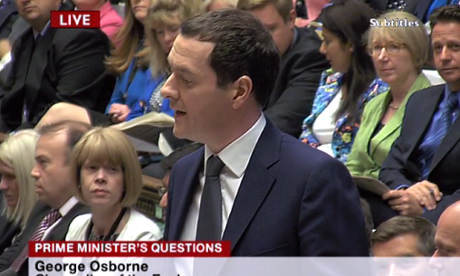
PMQs - Verdict: Some of the commentary before PMQs billed this as our chance to determine whether George Osborne would be up to the job of being prime minister. That’s not the best way of framing it, because Osborne has been a successful (at least, in his terms) chancellor for five years, and he is often the person David Cameron relies on most at PMQs for advice about what to say, and so there was never really much doubt about whether he is capable of standing in for the prime minister. He is, and he showed it today.
That said, he wasn’t great. In at least two places, he misjudged it, and struck the wrong tone. The joke about Hilary Benn and Bennites may have sounded fine in rehearsal, but when Benn opened with a serious, non-partisan question about Islamic State, he should have realised that the gag was inappropriate, and dropped it. Equally, when Jess Phillips asked about whether women in refuges would lose housing benefit, he should have stuck to his (semi-informative) answer, before launching into a broader rant about Labour’s stance on welfare reforms.
But these were not huge mistakes (although they do, perhaps, illustrate quite how polished David Cameron is at all this). Overall, Osborne was fine. He was helped by the fact that he had some news to announce too. He said the government might cap the amount pension firms can charge for withdrawal of money, and he had a go at the Chilcot inquiry for taking too long to publish its report.
Benn was perfectly good as well. A former communities secretary, who now speaks on foreign affairs, he asked about radicalisation, a policy area that straddles both those portfolios, and he sounded authoritative and sensible. It helped that he was not trying to score too many political points.
So, if this was an audition, Osborne passed.
And why not extend the idea more widely? As I was monitoring Twitter during PMQs, the thing I saw was a retweet of this, from Labour MP Ian Austin.
Here's an idea: Why not put candidates for Labour leader up against Cameron at PMQs? Give them each a week so public can see how they get on
— Ian Austin (@IanAustinMP) June 14, 2015
Sadly, though, it is probably not a runner. On the Daily Politics, when it was pointed out that this might mean Jeremy Corbyn speaking for the party in the Commons, Emma Reynolds, the shadow communities secretary, said it was probably best to let Harriet Harman carry on leading at PMQs.
Updated
Sir Gerald Howarth, a Conservative, praises Osborne for his long-term economic plan. He urges Osborne to spend 2% of GDP on defence. Defence of the realm should be the number one priority of the government, he says.
Osborne says the government will set out its plans at the spending review.
Today is the 75th anniversary of the sinking of RMS Lancastria in the second world war, he says. It caused the biggest loss of life in a British sinking ever, and it was kept quiet during the war, he says. He says we should remember the victims today.
And that’s it.
I’ll post a verdict shortly.
Updated
Labour’s Jim Dowd asks about the way writers are losing out from the calculation of public lending right because so many libraries are run by volunteers.
Osborne says he is happy to look at this issue.
Osborne says, after 32 minutes, there has been not a single question from Labour on jobs.
Osborne says tackling the problem of the radicalisation of young people is not something that will be solved easily, or perhaps even in this parliament. It requires parties to work together.
Labour’s Judith Cummins asks what the government is doing to tackle knife crimes in schools.
Osborne says teachers have been given powers to search bags. But if more can be done in the light of the lessons learnt from the attack on a teacher in Bradford, it will be done.
Andrew Tyrie, a Conservative, says today’s election for select committee chairs are a success for parliament as a whole. (There is cheering, because Tyrie has been re-elected unopposed as chair of the Treasury committee.) Will David Cameron appear before the liaison committee more than three times a year?
Osborne says he will pass the message on.
Labour’s Jess Phillips asks for an assurance that women living in refugees will not be included in housing benefit cuts.
Osborne says the government made it clear, when it published its housing benefit plans, that vulnerable people, like abused women, would be protected.
But Britain needs to curb welfare spending, he says.
The Green’s Caroline Lucas says there is a mass climate change lobby at Westminster today. Should the parliamentary pension fund divest from fossil fuels?
Osborne says what happens to that pension fund is “way above my pay grade”. But Britain will play its full part in setting climate change targets at the Paris talks later this year. It should be done in the cheapest possible way for consumers.
Labour’s Geraint Davies asks if waste water from fracking will be properly treated so it is safe to drink again.
Osborne says proper standards will apply. But we should pursue fracking, he says. He does not want to be part of a country that sees economic activity happening elsewhere.
Richard Harrington, a Conservative, asks about apprenticeships.
Osborne says Harrington is the apprenticeship adviser to the prime minister. It’s an important job, he says.
Labour’s David Lammy says the number of reported rapes has risen by 68% in the last 10 years in London. Will the government give the police more resources?
Osborne says the police are focusing more on these heinous crimes. He is prepared to consider extra requests for resources.
The SNP’s Angus Robertson asks if it is true that the Chilcot report has been delayed until next year.
Osborne says the Chilcot inquiry is independent. But he says people are running out of patience.
Robertson says Osborne voted for the war. Does he feel he has no moral or political responsibility to get to the bottom of what happened? And what is he going to do about it?
Osborne says he voted for the inquiry. Chilcot will have heard the views of the Commons. The inquiry is independent. “But I think it should get on with it,” he says.
-
Osborne says urges John Chilcot to speed up the publication of his Iraq inquiry report.
Osborne says unemployment is down again, employment is up, and wages are growing faster than before the great recession.
Benn asks what expectations the government has for talks about refugees in Geneva.
Osborne says Britain can be proud of its aid spending.
Benn says the deployment of HMS Buwark is under active review. Will the government continue to keep it in the Mediterranean saving the lives of refugees.
Osborne says essential maintenance has to be carried out, but Britain will continue to play its part in the search and rescue mission. Rescue operations are essential. But you have to stop people wanting to come to Europe, he says.
Benn asks if training is being provided to bodies that need to apply these counter-terrorism moves.
Yes, says Osborne, it is. He says he hopes Labour will support the extremism bill.
Benn says Isis (which he calls Isil) is the common enemy. Will the government encourage countries in the region to cooperate against it.
Osborne says the government is playing a leading role in this. There have been reports in recent days that leading figures in Isis have been killed. In Syria Britain supports the moderate opposition.
Hilary Benn congratulates Osborne on being first secretary of state. He asks what the government is doing to stop young people travelling abroad to join Islamic State (Isis).
Osborne congratulates Benn on speaking for his party. His father would be proud, he says. He says the Tories are glad there is no Benn in the Labour leadership contest, but there is a Bennite.
He says people will be very concerned about young people going to Syria and Iraq. The intelligence services need more powers, he says.
Benn says the intelligence and security committee said counter-terrorism programmes were not working. Why?
Osborne says that under the Labour there was a confusion between community cohesion programmes and counter-terrorism programmes. There is now a new duty on universities to tackle extremism.
Nigel Huddleston, a Conservative, says the government has given freedom to pensioners to spend their money. Will Osborne make sure the industry gives people access to their money?
Osborne says some firms are not doing their part. The government is considering a cap on charges. The Financial Conduct Authority has been asked to investigate.
-
Osborne says government may cap amount pension firms can charge for withdrawal of money.
Labour’s Heidi Alexander says the construction of socially-rented homes has fallen to a 20-year low. But more landlords are getting housing benefit. Does George Osborne understand the connection?
Osborne says the government built more council housing in the last five years than Labour did in 13 years. He says the economic plan is working.
Osborne at PMQs
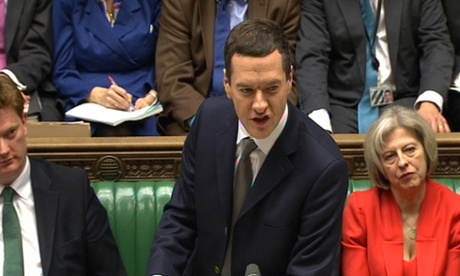
George Osborne is about to take PMQs.
Angela Eagle and Ben Bradshaw also on Labour deputy leadership ballot, Umunna says
According to Chuka Umunna, Angela Eagle and Ben Bradshaw are on the ballot too.
All remaining @UKLabour deputy leadership candidates are now on the ballot after @rushanaraali's withdrawal - big thanks to @rushanaraali!
— Chuka Umunna (@ChukaUmunna) June 17, 2015
Updated
Ivan Lewis nominated Stella Creasy for the Labour leadership.
Nominated @stellacreasy to ensure she's on ballot. Impossible to justify denying members chance to see her ability to bring politics alive.
— Ivan Lewis (@IvanLewis_MP) June 17, 2015
And so did David Lammy.
David Lammy is Creasy's 34th nomination.
— Stephen Bush (@stephenkb) June 17, 2015
Stella Creasy gets on to the ballot for Labour's deputy leader
Stella Creasy is on the ballot for the Labour deputy leadership.
Stella Creasy is on the ballot with 35.
— Stephen Bush (@stephenkb) June 17, 2015
Updated
Chuka Umumna has just nominated Stella Creasy.
Just nominated @stellacreasy for deputy leader after @RushanaraAli withdrew. @UKLabour needs as many candidates on the ballot as poss
— Chuka Umunna (@ChukaUmunna) June 17, 2015
My colleague Patrick Wintour predicts that Creasy will make it.
Creasey will now go over the threshold and possible Eagle and Bradshaw now that Ali withdraws. This is about the Labour deputy leader race.
— Patrick Wintour (@patrickwintour) June 17, 2015
Rushanara Ali pulls out. Chuka Umunna has pulled out. Barring a Rachel Dolezal move from Tom Watson, it's an all-white field.
— Stephen Bush (@stephenkb) June 17, 2015
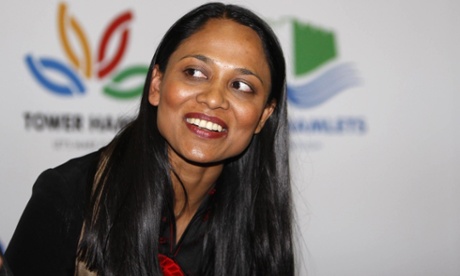
Rushanara Ali has withdrawn from the Labour leadership contest, Stephen Bush reports. That means her 24 votes are up for grabs.
Rushanara Ali has withdrawn!
— Stephen Bush (@stephenkb) June 17, 2015
Updated
Here is the top line from the Number 10 lobby briefing.
Downing Street spokesperson says David Cameron is "stepping up" preparations for a possible Greek exit from the euro zone
— Sky News Newsdesk (@SkyNewsBreak) June 17, 2015
Angela Eagle has got another nomination.
Daniel Zeichner has nominated Angela Eagle. Creasy 30, Eagle 26, Bradshaw 25, Ali 24. http://t.co/PgnUYqvgjm
— Stephen Bush (@stephenkb) June 17, 2015
Unemployment figures by region
Here are the unemployment figures by region.
Region - total unemployed - change on previous quarter - rate as percentage
North East - 95,000 - down 5,000 - 7.4%
North West - 203,000 - down 16,000 - 5.7%
Yorkshire/Humber - 185,000 - up 24,000 - 6.9%
East Midlands - 115,000 - down 2,000 - 4.9%
West Midlands - 177,000 - down 5,000 - 6.4%
East of England - 136,000 - down 22,000 - 4.4%
London - 286,000 - up 2,000 - 6.3%
South East - 189,000 - down 20,000 - 4.1%
South West - 117,000 - down 5,000 - 4.2%
Wales - 95,000 - up 3,000 - 6.4%
Scotland - 163,000 - up 1,000 - 5.9%
Northern Ireland - 54,000 - up 2,000 - 6.1%
Here is some Twitter reaction to the earnings figures.
From Newsnight’s economics correspondent Duncan Weldon
Employment rate plateauing at record highs but shift within that away from self employment/part-time to regular employment & full-time work.
— Duncan Weldon (@DuncanWeldon) June 17, 2015
This shift to more full time employee jobs & away from involuntary part-time & self employment is probably pushing average wages up.
— Duncan Weldon (@DuncanWeldon) June 17, 2015
At the moment the UK has decent real wage growth & still seems to be lacking decent productivity growth. That can't last forever.
— Duncan Weldon (@DuncanWeldon) June 17, 2015
From the Sunday Times’s economics editor, David Smith
Private sector driving pay growth - up 3.3%. Public sector 0.3%, or 1.3% excluding publicly-owned banks: http://t.co/dCrHcYiZbJ
— David Smith (@dsmitheconomics) June 17, 2015
From the Financial Times’s economics editor, Chris Giles
The divergence will make public spending cuts more difficult https://t.co/AoKfUyW1FD
— Chris Giles (@ChrisGiles_) June 17, 2015
Here is Diane Abbott tweeting about nominating Stella Creasy.
Just nominated Stella Creasy for deputy leader. Important to have the widest possible debate pic.twitter.com/Q9wHry3DJR
— Diane Abbott (@HackneyAbbott) June 17, 2015
Stella Creasy has got two more nominations, according to the New Statesman’s Stephen Bush. She is now just five MPs short of getting her name on the ballot.
Madeleine Moon is backing Stella Creasy for deputy. She requires a further six names. #labourleadership
— Stephen Bush (@stephenkb) June 17, 2015
My MP @HackneyAbbott is nominating Stella Creasy. She now needs just five names. http://t.co/PgnUYqvgjm
— Stephen Bush (@stephenkb) June 17, 2015
Here is Frances O’Grady, the TUC general secretary, on the unemployment and earnings figures.
Although today’s improvements are welcome, there is still a long way to go for youth unemployment and underemployment. Real wage growth remains too reliant on low inflation, and even if prices remain exceptionally low we are facing a lost decade on pay growth.
The weaknesses in the labour market that remain behind the headlines should not be swept under the carpet. The government must set clear goals this parliament to bring down youth unemployment and underemployment, and ensure that everyone who needs work has access to a secure and fairly paid job.
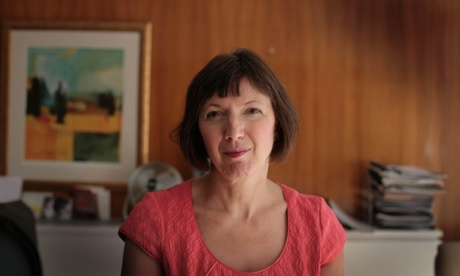
There’s no news yet as to whether Stella Creasy will make the Labour deputy leadership ballot, although, on Twitter, her supporters are speaking out.
This is from Dan Jarvis MP.
There will be a lot of very unhappy #Labour members today if @stellacreasy is not on Dep Ldr ballot #stella4deputy pic.twitter.com/Habyz3rufC
— Dan Jarvis (@DanJarvisMP) June 17, 2015
And here are two journalists from opposite ends of the Labour spectrum.
Ah come on Labour MPs. It'll just look silly if @stellacreasy isn't on the ballot paper
— Owen Jones (@OwenJones84) June 17, 2015
To be able to get @jeremycorbyn on the leadership ballot but not @stellacreasy on the dep leadership would say all the wrong things.
— David Aaronovitch (@DAaronovitch) June 17, 2015
The Resolution Foundation, the low-pay thinktank, has put out a news release saying that ultra-low inflation is responsible for the wage growth we are seeing today and that this may not last long. Here’s an extract.
Strengthening pay and ultra-low inflation mean that real wages are now rising more quickly in real-terms than before the financial crisis. But this rebound may prove short-lived as inflation begins to pick up, the Resolution Foundation said today, in response to the latest ONS labour market figures.
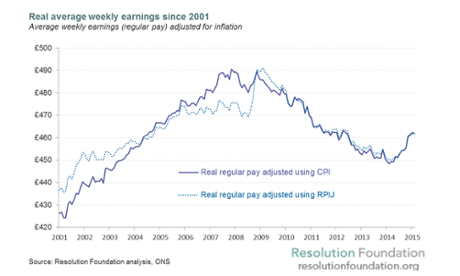
Year-on-year growth in regular pay of 2.7 per cent, combined with inflation of -0.1 per cent, means real earnings growth increased to 2.8 per cent in the three months to April 2015. Since August 2002 this rate of growth has only been exceeded once – in September 2007. Real growth averaged 2.2 per cent over the pre-crisis (2001-2007) period.
Underpinning this rebound is strong pay performance in parts of the private sector (3.3 per cent real growth), with growth of 4 per cent in the low paying retail and hospitality sector and 4 per cent in construction. In contrast, pay was up just 1.1 per cent in manufacturing and 1.1 per cent in the public sector.
Real wage growth has built strongly over the course of 2015, but the Foundation expects this momentum to ease off in the coming months as inflation edges up, reflecting the fact that nominal pay growth remains well below its pre-crisis level. According to the Bank of England’s last forecast, real wage growth will have fallen back below the pre-crash norm by the end of the year.
It also points out that average earnings remain around £30 a week below their pre-crisis peak.
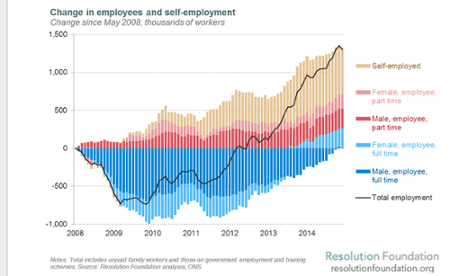
And it has produced this chart too, showing how the labour market has changed since 2008.
Here is Stephen Timms, Labour’s acting shadow work and pensions secretary (because Rachel Reeves is on maternity leave) on the unemployment figures.
The fall in overall unemployment is welcome, but with more than 740,000 young people unemployed it’s clear the government needs to do far more to give young people the chance to earn a living.
Ministers are failing to ensure young people get the best start in life. Last year the number of under 25-year-olds starting an apprenticeship fell. It’s time for ministers to give young people the world-class apprenticeships and training they need to succeed in life.
Private sector workforce 2.4m bigger than in 2010
In its news release, the Department for Work and Pensions has highlighted other “good news” in the employment figures, beyond the fall in unemployment and the increase in wage growth. (See 9.53am.) Here are some of the points they highlight.
- There are now 2.4m more people working in the private sector than in 2010.
- Annual private sector pay growth is now up to 3.3%.
- The claimant count, the number of people claiming benefits because they are unemployed, is down to 2.3% - its lowest level since 1975.
- Some 85% of the increase in employment in the last year has been in full-time work.
-
Youth unemployment, excluding full-time students, is lower than it was before the recession.
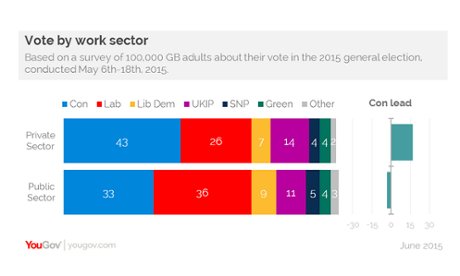
All this will be very good news for George Osborne when he stands in at the despatch box at 12pm. As a political strategist, he will be particularly interested in the first figure (about the increase in the size of the private sector workforce). As Peter Kellner pointed out in a very useful election analysis, private sector workers are far more likely to vote Tory than public sector workers.
Here is James Sproule, chief economist at the Institute of Directors, on the unemployment and wages figures. (See 9.53am.)
With real wages growing and unemployment continuing to fall, today’s figures indicate the UK economy is well along the road of recovery. Falling energy prices and low inflation have eased the pressure on companies and boosted their balance sheets. Many are now able to pass these benefits on to their staff through pay rises and bonuses.
During the downturn, businesses made the difficult decision to preserve jobs and asked that employees forsake pay rises. The strength of the recovery proves this was the right choice. Encouragingly, pay rises are being handed out in a manner which is both sustainable and in line with long-term productivity trends. As the labour market continues to tighten and competition for jobs heats up, real wage growth should remain entrenched for some time to come.
Nigel Farage, the Ukip leader, told LBC this morning that, although he was “prepared” to lead the No (to staying in the EU) campaign in the referendum, he thought someone from outside politics should take that role.
The role of Ukip, the role of myself will be important. That’s not saying that I have to take the lead. I would be prepared to of course. But I suspect what we will see is somebody coming from completely outside of normal politics, somebody from the world of business or entertainment that hasn’t got any political baggage at all. I think someone like that may well emerge.

Wage growth highest in real terms since October 2007
Here is the start of the Press Association story about the unemployment figures.
Wage rises have reached their highest rate for nearly four years, official figures showed today.
Total pay climbed by 2.7% compared with a year earlier in the three months to April, the Office for National Statistics (ONS) said.
It was the biggest rise since August 2011, and up from a revised 2.3% in the three months to March.
Ultra-low inflation - which fell to minus 0.1% in April - means the surge in pay is worth more in real terms.
The growth in real wages for the period, at 2.8%, is the highest since October 2007.
Meanwhile, the ONS figures showed unemployment fell by 43,000 to 1.81 million in the three months to April compared to the prior three months while the jobless rate was down to 5.5%, from 5.7%.
The unemployment figure was last lower in the three months to August 2008.
The number of people in work rose to 31.05m, 114,000 more than in the three months to January.
Numbers claiming unemployment-related benefits in May - under a new measure including both those on Jobseeker’s Allowance and some of those receiving Universal Credit - fell 6,500 to 791,800.
This was the smallest fall since February 2013.
ONS statistician Nick Palmer said: “Total pay is now up 2.7% on the year, the sharpest rate of growth since summer 2011.
“Meanwhile employment continues to rise and unemployment to fall, maintaining the general trend of the last three and a half years.”
Unemployment down to 5.5%
Here are the headline unemployment figures.
- Unemployment fell by 43,000 between February and April to 1.8m. That is 5.5%, down from 5.7% in the previous three months, and 6.6% a year earlier.
- The number of people claiming unemployment-related benefits last month fell by 6,500 to 791,800.
- Average earnings increased by 2.7% in the year to April, 0.4% up on the previous month.
Here is the Office for National Statistics summary. And here is the ONS statistical bulletin, with the full details (pdf).
According to Paddy Power, 90% of the money bet on the Labour deputy leadership in the last week and a half has been on Tom Watson. He is the 4/5 favourite, behind Carline Flint on 7/2, Stella Creasy on 4/1, and Angela Eagle and Rushanara Ali on 10/1.
But, according to the Tory MP Chris Heaton-Harris, there is also a campaign to keep Creasy off the ballot. He tweeted this yesterday.
Am watching political machines at work. Govt 1 on the EU Ref Bill, Labour one trying to stop @stellacreasy getting on the Dep Leader ballot.
— Chris Heaton-Harris (@chhcalling) June 16, 2015
I guess this counts as a celebrity endorsement for Stella Creasy.
MPs still deciding who to vote for as Labour's new deputy - @stellacreasy looks like the future to me. Foe of Wonga, grassroots campaigner.
— Caitlin Moran (@caitlinmoran) June 17, 2015
Online, the “get Creasy on the ballot” campaign seems reasonably active.
29 MPs still to nominate, a few hours left. Please let these Labour MPs know you want @stellacreasy on the ballot pic.twitter.com/VeB1llh6T2
— Steve Doran (@girlsteve) June 17, 2015
We’re going to see George Osborne take PMQs for the first time today. In a very good Guardian column, Rafael Behr has an elegant explanation.
In the hierarchy of people who matter to David Cameron these days, the entire Labour party sits well below the prime minister of Luxembourg. Since renegotiation of Britain’s EU membership will require unanimous support from 27 other member states, the hostility of a single head of government could sink the whole plan. So instead of taking questions in the House of Commons tomorrow, Cameron is courting Italy’s prime minister Matteo Renzi in the morning, followed by dinner with Xavier Bettel of Luxembourg.
As first secretary of state, as well as chancellor, which makes him deputy prime minister in all but name, Osborne is Cameron’s stand-in. It will be worth watching closely because taking PMQs regularly is now clearly party of Osborne’s long-term career planning. Labour are putting up Hilary Benn to oppose him.
Before that, we’ve got a mini race to see whether any more candidates can make it onto the ballot for the Labour deputy leadership. Tom Watson and Caroline Flint already have the nominations they need, but Stella Creasy, Angela Eagle, Rushanara Ali and Ben Bradshaw are all short of the 35 names they need. Creasy seems to have the best chance; she is is on 28, making her seven short. According to the New Statesman’s list, Eagle currently has 25 backers, Ali 24 and Bradshaw 21.
Tonight we’ve got the first televised hustings for the Labour leadership. It starts at 7pm. I will be covering that on a separate live blog, which I will launch at around 6pm.
Here is the agenda for the day.
9.30am: Unemployment figures are released.
10.50am: Nigel Farage, the Ukip leader, and William Dartmouth, the Ukip MEP, launch a pamphlet called “The Truth about Trade Beyond the EU.”
12pm: Nominations close for the Labour deputy leadership.
12pm: George Osborne faces Hilary Benn at PMQs.
Cameron will be in Milan, meeting his Italian prime minister Matteo Renzi, before going to Luxembourg to meet the prime minister, Xavier Bettel.
As usual I will be covering the breaking political news as it happens, as well as bringing you the best reaction, comment and analysis from the web. I will post a summary at lunchtime and another in the afternoon.
If you want to follow me on Twitter, I’m on @AndrewSparrow