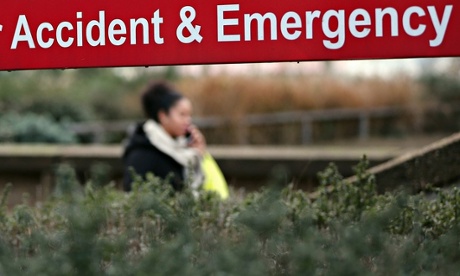
The number of extra people seeking accident and emergency care has increased almost 10-fold under the coalition because the government has made major mistakes with the NHS, Labour has said.
The party will reveal on Wednesday that a House of Commons library analysis shows that while total A&E attendances in England rose by 64,000 during its last four years in power, arrivals at emergency departments increased by 595,000 people during the coalition’s’s first four years in office – 930% more than under Labour.
In a Commons debate on the growing pressure on A&E units, Labour will blame the rise under the coalition on cuts to social care services, the removal of the right to see a GP within 48 hours and the closure of NHS walk-in centres.
According to the Commons library the number of patients going to an A&E unit at a hospital increased from 13.554m in 2005-06 to 13.618m in 2009-10, a rise of 64,000. Attendances rose much faster under the coalition, which took power in May 2010, reaching 14.213m in 2013-14 – 595,000 more than the 13.618m in Labour’s last year in government.
Jeremy Hunt, the health secretary, recently said that the ageing population and changing consumer behaviour, especially among young people, were drivers of the surge in recent years.
But Andy Burnham, shadow health secretary, will claim Hunt is overlooking factors related directly to decisions by the government. He will say an extra 289,551 patients a year turn up at A&E compared with 2011 because they cannot get an appointment with a GP and that at least 98,000 patients aged over 90 go there because they have lost social care support as a result of cuts in local council budgets.
An NHS England spokeswoman said: “This winter our local health services are responding to far and away the highest-ever number of ambulance and NHS 111 calls, A&E attendances and emergency admissions in the NHS’s history.”
Even though an extra £700m has been given to the NHS to help it deal with winter pressures, “it’s crystal clear we need a fundamental redesign of the urgent care ‘front door’ – A&E, GPs, 999, 111, out of hours, community and social care services – as part of the broader programme of care transformation set out in the NHS Five Year Forward View”, she added.
The Department of Health said its extra investment in the NHS had paid for extra doctors, nurses, beds and treatment, and that it was transforming out-of-hospital care.
Other figures reveal that hundreds of thousands of vulnerable, often isolated older people have lost access to key services – such as meals on wheels – as social care has been pared back under the coalition.
Only half of those who need help to wash or get into their bath now receive it, while one in three who need assistance in using the toilet are denied it, according to evidence collated by the charity Age UK from official sources.
Similarly, 80% of those who need help to take medication do not get it, while more than two-thirds of those who struggle to eat on their own – 160,000 people – do not receive such assistance.
The number of people receiving care at home has fallen by 32% from 542,965 in 2010-11 to 370,630 in 2013-14, while numbers receiving meals on wheels have plummeted from 81,460 to 29,560 – down 64%.
Caroline Abrahams, Age UK’s charity director, said its analysis “lays bare the fact that our state-funded social care system is in calamitous, quite rapid decline.
“The more preventive services like meals on wheels and daycare are being especially hard hit, leaving the system increasingly the preserve of older people in the most acute need, storing up big problems for the future.”
Hundreds of thousands of older people are “being left high and dry” as a result of Whitehall cuts to town hall budgets across England, Abrahams added.
A Department of Health spokesperson said: “Like healthcare systems around the world, the NHS is busier than ever. That’s why we have given almost £1bn this year for almost 800 more doctors, 4,700 more nurses, 6,400 more beds and treatment for an extra 100,000 patients, and why we are transforming out of hospital care.”