Summary
- Jeremy Corbyn has been elected leader of the British Labour party, in a stunning first-round victory that dwarfed even the mandate for Tony Blair in 1994. As Rowena Mason reports, Corbyn won with nearly 59.5% of first-preference votes, beating rivals Andy Burnham, who trailed on 19%, and Yvette Cooper who received 17%. The “Blairite” candidate Liz Kendall came last on 4.5%. Minutes after his victory, Corbyn said the message is that people are “fed up with the injustice and the inequality” of Britain. “The media and many of us, simply didn’t understand the views of young people in our country. They were turned off by the way politics was being conducted. We have to and must change that. The fightback gathers speed and gathers pace,” he said. The north London MP is one of the most unexpected winners of the party leadership in its history, after persuading Labour members and supporters that the party needed to draw a line under the New Labour era of Blair and Gordon Brown. Corbyn is now working on put together a shadow cabinet and frontbench team. He has said he wants to make it “as inclusive as possible”, but some of the party’s most high-profile figures have said they will not serve under him.
That’s all from me for today.
I will be blogging again tomorrow, covering Jeremy Corbyn’s first full day as Labour leader.
Thanks for the comments.
Here’s a Guardian video of Billy Bragg singing the Red Flag with Jeremy Corbyn alongside him at the Parliament Square rally.
Here’s an extract from Tom’s piece.
Even harder for the Corbynistas is to understand why it is so many MPs are so terrified. Maybe some of them are, as the far left always says, self-serving careerists without a principled bone in their body. Most of them, however, are not.
They are simply people who were tasked with knocking on doors in May. In doing that, they found that too many voters were not prepared to trust Labour with their taxes. They see no reason to believe that Corbyn’s oppositionist brand of politics is going to win the missing trust back.
Corbyn won the votes of 250,000 people. In its way, that is an extraordinary achievement. But in May, after years of stagnation and cuts, David Cameron notched up just over 11.25 million. Unless Corbyn can now turn some of his talk away from his own band of loyalists, to address the concerns of this much bigger group, then today’s victory will soon enough be followed by defenestration or defeat.
Jeremy Corbyn has been tweeting.
To everyone who wants to see a fairer Britain I welcome you to join our movement, if you haven't already https://t.co/yGIJcC4mdt
— Jeremy Corbyn MP (@jeremycorbyn) September 12, 2015
I joined thousands in Parliament Sq. today who want a government that can & will respond properly to refugee crisis pic.twitter.com/ltsLu1vOO4
— Jeremy Corbyn MP (@jeremycorbyn) September 12, 2015
Here is Stefan Rousseau, the Press Association’s chief political photographer’s, picture of the day.
Photo du Jour: Jeremy Corbyn becomes leader of the Labour Party. By Stefan Rousseau/PA pic.twitter.com/AvaNZ5gPpi
— Stefan Rousseau (@StefanRousseau) September 12, 2015
Corbyn's speech to the pro-refugee rally
This is what Jeremy Corbyn said when he addressed the pro-refugees rally in Parliament Square. Addressing the government, he said:
Recognise your obligations in law, that would be good. Recognise your obligations to help people which you’re required to do by law, that would be good.
But above all, open your hearts and open your minds and open your attitude towards supporting people who are desperate, who need somewhere safe to live, want to contribute to our society, and are human beings just like all of us. Together in peace, together in justice, together in humanity, that surely must be our way forward.
Explaining why he was making the appearance just three and a half hours after being elected, he said: “I do that because we are all humans, we all have a sense of decency, and humanity and reaching out to others.
He also said that those trying to flee to the UK are “victims of war, victims of environmental degradation, victims of poverty and victims of humans rights abuses”. And he went on:
Tragically wars don’t end when the last bullet is fired, or the last bomb is dropped. The mourning and the loss of all soldiers of all uniforms goes on. The mourning and the loss of families that lost loved ones because of bombardments and fighting, that goes on. The refugees move on and on, and there are whole generations of refugees around the world that are victims of various wars.
Surely, surely, surely, our objective ought to be to find peaceful solutions to the problems of this world, to spend our resources on helping people, not hindering people and to try and bring about that world of decency, humans rights and justice.

The Economist’s Jeremy Cliffe has summed up what the election of Jeremy Corbyn as Labour leader means in 20 tweets. They’re all collected here, and they’re well worth reading.
Corbyn confirms he wants to let other Labour MPs stand in for him at PMQs sometimes
Today the Sun said that Jeremy Corbyn was planning to let other Labour MPs stand in for him at PMQs.
Corbyn himself has now confirmed that he does plan to do this sometimes in an interview with Huffington Post. He said:
I want prime minister’s Question Time to be less theatre, more fact, less theatrical, more understandable. I think it’s very exciting for political obsessives, it’s utterly boring for most of the population, who think it’s an utter irrelevance,” he said.
I will be trying to conduct my part in prime minister’s Question Time on the basis of the questions and also share out a lot more stuff in within the parliamentary Labour party.
I’ll obviously be there and do all the things that I’m asked to do. But we’ve got a lot of very talented people within the parliamentary Labour party. They can call ask questions, they can all do things, let’s share it all out a bit. It won’t all be me everywhere all the time.
It’s a whole party, and a whole movement. We are about bringing people on, not stopping people.

Updated
Corbyn says he hopes Labour will “come together” around his anti-Trident position
Here’s a YouTube clip of Jeremy Corbyn talking to Channel 4 News’ Jon Snow.
Corbyn said he wanted to make his shadow cabinet “as broad as possible and as inclusive as possible”.
And he address the Trident question. (See 12.39pm). He replied:
My views on Trident are very well known. There has to be a discussion about that, and I’m hoping that the party will come together around this issue. We don’t need nuclear weapons. We need to keep those people who make them in good jobs so we have defence diversification. But we need to fulfil our obligations under the non-proliferation treaty.
-
Corbyn says he hopes Labour will “come together” around his anti-Trident position.
According to BuzzFeed’s Jim Waterson, this how the Tories are attacking Jeremy Corbyn in material sent to party supporters.
This is the email sent by the Conservatives to their mailing list. Brutal. pic.twitter.com/yDSwKcaC4C
— Jim Waterson (@jimwaterson) September 12, 2015
What focus groups say about Jeremy Corbyn
Jeremy Corbyn splits opinion among swing voters who are just as likely to see him as “genuine and compassionate” as “dangerous and untrustworthy”, according to focus groups in five constituencies.
The panels of voters in key battleground seats were picked because they were undecided about which party to voter for before the last election by pollsters at Britain Thinks. More recently, they were asked again for their views on the Labour leadership election, with Corbyn appealing most to past Labour and SNP voters but proving a turn-off to those who have voted for the Conservatives and Liberal Democrats.
The study found that he is associated with the word “socialist” and “old-fashioned” politics and values. The biggest hopes for a Labour party led by Corbyn were equality and fairness, though others feared what it might mean for the stability of the Labour party, and worried about his ability to stand up to the Conservatives.
The panel of swing voters said that, of all the candidates, they would have been marginally most likely to vote for Labour with Andy Burnham in charge. Since the general election, their overall satisfaction with the Conservatives was 41%, compared with overall satisfaction with Labour at 7%.
The main concern of voters was immigration, which has shot to the top of the list since the refugee crises across Europe. It found that while there is still concern about public sector cuts and more austerity, public services including the NHS have slipped down the
agenda for most of the swing voters. The study involved 12 swing voters in each of the five constituencies: Taunton Deane, South Thanet, Dewsbury, Ealing and Acton South and Glasgow East.
Updated
Jeremy Corbyn has been speaking at the rally in favour of refugees.
Jeremy Corbyn arrives for his first speaking engagement - a huge refugee protest rally outside Parliament's gates
— Jack Blanchard (@Jack_Blanchard_) September 12, 2015
Corbyn: "I've never seen Parliament Square look so beautiful."
— Jack Blanchard (@Jack_Blanchard_) September 12, 2015
Corbyn immediately renews his attack on 'the media'. Becoming a theme
— Jack Blanchard (@Jack_Blanchard_) September 12, 2015
Corbyn: "There is a popular uprising in favour of decency on our society."
— Jack Blanchard (@Jack_Blanchard_) September 12, 2015

Updated
Over in Greece, Syriza, the party that rose to power on a wave of anti-austerity sentiment, has just hailed the new labour leader’s landslide win as a “historic election” victory, says our correspondent Helena Smith in Athens.
“Syriza salutes today’s historic election of Jeremy Corbyn to the leadership of Britain’s Labour party,” the left-wing party said in a statement adding it would significantly strengthen the “pan-European front against austerity.”
“It sends a message of hope to the people of Europe,” the party insisted in what was immediately interpreted as a clear hint to wavering Greek voters ahead of next week’s general election.
Corbyn’s “rich [corpus] of action” not only included his campaign work “against the war, racism and austerity” but “diverse solidarity initiatives in Greece”, including actively supporting Syriza’s pre-electoral campaign in 2012, when the radicals were catapulted from the margins of Greek political life to the centre as the main opposition party.
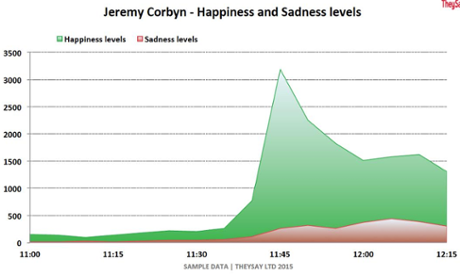
Twitter likes Jeremy Corbyn. TheySay, a company that does social media sentiment analysis, says that it has analysed more than 270,000 tweets about Corbyn today and that 90% of them are positive.
Syriza has congratulated Jeremy Corbyn.
Ο ΣΥΡΙΖΑ χαιρετίζει τη σημερινή ιστορική εκλογή του Τζέρεμι Κόρμπιν στην ηγεσία του Εργατικού Κόμματος Βρετανίας από τον πρώτο γύρο των ψηφοφοριών”, αναφέρει το μήνυμα του ΣΥΡΙΖΑ και συνεχίζει.
According to Google Translate, Syriza has particularly praised Corbyn’s record fighting war, austerity and racism.
Rupert Murdoch has pronounced. He’s not a Jeremy Corbyn fan, obviously.
Hard left Corbyn wins in landslide, goes on TV singing "Red Flag". How did Cameron get this lucky? Hope he doesn't slack off.
— Rupert Murdoch (@rupertmurdoch) September 12, 2015

Updated
Is Corbyn really unelectable? - Analysis
The controversy in Labour circles about the election of Jeremy Corbyn centres on the issue of whether or not he is electable. While there are divisions about policy, all Labour members are signed up to Corbyn’s broad goals of social justice, equality and peace. But there is a profound disagreement about whether or not Corbyn can get the party into government.
People on both sides have very entrenched views on this. There is no simple way of resolving the question, but here are 10 reflections that might (hopefully) shed some light on what has become the key question in British politics.
1 - “Leftwing” is a catch-all label that covers many aspects of Jeremy Corbyn’s politics - some of which are more popular/unpopular than others. Corbyn is happy to call himself a socialist, and no one has objected to him being called “leftwing”, but it is not always a helpful phrase and his supporters have objected to him being described as “far left” because that implies that he is extreme, and at the margins of public opinion. In some respects he probably is. But in others, he isn’t. His support for expansionary economic policies has more mainstream economic support than is commonly assumed and some of his ideas, like nationalising the railways, a policy often dismissed as irresponsible lefty wishful thinking, have overwhelming popular support.
2 - “Leftwingers” can win - but it does not happen often. The Blairite rule that Labour loses general elections when it heads left has generally been true in recent years but Ken Livingstone offers Corbyn some hope, as he said himself this morning. (See 9.27am.) Dismissed as being on the lunatic fringe, he won two elections as London mayor and ran the capital very effectively. (It is interesting to speculate on what would have happened if Corbyn had stood for the mayoral nomination. While his chances of becoming prime minister may seem remote, given the support he is attracting now, if he had entered that contest he would probably be a dead cert to replace Boris Johnson next year.)
3 - But Corbyn is ignoring what many people believe are the lessons of the general election. It would be wrong to say there is a consensus about why Labour lost the election, but there is quite a lot of evidence to suggest that a huge problem (in England and Wales at least) was the the voters did not support the party on the economy, on immigration and on welfare. For example, read the Feeling Blue report from James Morris, Labour’s pollster; the Reconnecting Labour report from Dan Jarvis MP; the review carried out by Jon Cruddas MP; and Lord Ashcroft’s Project Red Dawn report. The academic Matthew Goodwin made a similar point on Twitter yesterday.
1/2 Cameron to say Corbyn Lab "no longer represents working ppl" & "committed to more spending & borrowing", shows how easy Cons will...
— Matthew Goodwin (@GoodwinMJ) September 11, 2015
2/2 deal with Corbyn. Lab has big prob with both groups: econ disaffected w.class & majority who accept cuts/see Lab econ as part of problem
— Matthew Goodwin (@GoodwinMJ) September 11, 2015
Tim Bale, another academic, has said the face choicing political parties ultimately boils down to “a choice between ‘preference shaping’ (the heroic assumption that you can get voters to see things your way) and ‘preference accommodation’ (the assumption that you need to meet them halfway).” Corbyn’s victory can be seen as Labour putting a monumental bet on “preference shaping”. It can work but, as Bale has pointed out, it can fail too.
4 - A lot depends on how well a leader can change public opinion - and as yet there is little evidence that Corbyn will be a great persuader. He has, of course, had a remarkable election victory, but that does not seem to be because he has changed minds; as he has suggested himself in interviews, it is more because he became the outlet for voters totally fed up with the Labour establishment who found at last a candidate who represented their views. He has shown little interest in what a Labour leader might have to say to win over voters who don’t already agree with him. Indeed, his victory speech this morning was notable because contained almost nothing aimed at appealing to the classic, middle England “floating voter”.
5 - Corbyn’s alternative “expand the electorate” strategy may be flawed. Asked how he could win an election with his policies, Corbyn has highlighted the large number of votes Labour could win by mobilising a leftish coalition of people who either did not register or turn out in 2015, or who voted for other progressive parties because they found Labour uninspiring. It is true that there are plenty of votes in this pool. But a Fabian analysis looked at this strategy in some detail and concluded that the prospects of it providing a route to electoral victory were “bleak”.
6 - Party image matters too - and it remains to be seen whether Labour will enjoy a “Corbyn bounce”. The Tories under Michael Howard and Labour under Ed Miliband have both been in the situation where they have had individual policies that are popular, but where they have found it hard to capitalise on those because the party’s image overall is negative. Will having Corbyn as leader make people feel more positive about Labour generally? It is far too soon to know, but as yet there is no evidence that it will. There have been at least two state of the party polls conducted since Corbyn took the lead in the leadership race, and they have both shown it languishing well behind the Tories (on 31 points and 28 points respectively).
7 - On a personal level, voters may warm to Corbyn. The public probably has not yet formed a settled view on Jeremy Corbyn, but there are some aspects of his character people are likely to find very appearing. He is the antithesis of a career politician (in fact, it would be hard to find a politician less careerist), he doesn’t speak in politico-cliche about hard-working families and he is self-effacing, modest and frugal.
8 - But leaders have to be good at leading - and Corbyn’s leadership skills are almost entirely untested. He could turn out to be hopeless, or he could turn out to be surprisingly good. His executive experience may be limited to chairing Haringey council’s public works committee in the 1970s, but that is more executive experience than Tony Blair had when he became Labour leader and there are different models of effective leadership. Corbyn has said he wants to run a consensual administration (ie, more Attlee than Churchill), and perhaps he will do this effectively. But, equally, many of his colleagues think he will prove temperamentally unsuited to leadership (for reasons Andy McSmith set out here, in the Independent.)
9 - And it is hard (though not, of course, inconceivable) to see Corbyn as prime minister. Ultimately elections are about choosing a prime ministers, and even many Corbyn admirers find it hard to see him walking through the door of Downing Street. That may explain why the notion that he will only be a caretaker leader is so widespread. (In his excellent account of the Corbyn campaign today, my colleague Ewen MacAskill says that, if Corbyn was ever minded to think this way, he has changed during the campaign, and is now “in for the long haul”.)
10 - Everything could change, particularly if some crisis erupts, making all conventional assumptions redundant. The most obvious example would be some sort of economic catastrophe, that could lead to Corbyn-led Labour defying the pundits and taking power in the manner of Syriza in Greece. It does not seem probable but, equally, it is by no means unthinkable.
So, overall, is Corbyn really unelectable? Quite possibly, but no one can plausibly say yes or no to this question with 100% certainty, and ultimately this one is going to have to be resolved by the electorate.
(To be fair, it is also worth pointing out that there are also strong grounds for thinking that Corbyn’s three Labour leadership rivals would also have had considerable difficulties winning the next general election.)
Updated
At least two Tories are warning their party not to become cocky in the light of Jeremy Corbyn’s victory.
This is from Nick Hurd, a former minister.
Congrats to @jeremycorbyn on stunning victory .Caution my party against complacency. Cocky Tory always a bad look. #one nation
— Nick Hurd MP (@nickhurdmp) September 12, 2015
And this is from Daniel Hannan, the Tory MEP.
My final thought on the #labourleadership: there is now a real danger of Tory cockiness and complacency. http://t.co/OMEsIEi9ZS
— Daniel Hannan (@DanHannanMEP) September 12, 2015
Jeremy Corbyn is heading for the rally in London in support of refugees.
Here is some footage from my colleague Mark Rice-Oxley showing what it going on.
What do we want - refugees; when do we want them? Now pic.twitter.com/rmUVIEwEwm
— mark rice-oxley (@markriceoxley69) September 12, 2015
And still they come #tefugeewelcome pic.twitter.com/8CIp6lTs0m
— mark rice-oxley (@markriceoxley69) September 12, 2015
Matthew Doyle, a former adviser to Tony Blair and one of those running Liz Kendall’s campaign, has just told Sky News that he does not think Labour can win in 2020 under Jeremy Corbyn’s agenda.

Updated
Here is some more support for Jeremy Corbyn from Spain’s Podemos party. This is from Inigo Errejon, its political secretary and second in command after Pablo Iglesias. (See 12.48pm.)
The wave of change has arrived to the north of Europe. It is time to build an European Union for its people. With @jeremycorbyn, Podemos!
— Íñigo Errejón (@ierrejon) September 12, 2015
Jeremy Corbyn won’t be giving any broadcast interviews tomorrow, a Corbyn source has told my colleague Rowena Mason.
If you are looking for the full leadership election results, showing how many people voted for each candidate in which section (ie, members, registered supporters, affiliated supporters), they are here, on the Labour website.
My colleague Patrick Wintour has written a good analysis of what the results tell us about the Labour party. Here’s an extract.
There has been a huge increase in individual party membership, but the decline in trade union activity is happening possibly at a rate that will bring the future financial basis of the party into question.
It also opens doors for the coming Conservative attack that the Labour party itself, and not just its new leader is now a leftwing risk.
Labour officials had initially wanted to hide how each section of the Labour’s electoral system had voted but in an era of transparency were forced to backtrack.
Critics of this secrecy said it would be impossible to judge whether the new system introduced for the first time in this election had worked.
It has revealed three big truths:
- The way in which the new £3 registered supporters are a new phalanx in the party.
- It is now possible to see how few union political levy payers that are not party members are interested enough in Labour politics to vote for a new leader.
- The big shift of full party members to the left since 2010 leadership election where they voted for David Miliband.
Michael Fallon, the defence secretary (and normally first in the queue when CCHQ need someone to attack Labour - remember that stuff during the election about how Ed Miliband could not be trusted over Trident because he “stabbed his brother in the back”) has put out the official response to Corbyn’s victory on behalf of the Conservative party. In a statement he said:
Labour are now a serious risk to our nation’s security, our economy’s security and your family’s security.
Whether it’s weakening our defences, raising taxes on jobs and earnings, racking up more debt and welfare or driving up the cost of living by printing money – Jeremy Corbyn’s Labour Party will hurt working people.
This is a very serious moment for our country – the Conservatives will continue to deliver stability, security and opportunity for working people.
GMB leader Paul Kenny says Labour members who won't accept Corbyn as leader should leave
Paul Kenny, the GMB leader, says people in Labour should unite behind Jeremy Corbyn. In a statement he said:
Jeremy has a massive job to do. It is one thing to win votes in a leadership election. It will be a much bigger job to win back the support of the millions who stopped voting Labour.
Jeremy will concentrate on issues and not personalities. People should wait and see and judge Jeremy on what he does. The composition of the shadow cabinet will be an interesting test.
It was New Labour that pushed for registered supporters to dilute the influence of the votes of union members. They have been successful in reducing the participation of union members but on the registered supporters it may be “careful what you wish for”.
There will be plenty of room for people with alternative views and arguments in the Labour Party but at the end of the day the sniping has to stop. Those who cannot accept the democratically elected leader of the party should “ave it on their toes” now.”
I have not heard the phrase “ave it on their toes”, but I assume it means “leave”. Can anyone help?
UPDATE:
@AndrewSparrow "I'm on me toes" = I'm off (East London expression)
— Rob Jacques (@KnutCrosswords) September 12, 2015
Updated
More shadow cabinet members have begun to confirm that they will not serve in Corbyn’s shadow cabinet. This is Emma Reynolds, the shadow communities secretary:
Congratulations to @jeremyforlabour - he needs to space to build his own team. I will serve our party and my constituents from backbenches.
— Emma Reynolds (@EmmaReynoldsMP) September 12, 2015
Tristram Hunt, the shadow education secretary, has also said he will return to backbenches.
Confirmation by @TristramHuntMP he will not serve in @jeremycorbyn shad cab: JC deserves respect for victory + space to build his own team
— Nicholas Watt (@nicholaswatt) September 12, 2015
Dave Prentis, general secretary of Unison, has reacted with jubilation to Corbyn’s victory.
Today people for the first time in a decade are hearing a message of hope.
A clarion call that there is another way, an alternative message that it doesn’t need to be like this. People see in Jeremy a politician who has created a wave, a vision of a better, kinder world that works for everyone, not just a self-serving few.
Jeremy has ignited a spark of hope, a spark that had been dampened for decades. This is a chance to claim back the heart and the soul of the party and make it our Labour Party once more.”
Yvette Cooper has also confirmed she won’t serve in a Jeremy Corbyn shadow cabinet.
Confirmation @YvetteForLabour won't serve in @jeremycorbyn shad cab: But not taking my bat + ball away I want to work in Lab for EU campaign
— Nicholas Watt (@nicholaswatt) September 12, 2015
This puts Jeremy Corbyn’s win in perspective.
The technical description of @jeremycorbyn win is: biggest party mandate for any political leader in UK political history
— Nicholas Watt (@nicholaswatt) September 12, 2015
Rachel Reeves says she won't take frontbench post under Corbyn
Rachel Reeves, the shadow work and pensions secretary, who is on maternity leave, says she will not serve on the frontbench under Jeremy Corbyn.
When I return from maternity leave in January I will serve my constituents in Leeds West, party & new leadership from backbenches. #Labour
— Rachel Reeves (@RachelReevesMP) September 12, 2015
If Andy Burnham had won, she was tipped to end up as shadow chancellor.
John Prescott isn’t impressed by Jamie Reed’s resignation.
Watch @johnprescott: Who’s Jamie Reed? Is he in our party? pic.twitter.com/c2lSpkHpYi #labourleadership
— Sebastian Payne (@SebastianEPayne) September 12, 2015
Jeremy Corbyn’s victory is making news abroad too. This is from Pablo Iglesias, head of Podemos, the leftwing insurgency party in Spain that has been hugely successful, despite only being formed two years ago.
Corbyn's victory as leader of the Labour party is great news, it's a step forward towards a change in Europe for the benefit of the people.
— Pablo Iglesias (@Pablo_Iglesias_) September 12, 2015
Sturgeon hints Corbyn's election could boost case for second Scottish independence referendum
And this is interesting too. Nicola Sturgeon is also suggesting that the election of Jeremy Corbyn could boost the case for a second Scottish independence referendum.
If Lab can't quickly show that they have credible chance of winning UK election, many will conclude that Indy only alternative to Tory gov
— Nicola Sturgeon (@NicolaSturgeon) September 12, 2015
Sturgeon challenges Corbyn to clarify Labour's position on Trident
Nicola Sturgeon, the SNP leader and Scottish first minister, is challenging Jeremy Corbyn to clarify Labour’s position on Trident.
Hope Corbyn will give early and cast iron commitment that Labour MPs will join @theSNP in voting against Trident renewal.
— Nicola Sturgeon (@NicolaSturgeon) September 12, 2015
It is a good question - and one calculated, of course, to cause trouble for Corbyn.
At the moment it is not at all clear what Labour’s position on Trident is. Corbyn is opposed, and he won the leadership election with an overwhelming mandate, but party MPs were elected in May on a pro-Trident manifesto.
(It is issues like this that may help to explain why Corbyn might not be keen on doing the Marr show tomorrow. See 12.32pm.)
Ed Miliband, who stood down as Labour leader after the election, triggering the race, has given an interview outside his house in north London. He said:
I’ll be offering Jeremy Corbyn my support. I hope also that Jeremy Corbyn reaches out to all parts of the party because he has a big job to do to unite the party. Jeremy has won a very clear victory in all sections. I believe we should respect that mandate.
The task of the leader is to reach all parts of that movement and I believe that’s what Jeremy should do. It’s about the fact that right across our party they voted for Jeremy Corbyn. It’s a massive opportunity for our party.
Asked whether he regretted his resignation, he said:
I dont believe so i think it was the right thing to do. To choose a new leader unencumbered by the previous leader. I’m going to be serving as a backbencher concentrating on the issues I care about.
Will he serve in Corbyn’s shadow cabinet?
He [Corbyn] and I spoke about this but I believe the right thing for me to do is to be a backbencher.
Yvette Cooper, who lost to Corbyn, has just said this:
Congratulations to Jeremy because it was a very strong win. I’m obviously disappointed but we’ve really enjoyed the campaign.
Rob Burley, who edits the Andrew Marr show, says Jeremy Corbyn has pulled out of doing an interview tomorrow.
The Labour Leader Jeremy Corbyn has pulled out of Andrew Marr Show tomorrow. We will update with new line-up when we have it #marr #marrshow
— Rob Burley (@RobBurl) September 12, 2015
And Simon Walker, director general of the very pro-market Institute of Directors, has also issued a statement offering Corbyn his congratulations, although it also stresses that the IoD is not going Corbynite.
It is no secret that business has not always seen eye-to-eye with the new leader of the opposition. From renationalising the railways, to raising taxes on businesses and increasing government spending, Mr Corbyn has proposed some policies in the leadership campaign that we believe would undermine our open and competitive economy. Politicians and business leaders are never in perfect agreement on how the economy should be managed, irrespective of who is in government, and who in opposition. We will continue to engage with Labour honestly and directly on behalf our members, who represent businesses large and small across the UK, and hold a variety of political views.

Updated
Here is the full result of the labour leadership election:
Gerry Adams, the Sinn Fein leader, has sent his congratulations.
Sinn Féin President Gerry Adams TD congratulates Jeremy #Corbyn on election as leader of the British Labour Party pic.twitter.com/psVjyVn26z
— An Phoblacht (@An_Phoblacht) September 12, 2015
Unite backed Jeremy Corbyn for the leadership. This is from its general secretary, Len McCluskey.
Voters can now look at Labour and see, unquestionably, that it stands for fairness, justice, peace and strong communities. It is the party of hope, ready to take on a government hell-bent on making life worse for ordinary people.
The task now for all of us who support Labour is to back the leadership team, to unite, to turn to face the Tories and hold them to account. It is what the voters expect, it is the way back to power and it is the duty of those at all levels of the party to deliver.
Natalie Bennett, the Green party leader, has put out a statement offering to work with Jeremy Corbyn on progressive campaigns. Here’s an extract.
The selection of Jeremy Corbyn, combined with the remarkable Green surge of the past year, and the SNP’s success at the General Election, shows how many people support an alternative to austerity economics, to the head-in-the-sand approach to our environmental crisis and to tired, business-as-usual politics.
The Green Party shares Corbyn’s opposition to austerity, Trident nuclear weapons, and the sell-off of public assets and we will be delighted to work with his Labour Party and others who share our views on these and other issues ...
We hope to engage Corbyn and the Labour Party in discussions about the urgent need for electoral reform. As the May 2015 General Election proved, our outdated and unrepresentative system fails both democracy and the electorate.
We hope Corbyn will encourage his supporters to join with us and other campaigners working on these issues, and, in particular, on pushing the issue of climate change to the top of the political agenda ahead of the upcoming Paris talks.
Here is a Guardian video of the moment Jeremy Corbyn was elected leader.
Jamie Reed resigns as shadow health minister
The Labour MP Jamie Reed has marked Jeremy Corbyn’s victory by posting his resignation letter on Twitter. He was a shadow health minister.
Congratulations to Jeremy Corbyn. My resignation letter from the @UKLabour front bench. pic.twitter.com/Ul6XfvEHkZ
— Jamie Reed (@jreedmp) September 12, 2015
http://t.co/yQWVAlpy25 Time to turn the despair of defeat into the determination to win. #labourleadership
— Jamie Reed (@jreedmp) September 12, 2015
In the letter Reed implies that he is going because Corbyn’s election will make it harder for Labour to achieve power, but he also says he disagrees with Corbyn over nuclear energy policy. As resignation letters go, it is not particularly coherent.
It is also an odd move because, with the election of a new leader, all frontbench posts are effectively up for grabs because the new leader will choose his own team.
Here’s Newsnight’s Ian Katz on the resignation.
Jamie Reid joins elite band of politicians who most people have never heard of till moment they resign #newsnight #labourleadership
— Ian Katz (@iankatz1000) September 12, 2015
Updated
Corbyn says the Tories have used the economic crisis to impose a terrible burden on the poor. It is not right, and it has got to change.
You must tackle grotesque levels of inequality. We need an economic policy to deal with that, he says.
He says Labour stands here because of the work of others.
But it will go forward stronger. Its passion and humanity is intact.
It is going to reach out to everyone, he says, to help offer people a decent start in life.
The party is going to become more inclusive, more involved, and more democratic.
It will shape the future for everyone, he says.
And he says thank you in advance to everyone working together.
Poverty does not have to be inevitable. Things can, and they will, change, he says.
And that’s it.
He is getting a standing ovation.

Updated
Corbyn says the Tories are pressing ahead next week with the trade union bill and the welfare bill. He will oppose that.
People understand that those fleeing from wars are victims, he says. They are human beings, just like you and me.
Let us deal with the refugee crisis humanely, he says.
Going to war creates a legacy of bitterness, he says.
We cannot go on like this, with grotesque levels of inequality and poverty.
We are one world. Let that message go out today, he says.

Updated
Corbyn says Kezia Dugdale, the new leader in Scotland, is here. He congratulates her. He congratulates Carwyn Jones, the Welsh first minister, for ending the market in the health service in Wales. He congratulates the Labour candidate for Bristol mayor chosen yesterday, Marvin Rees.
And he congratulates Sadiq Khan. He says he is fed up of the social cleansing in London being undertaken by the Tories.
Corbyn says the media did not understand the views of many young people. They had been written off as uninterested in politics. But they are very political. They are just turned off by the way politics has been conducted.
Corbyn says Labour has changed during the last three months. It has grown, because people want a better Britain.
Addressing new members, and registered supporters, he says welcome to the party, welcome to the movement.
To those who are returning, he says welcome back.
He thanks the MPs who nominated him. Some had “some reluctance to do so”, he says. But they did so in a spirit of inclusion and democracy.
The campaign began with very little. But it gained support and volunteers. He thanks the unions that supported him.
Labour is a party organically linked together, between the unions and the affiliated organisations.
Corbyn says he used to be an organiser for NUPE (now part of Unison). That is why he is so opposed to what the government is doing with the trade union bill.
He says he has done 99 rallies. Today is is century. (He means the party conference.)
He thanks people in Islington North Labour for helping him get elected.
And he thanks his family. They have suffered the most appalling levels of abuse from some of the media in past months.
Addressing journalists, he says it is okay to attack public figures. But journalists should leave their relatives alone.
Corbyn thanks those who attended the hustings meetings. That shows how passionate people feel about being involved in debate.
He wants to make the party more democratic, he says.

Updated
Corbyn now pays tribute to his fellow leadership candidates. They managed a group hug at the end of the contest, he says.
He praised Andy Burnham for his passion for a free health service, and for comprehensive education.
He praises Yvette Cooper for helping to turn around public opinion in recent weeks on the refugee crisis. One of his first acts as leader of the party will be to go to the demonstration this afternoon to show support for refugees.
He thanks Liz Kendall for her friendship during the campaign. They have had disagreements, but have remained friends. He says he admires her because she stands up for what she believes in.
Jeremy Corbyn's speech
Jeremy Corbyn is starting now. He starts by thanking Iain McNicol, the Labour staff and Harriet Harman.
Harman’s decency and passion for the rights of women is something we must thank her for. We have legislation on the statute books to thank her for, he says.
And he congratulates Tom Watson on his election. Watson is passionate about communication, and about holding people who do not want to be held to account.
And he thanks Ed Miliband for all his work. He says he had a long conversation with him recently. He thanked him for his work as leader and as energy secretary, and for the way he showed dignity when under attack by the media, particularly when his father, the late, great Ralph Miliband, was criticised.

Updated
Jeremy Corbyn wins the Labour leadership with 59.5% of the votes on first round
There 540,272 eligible voters.
Some 422,664 people cast votes
There were 207 spoilt votes.
Jeremy Corbyn: 251,417 - 59.5%
Andy Burnham: 80,462 - 19%
Yvette Cooper: 71,928 - 17%
Liz Kendall: 18,857 - 4.5%

Updated
Jim Kennedy is back with the main results.
Watson says the Tories believe in unforgiving markets. Labour believes in markets that contribute.
Anyone who believes that there isa contradiction between being pro-worker and pro-business does not understand either, he says.
He says he wants to put councillors and members at the heart of the party.
And he wants to overhaul its digital campaign.
He has spoken to many, many people during the election. It has been an election as much about Labour’s culture as about policy.
People are sick of the old way of doing politics, he says. They want a new way of doing things.
Let Tories assume they are weak. Labour will unleash the power of hope.
To all those Tories sniggering, he says: ‘Watch this space.’
Watson is winding up now. He says Labour is going to weave its way back into communities. It stands for the common sense and decency of British people. Nothing is stronger than that. If it takes that out to the streets, it will win.
Tom Watson's speech
Tom Watson is speaking now.
He says his 10-year-old told him in his speech he had to thank his mum and dad. So he thanks his mum and dad, and his campaign manager.
He also thanks members of West Bromwich East Labour party. And he thanks all those who supported him.
It has been a strange campaign. But he has had time to reflect on memories. He recalls being told in the 1972 miners’ strike that the lights were going out because Heath was not paying them enough money. Only three unions supported him in this contest, he says. He thanks the NUM for backing him, returning the support he offered them as a five-year-old.
The new leader will have to cast a new vision for the country.
He will back the new leader 100%, he says.
Only through unity will Labour be able to fight the Tories. And Labour is the last line of defence for those threatened by the Tories, he says.
He says, to those alarmed by the way the party is changing, there is only one Labour. They are the “guardians of decency in the United Kingdom”, he says.
At their best they embody the common sense compassion of the British people, the sense that if you put in when you can, you get out when you are in need.
This has never been a Tory country, he says.

Updated
Corbyn wins
Breaking news: Guardian sources say Jeremy Corbyn has won the leadership race.
Updated
Tom Watson elected deputy leader
Jim Kennedy is reading the results of the deputy leadership contest.
(I have put question marks where I did not hear the figures.)
There were 554,272 eligible voters.
There were 408,470 votes cast.
There were 374 spoilt votes
Round one
Tom Watson: 160,852 - 39.4%
Angela Eagle: 66,013 - 16.2%
Caroline Flint: 64,4?? - 16.8%
Stella Creasy: 78,100 - 19.1%
Ben Bradshaw: 39,080 - 9.6%
Round two
Tom Watson: 170,5?? - 42.2%
Angela Eagle: 72,517 - 17.9%
Caroline Flint: 74,5?? - 18.4%
Stella Creasy: 86,555 - 21.4%
Round three
Tom Watson: 198,962 - 50.7%
Caroline Flint: 89,538 - 22.8%
Stella Creasy: 103,746 - 26.4%
Updated
Iain McNicol is introducing Jim Kennedy, chair of Labour’s NEC, to announce the results.
There are more reports about Jeremy Corbyn winning on the first round.
Being told Corbyn has won in first round - not officially confirmed tho
— Laura Kuenssberg (@bbclaurak) September 12, 2015
Senior nec source confirms Jeremy Corbyn victory but won't be drawn on scale
— iain watson (@iainjwatson) September 12, 2015
Iain McNicol is back on stage.
During the election the candidates have travelled thousands of miles, he says.
Khan says together Labour can make a difference and change the city and the country.

Updated
Sadiq Khan's speech
Sadiq Khan says he never imagined that he, the son of immigrants who grew up on a council estate, could be standing here as Labour’s candidate for mayor of London.
He pays tribute to the other mayoral candidates, as well as the candidates in the deputy leadership contest and the leadership contest.
We should be proud of the positive campaigns we’ve run, he says.
He says winning back City Hall will be hard.
Labour has to show it is in tune with the needs of the British people, and that it has real solutions. For him, that is about increasing opportunity. His family were given the opporunity to have a council home, an education and an apprenticeship. He wants everyone in Britain to have these opportunities.
Whatever happens over the course of this morning, we must pull together.
- Khan appeals to Labour to unite behind the new leader.
McNicol says the elections in London next year will be one of the biggest tests for the party.
London needs someone who is the embodiment of Labour’s energy, its diversity and its buzz. That person is Sadiq Khan.
McNicol says he wants to say a few words about Harriet Harman.
She stepped up magnificently as acting leader, he says.
She has been deputy leader for eight years. She has been tireless fighting for Labour causes. People owe her a huge debt of gratitude.
He says only a handful of MPs were women when Harman was elected in 1982 in a byelection. Now more than 40% of Labour MPs are women.
McNicol says the challenge is to work out how to use the new supporters.
He wants those who became registered supporters to join the party.
He says they all know how vital activism is.
Labour’s ground campaign was exceptional.
But, if Labour does not speak to people’s concerns, then leaflets and phone calls make little difference.
McNicol says the Labour party is bigger than any one of us.
Leaders have come and gone.
Some, like Clem Attlee, have led for more than 20 years. Others, like John Smith, were taken all too soon and denied the chance to serve.
Each has strived and struggled and sacrificed for the party they love.
We just hold the Labour party in temporary trust, he says.
It is a might body for change. It embodies the best of British values. It has made Britain fairer, more civilised, and more decent.
Isn’t it remarkable that so many people have joined Labour, he says. He welcomes them all. And he looks forward to seeing them on the doorstep alongside members.
McNicol says attempts to “subvert” the leadership election have failed
McNicol says this is an important moment in the party’s journey.
Thousands of supporters have taken part.
There have been attempts to subvert the contest. But it has not worked. Those trying to cheat have been weeded out.
-
McNicol says attempts to “subvert” the leadership election have failed.
Iain McNicol, Labour’s general secretary, takes the stage.
Welcome, he says. We are here for one reason, and one reason only. He can tell us that the winner is ...
going to be announced very shortly.
(It works better in the hall than in print, I think.)
We will also hear from Sadiq Khan, the candidate for London mayor, he says.
The conference is now getting underway.
They are showing a video featuring the leadership and deputy leadership candidates.
Supporters are cheering as the various candidates appear on screen.
Jeremy Corbyn gets a particularly loud cheer.
One source tells me Corbyn has won, but not with 60% of the votes on the first round, as some other sources are claiming.
Updated
The BBC’s Andrew Neil is saying the same.
Several Labour sources now claiming Corbyn has 60% first preferences. I'm unable to verify.
— Andrew Neil (@afneil) September 12, 2015
Updated
This is from PoliticsHome’s Kevin Schofield.
Senior aide to Liz Kendall says Corbyn has won in the first round with over 60% of the vote.
— Kevin Schofield (@PolhomeEditor) September 12, 2015
There is some chanting at the back of the hall, but it is not clear from where I sit what they’re saying.
It doesn’t last long.
It’s a bit like flying on an aircraft. We’ve just had an announcement about what to do in an emergency. I’ll leave the rest to the sketchwriters.

Updated
This is from the BBC’s Norman Smith.
Speculation in rival camps that Corbyn cd win on first ballot
— norman smith (@BBCNormanS) September 12, 2015
And this is from the Sunday Times’ Tim Shipman last night.
Clever number crunchers using turnout information are predicting a 53% Corbyn win on the first ballot.
— Tim Shipman (@ShippersUnbound) September 11, 2015
This would be a terrific result for YouGov, as well as for Jeremy Corbyn. It would be exactly what they were forecasting in their August poll.
The conference is about to start, the announcer says.
More from inside the hall.
The podium pic.twitter.com/e2veSTG64T
— AndrewSparrow (@AndrewSparrow) September 12, 2015
The backdrop pic.twitter.com/3iYxXMdnwm
— AndrewSparrow (@AndrewSparrow) September 12, 2015
The members pic.twitter.com/NXQWiDrbbR
— AndrewSparrow (@AndrewSparrow) September 12, 2015
The announcer is telling people to take their seats. There must be space for almost 1,000 people here, and most of the seats are taken.
Whoever wins the party’s leadership contest, Labour will need to face up to three electoral challenges:
1) at the last election, the Conservatives were not only the best party at retaining their 2010 vote, but the Tories also did disproportionately well with voters in the highest turnout groups - with voters aged 65 or above and among ABs, the Tories registered a positive swing from Labour. And in both cases, the Tories’ lead over Labour was a greater margin than the overall election result.
Meanwhile, Labour only did well, in terms of swing from the Conservatives and margin over the Tories, among 18-to-34 year olds, among renters, with voters in social class DE and among black, Asian and minority ethnic (BAME) voters. But with all these groups turnout was lower than the overall level (66%). Moreover, Labour failed to make in roads into C1 voters, the country’s largest chunk of the electorate.
Obviously put, there simply weren’t enough Labour voters.
2) In order to win a majority in 2020, Labour need to win about 100 more seats. Even if the party were to reverse all its losses in Scotland, which it won’t, it would still need the majority of its parliamentary gains to come from the Conservative party.
3) Those that switched to the Conservatives from Labour cited Ed Miliband’s credentials as PM as the main explanation for switching, followed by Labour’s economic credibility and competence.
More from Project Red Dawn: Top 3 reasons for switching away from Labour - Defectors to Con v Defectors from UKIP: pic.twitter.com/SGamVl9Z55
— Lord Ashcroft (@LordAshcroft) September 10, 2015
Labour will attempt to tackle the leadership question today, but whoever wins and however you slice the numbers, the road back to power will have to run through winning back Conservative voters.
I’m in. They didn’t sing the Red Flag when I arrived, but I’ve got one of the few press tickets for the special conference (the party was not handing many out, because so many members want to come) and I’m now in the main hall, a windowless cavern where the main proceedings will take place.
Inside Labour's special conference pic.twitter.com/pKt64LeMcj
— AndrewSparrow (@AndrewSparrow) September 12, 2015
There are a lot of youngish activists here with badges from the various campaigns they’ve been supporting. But also a lot of MPs, former MPs, peers, and other figures from the wider Labour family. And it is not just Corbynites; it is as if people want to be here, even though they may dread the result.
And here’s Liz Kendall arriving, with her father.
Still smiling. Outsider Liz Kendall arrives to hear the Labour leadership result, accompanied by her father. pic.twitter.com/4H2OyHFYAD
— Joe Churcher (@JoeChurcher) September 12, 2015
She has some supporters too, but not as many as Jeremy Corbyn. And they weren’t singing the Red Flag.
I’m off to the QEII centre myself now. I will post again from inside.
Here’s another picture.
Cornyn-mania. The man of the moment arrives at the #labourleadership announcement pic.twitter.com/xxPEh95JKr
— Max Foster (@MaxFosterCNN) September 12, 2015
And here is some more video of the Corbyn arrival.
This is what the arrival of #labourleadership 'outsider' looks like. Some singing red flag pic.twitter.com/D7rSC2ULLp
— Robin Brant (@robindbrant) September 12, 2015
Here is some video of Jeremy Corbyn arriving at the QEII conference centre.
The favourite arrives to a chorus of The Red Flag. Will they still be singing in a couple of hours? pic.twitter.com/lqqZkNY4Ws
— Joe Churcher (@JoeChurcher) September 12, 2015
Jeremy Corbyn has not even been elected yet, but already there is speculation about the next leadership election. This is from Sunder Katwala, the former general secretary of the Labour thinktank, the Fabian Society.
The single move that would most stabilise a Corbyn leadership would be his proposing a 2018 leadership vote to select Labour's PM-candidate
— Sunder Katwala (@sundersays) September 12, 2015
Jeremy Corbyn has arrived at the QEII centre.
Corbyn arrives to cheers of "Jez we can!" from supporters.
— George Eaton (@georgeeaton) September 12, 2015
And this is from the Labour MP Sarah Champion.
Extraordinary! @jeremycorbyn has just entered the conference with a mob of photographers & young people chanting #JezWeCan
— Sarah Champion MP (@SarahChampionMP) September 12, 2015
Updated
For those of you interested in this sort of thing, this House of Commons library briefing note contains the result of every Labour party leadership election since 1922 (pdf).
By way of comparison: 198,844 voted in last Tory leadership contest, 33,897 in last Lib-Dem one https://t.co/MWHpg7Mq3Y
— Jonathan Reynolds MP (@jreynoldsMP) September 12, 2015
If you haven’t already seen it, this long blog by Owen Jones, on what Jeremy Corbyn should do next if he wins, is well worth reading.
If Jeremy Corbyn wins today, here's what I think he has to do to overcome the formidable challenges ahead: https://t.co/zawunitSvO
— Owen Jones (@OwenJones84) September 12, 2015
Updated
The Labour MP Mike Gapes did not get the memo about party unity. (See 9.13am.) He has tweeted this this morning.
Thought for the day. Parliament may have rejected Assisted Suicide yesterday. But Labour will restore it for political parties today.
— Mike Gapes (@MikeGapes) September 12, 2015
Turnout was 76.3% in the leadership election, sources say
Labour sources say the turnout in the leadership election was 76.3%.
The total electorate was 553,954, so that means around 423,000 people voted.
Updated
The Labour MP John McDonnell has arrived at the special conference. As the BBC’s Norman Smith says, some are tipping him for shadow chancellor if Jeremy Corybn wins.
Next shadow chancellor ??? Arriving at Labour leader conference pic.twitter.com/neXk3vLm8b
— norman smith (@BBCNormanS) September 12, 2015
Ken Livingstone says Corbyn has the popular touch like Nigel Farage
Ken Livingstone, the former mayor of London and one of Jeremy Corbyn’s main supporters, was on the Today programme earlier. Here are the key points he made.
- Livingstone suggested that MPs would support Corbyn because he would run a consensual leadership.
It will work if Jeremy starts to connect with people ... He is nice and that connects with people. Don’t forget, a big factor in John Major’s surprise win in 92 was the fact that people thought John Major was nice.
- He said he thought Corbyn could win the general election.
I’ve got five kids. I want my kids to have a better Britain. I would not be voting for a Labour leader that I thought was doomed to lose.
- He said that Corbyn’s advantage over candidates was that he had an economic policy. At the election Ed Miliband refused to adopt the kind of policies proposed by Corbyn because they were seen as too radical, he said.
- He said people claimed that he (Livingstone) was too leftwing to get elected, but that, after his first term as London mayor, Tony Blair was begging him to rejoin Labour.
- He played down the suggestion that he might serve in government under Corbyn. He would be 75 in 2020, he said.
-
He said that in some respects Corbyn was similar to Nigel Farage, because they were both the kind of “ordinary guy” that people would like to talk to in the pub. But Corbyn hated the comparision, he said.
Seventy per cent of the people who voted Ukip want Jeremy Corbyn to be the Labour leader because like Nigel Farage – Jeremy hates me saying this – he connects [with people], he comes over as an ordinary guy and if he was having a pint in the pub, you’d want to have a chat with.

Updated
In an interview in the Times (paywall), Harriet Harman, whose term as acting leader ends today, urges Labour MP to unite behind whoever becomes leader. She also says MPs should serve in the shadow cabinet if asked. She told the paper:
You’ve got a commitment to the party whoever is the leader. I’ve served under Michael Foot to Tony Blair, my first boss was Michael Meacher. The point is, it’s a broad team and you don’t decide you’ve got abilities and energy and commitment by virtue of who the leader is.
We’re likely to hear a lot of other Labour MPs saying similar things today. Here’s is Graham Allen on Twitter.
As a representative of Labour we serve our Party (whoever the Leader) otherwise we self serve.I expect it from all
— Graham Allen MP (@GrahamAllenMP) September 12, 2015
The Telegraph today says that up to a dozen members of the shadow cabinet will not serve under Jeremy Corybn. Here’s an excerpt.
The Telegraph understands a dozen members of the current shadow cabinet will reject any offer Mr Corbyn makes unless he ditches policies that were central in his campaign.
They are Tristram Hunt, Chris Leslie, Emma Reynolds, Vernon Coaker, Michael Dugher, Shabana Mahmood, Mary Creagh, Yvette Cooper, Chuka Umunna, Lucy Powell, Liz Kendall and a twelfth who asked not to be named.
Jack Straw, the Labour former foreign secretary, told the Today programme that the Labour party was in a worse state than in 1983.
Jack Straw tells @bbcr4today Labour 'in worse state than 1983'. Labour Leader Contest Live - http://t.co/IMY55qFQAU via @BBCNews
— Alex Hunt (@iAlexhunt) September 12, 2015
He explained that by saying the party had been wiped out in Scotland, which did not happen under Michael Foot. “It is the worst challenge that the party has faced, at least since the Second World War,” he said.
Here’s the stage at the QEII centre in London, where the special conference is being held.
The stage is set for the announcement of Labour's Leader and Deputy Leader. Result due at 1130. pic.twitter.com/pg6z3zxBpf
— Labour Press Team (@labourpress) September 12, 2015
The last time Labour held a special conference on a Saturday was in March 2014, when the party met in London to vote on changes to the leadership election rules. Ed Miliband explained in his speech why he wanted to open the process up so that people who supported the party, but who were not full members, could take part.
More and more people are turned off from politics. It increasingly feels like a match being played while the stands are emptying. We won’t turn that round by saying we’re right and they’re wrong. We won’t do it by singing the old songs even louder. If we do we’ll find ourselves shouting in an empty stadium.
That’s why today we are debating much more than our internal party structures. We’re debating something far bigger: how do we get people back into our politics? Think about the people you meet in your daily lives. Let’s not fall for the myth that they don’t care. They do. They are just turned off political parties ...
It has always been movements and people that change countries and change our world. If I am elected as Prime Minister I want to change this country, but I can only do it with a movement behind me, supporting what we do and shaping our policy.
Today if you vote for these reforms you will be voting for Labour to be a movement again. Arguing our case house by house, village by village, town by town.
Today we’re getting the result of the first election fought under those rules and, with Jeremy Corbyn, the rank outsider, arch leftwinger and career backbencher, widely expected to win, after running a campaign that has energised an army of supporters who were thoroughly disillusioned with conventional politics.
In one sense, Miliband has succeeded beyond his wildest dreams; Corbyn has created exactly the kind of movement Miliband was talking about in the ExCel centre last year.
But, in another sense, it has all gone horribly wrong. Many in the party (although not necessarily Miliband - we don’t know what he thinks) believe that a party run by Corbyn would be so leftwing as to be unelectable.
We’re not sure yet that Corbyn will win, but assuming that he does (as most people in Labour do), then British politics will have changed fundamentally in at least four ways.
- Anti-Westminster insurgency politics will have achieved its greatest victory yet over conventional politics. The forces explaining Corbynism are not exactly the same as those behind the rise of Ukip, and the rise of the SNP, but there are similarities, and the “fed up with Westminster” forces will have come closer than ever to taking over the political establishment.
- Labour will look more “leftwing” than it has ever done before. Tony Blair has already argued that it has become “a changed political party over the space of three months”, and this will trigger an intense debate about whether the new one is electable.
- Other parties on the left, like the Greens and the Trade Unionist and Socialist Coalition, may struggle, because Labour will occupying their territory.
- But a space on the centre left of politics will open up. On Twitter yesterday the Labour MP Mike Gapes suggested the Tories could exploit this.
All Labour MPs should read and digest this. Tories will increasingly steal our language and one nation policies https://t.co/oVtegc1JaX
— Mike Gapes (@MikeGapes) September 10, 2015
The special conference announcing the leadership election results starts at 11am. As well as the results of the leadership election, we will also find out who has won the deputy leadership contest.
I will be covering the build-up to the announcement and the special conference in full, as well as bringing reaction and analysis afterwards.
If you want to follow me or contact me on Twitter, I’m on@AndrewSparrow
Updated