Broadcasters have said they are willing to shift the date for a head-to-head television debate between David Cameron and Ed Miliband, after the prime minister told parliament he wanted to “get on with debates before the general election campaign”.
Cameron has repeatedly refused to commit to appearing opposite the Labour leader in a head-to-head encounter proposed by broadcasters on 30 April.
Labour said the prime minister was seeking to “scupper the negotiations and sink the debates” after Cameron told MPs he wanted the debates to happen before the campaign.
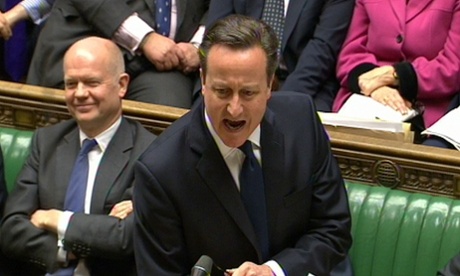
At prime minister’s questions, Miliband asked Cameron to give an undertaking that he would appear alongside him in a one-to-one debate due to be hosted by Sky News and Channel 4 on 30 April.
Two other debates featuring the seven party leaders are due on 2 April and 16 April.
Sky News and Channel 4 issued a statementafter the Commons exchanges saying they were continuing to prepare for a head-to-head debate between the prime minister and the leader of the opposition on 30 April, but that they “would obviously be willing to host a debate on a different day the two main party leaders could agree on”.
In the Commons, Miliband asked Cameron twice to clarify whether or not he would be appearing opposite him in the live television debate.
Cameron responded: “We’re having a debate now and [Miliband] can’t talk about the economy, he can’t talk about jobs, he can’t talk about living standards and he can’t talk about what we’ve done for our economy.”.
“So that’s a ‘no’ then,” MPs on the opposition benches could be heard saying.
A Labour source said: “Behind the scenes, [Cameron’s] team are doing everything they can to scupper the negotiations and sink the debates.”
Labour challenged the prime minister’s call for the debates to take place before the start of the formal campaign, which will be triggered by the dissolution of parliament on 30 March. The sources pointed to a letter Cameron sent to Gordon Brown in 2007, calling for the television debates to be held during the general election campaign.
In his letter dated 5 September 2007, Cameron wrote: “It is true, of course, that we have the opportunity to debate matters at prime minister’s questions. But that is a very different matter to a proper television debate during a general election campaign – when parliament is not sitting, and when people will be most receptive to engaging in political discussion.”
Downing Street sources said the prime minister has long suggested the debates should be held before the start of the formal general election campaign. The sources said Cameron believed the three debates in 2010 dominated the entire campaign.
But Labour sources said No 10’s conduct suggested they were trying to kill the debates. The Tory negotiating team missed a meeting with the broadcasters, while Labour attended. The Conservative party also missed a meeting where lots were drawn among the broadcasters for who would host which debate.
The Labour MP for Worsley and Eccles South , Barbara Keeley, repeated Miliband’s question to the prime minister: “To have the accountable government that the prime minister just talked about, he needs to answer questions asked of him. For the third time of asking today, there is a debate planned by broadcasters on 30 April, a two-way debate. Will he be there?”
Cameron responded: “I’ve been very clear. I say get on with the debates before the election campaign. I think we should start now.”
After a series of disagreements over who should be invited to the debates, broadcasters published renewed proposals in February. The first two debates would feature the leaders of the Green party, Scottish National party and Plaid Cymru as well as Cameron, Miliband, Nick Clegg, of the Liberal Democrats, and Ukip’s Nigel Farage. The final debate would be a head-to-head between Cameron and Miliband.
Labour MP Paul Flynn raised a point of order after prime minister’s questions, describing the “spectacle” as the worst ever. He suggested Cameron and his ministerial team should be taught “the precise meaning of the word ‘question’”.