This is the first installment of a two-part series.
For the logistics industry, the end of the year is the busiest season, with Christmas sales battles and year-end gift-giving overlapping. It has become taken for granted that packages will be delivered to homes and offices day after day. However, the ability of companies to maintain their high standards has begun to waver in the past few years due to labor shortages. The Yomiuri Shimbun investigated the present situation and the problems facing distribution networks, which have become part of the foundation of society.
Robots work alongside people
The Yomiuri Shimbun visited Prologis Park Chiba New Town, a large-scale distribution warehouse in Inzai, Chiba Prefecture, used by major online shopping websites and other businesses as a hub for product distribution. One of them is Acca International, a Tokyo-based distribution-related company.
Here, in early December when the handling of packages was at a peak, a dozen or so disk-shaped machines, twice the size of household cleaning robots, were hurriedly and noisily whizzing about Acca's area. Once they found their target products, the AI-controlled robots, named EVE, lifted and moved whole stacks of them.
When an EVE brought over some shoes, an employee placed them into a sorting box depending on their shipping addresses, then put it onto a conveyor belt. The EVE then turned around and made its way back to the product shelves.
The company said the amount of shelf-searching and product-moving work that had once required 10 people could be handled by just three after the robots were introduced in 2017. "There is a limit to how much of a labor shortage you can endure. Employees should focus on tasks that cannot be automated," said Chihiro Hayashi, who is responsible for introducing the robots.
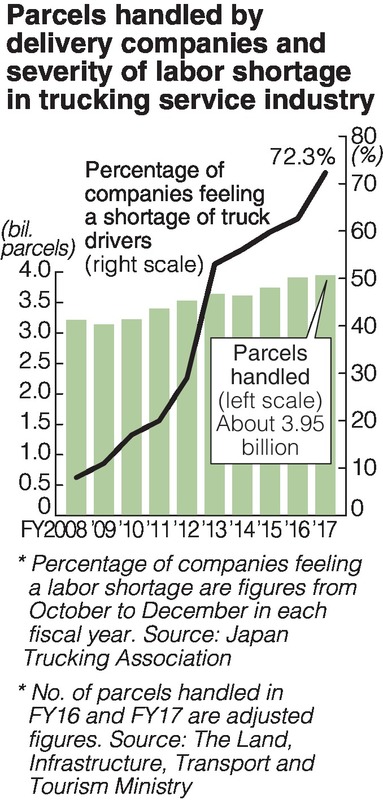
According to the Land, Infrastructure, Transport and Tourism Ministry, due to the expansion of internet shopping, the total number of units handled by delivery services in fiscal 2017 was roughly 3.95 billion, a 1.1 percent increase on the previous year. However, the number of cases in which the intended recipients of packages are not at home has increased, due to the rise in situations such as both partners in a couple working. Consequently, more than 15 percent of packages handled by major delivery companies need to be redelivered. Amid calls for work style reform, it is difficult to ask employees to take on even more work than they currently face.
Many companies continue to introduce advanced technology to compensate for labor shortages. There are warehouse operators that use power assist suits that support the user's muscles so that heavy loads can be lifted with the user exerting only a third of the required strength, making it easier for women and aged people to work. Groups using AI to analyze meteorological data to optimize inventory quantity have also started up.
Conventional transportation methods also have a role to play in solving these issues.
In 2013, transportation giant Fukuyama Transporting Co. in Hiroshima Prefecture began running the Fukuyama Rail Express, a freight train dedicated to transporting the company's cargo. Running on Japan's major transport routes of the Tokaido and Sanyo lines, this efficient train is able to transport a load equivalent to that of 42 10-ton trucks in one journey.
According to Japan Freight Railway Co., more and more companies have been using dedicated trains to transport their own cargoes in place of long-haul trucks. "The significant advantages of using freight trains are that there is no traffic congestion and that a small number of people can operate them," emphasized the stationmaster at Tokyo Freight Terminal.
The logistics crisis associated with labor shortages has also changed businesses' recruitment.
Women active in distribution
On Dec. 6 at the Sagawa Express Co. office in Koto Ward, Tokyo, Yumi Oneta, a driver with the company for six years, skillfully loaded her truck and set off. Among the packages, many with year-end gift wrapping paper stood out. On a regular day, there are up to 150 items to deliver. During the holiday season, however, there are days where that number can reach close to 200.
Sagawa Express actively appoints women as sales drivers, a job that has been strongly associated with men. The roughly 1,900 women that were working at Sagawa in fiscal 2013 had increased to roughly 3,000 in fiscal 2017. The so-called "delivery mate" position has also become more widespread. This is a position in which housewives and aged people, mostly riding bicycles, deliver packages in their own neighborhoods in their free time.
Such positions are also positively received by customers. "There are many things that I can do because I am a woman, like dealing with customers gently. I want to continue doing this even after I marry and have children," Oneta said.
There are also companies that have established facilities such as powder rooms, day nurseries and cafeterias in their distribution warehouses to make it easier for women to work. A representative of the Development Bank of Japan who is involved in providing financing and advice to the logistics industry said, "There is still room for improvement if Japan is to maintain its distribution network, which is internationally acclaimed for its high service standards."
Under the pressure of labor shortages, waves of reforms are slowly but steadily advancing in the logistics industry, which has been facing peak loads during the festive season.
Read more from The Japan News at https://japannews.yomiuri.co.jp/