Labor has closed the door to changes to the goods and services tax (GST) but is open to reforming superannuation concessions, as the Coalition calls for a “mature public debate” about modernising Australia’s revenue base.
The federal treasurer, Joe Hockey, signalled a desire to reduce Australia’s reliance on corporate and personal income taxes when he released a tax discussion paper on Monday designed to inform the Coalition’s 2016 election agenda.
Hockey, business groups and economists warned against prematurely ruling out ideas, but the federal opposition warned that increasing the 10% GST or broadening the base to include items like fresh food would have a disproportionate impact on poorer households.
The shadow treasurer, Chris Bowen, said it was “lazy just to say that the only tax reform worth doing is increasing the GST or broadening the base”.
Bowen said some aspects of the report were “sensible” and Labor intended to play a constructive and proactive role in the tax reform debate. He suggested superannuation tax concessions were “not working” and were “in need of improvement”.
“Where you’ve got the situation where the vast majority of tax concessions go to people on high incomes who don’t need and won’t need the age pension regardless of how many tax concessions you give them, that’s not a system fit for purpose,” Bowen told the ABC.
Hockey emphasised the need for stability in the superannuation system, saying that any changes needed to be “on a prospective basis” rather than having retrospective effect.
The treasurer said he was not ruling out any measures, but any changes to the GST would require broad political support and a “very significant” compensation package targeted at people on low incomes because they faced a bigger impost as a share of earnings.
Hockey said GST revenue was challenged by technological change and global competition. “I don’t see the GST necessarily as the answer. I think you have got to look at the whole tax system,” he told 3AW as he began a media blitz to encourage a conversation about tax reform.
The 200-page discussion paper is intended to generate community debate and submissions, which the government will consider before releasing a green paper with specific policy options later this year. The Coalition plans to set out its reform proposals in a white paper next year and then seek an electoral mandate.
Chris Richardson, from Deloitte Access Economics, said politicians should should seek to build community support for reforms and avoid ruling out particular options.
The Australian Chamber of Commerce and Industry backed calls for a review of superannuation tax concessions, while urging policymakers to keep changes to the GST on the table.
“If we rule out changes to the GST, we will condemn future generations of Australians to pay higher and higher income taxes, sapping incentives to work,” said the chamber’s chief executive, Kate Carnell.
The Australian Council of Social Service said tax reform must not be reduced to a narrow argument over increasing taxes on consumption such as the GST.
The group’s chief executive, Cassandra Goldie, argued income taxes were the fairest taxes and should be made more efficient.
“People understand we have a public budget problem: they want solutions that don’t impose the greatest burden on the least well-off,” she said.
“It is too easy for people with high incomes to avoid paying their fair share of tax through devices such as negative gearing and private trusts, for some international companies to artificially shift their profits elsewhere, and for retired people with substantial assets to churn their income through their super accounts to reduce tax.”
The Australian Council of Trade Unions (ACTU) called on the government to reduce super tax concessions for high income earners and “fix the corporate tax rorts that too many companies use to pay little or no tax”.
The Business Council of Australia (BCA) said Australia’s company tax rate was internationally uncompetitive. But the BCA vowed to take a broader focus and work alongside other groups to “build common ground on how tax reform can contribute to achieving our shared national interest objectives”.
The Australian Industry Group applauded the government for not ruling out any options and said the debate “must not involve pitting one group against another”.
Anglicare Australia also warned against allowing the debate “to sink to the level of competing self-interests motivated only by the desire to pay less tax”.
The leader of the Greens, Christine Milne, said the government should crack down on tax avoidance and raise revenue from those who could afford to pay rather than cutting from people who most needed support.
The discussion paper says Australia’s overall tax burden – about 27% of gross domestic product in 2012 – is relatively low compared with other developed countries, but higher than some of its major regional trading partners.
Australia relies more heavily on income taxes on company and individual income than other developed countries, the paper says, and company tax and stamp duties detract from economic growth. It suggests that Australia has a lower reliance on consumption taxes – which include the GST – than most developed countries.
Tony Abbott described the report as “an important conversation starter” and said he wanted taxes to be lower, simpler and fairer.
“Let’s see where the conversation takes us, but the point I stress is that there can be no change to the GST unless [opposition leader] Bill Shorten wants it,” the prime minister said.
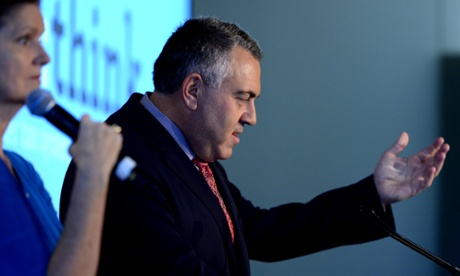
In a speech in Melbourne on Monday, Hockey said capital was “more mobile than ever” and companies could move to places with more competitive tax rates.
“Company tax has structural risks that are threatening its future. A corporate takeover, a corporate failure or a decision to offshore specific operations can have a profound overnight impact on our revenues,” Hockey said.
“Moreover, changing market dynamics such as falling commodity prices or disruptive technology can have a powerful and rapid impact on our revenue as well.”
Hockey said he would meet with state and territory treasurers in about two weeks to discuss a related but separate white paper process on the shape of the federation.
“This will end up having to be bipartisan – state and federal, Liberal and Labor, whoever is in government is going to have to deal with this issue,” he said.
“There are unstoppable forces at play in the world economy, in the digital economy, consumers are more empowered than they’ve ever been previously. The old regulation, the old system is not going to serve us into the future.
“Now there are no state elections [coming up], maybe, just maybe, we can have a fair dinkum discussion about the best interests of the nation without having parochial interests at play.”