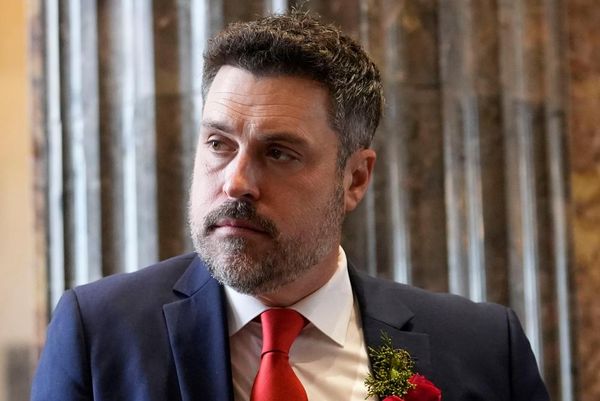
The new administrator of the Victorian branch of the ALP, Steve Bracks, has attempted to calm internal tensions, saying it should be possible to conduct an audit of the membership “reasonably quickly” allowing the party’s federal executive to then determine whether or not to restore voting rights before 2023.
The ALP’s national executive has launched an extraordinary intervention into the state branch as it grapples with the damaging fallout of the Adem Somyurek branch-stacking scandal, appointing party veterans Bracks and the former federal minister Jenny Macklin as administrators, and suspending all voting rights until at least 2023.
The suspension of voting rights for three years has created a stink in some quarters of Bracks’ faction, the Victorian right, and also with some trade unions who feel disenfranchised by the impending cleanup. The Herald Sun has reported the intervention could face a union-led legal challenge, but federal players are confident the process will stick.
Bracks said on Wednesday given the Nine Network had reported on Sunday night that Somyurek, the disgraced rightwing state powerbroker, orchestrated the payment of party memberships in a mass branch-stacking operation in Victoria “it’s important that we establish the legitimacy of the existing branch membership”.
But in a nod to fractious internal sentiment, Bracks said the audit would not preclude “the opportunity for genuine involvement in the Labor party going forward”.
Bracks, a former Victorian premier, said given the scale of the inappropriate conduct, the national executive had done the right thing. “I think it’s right that we will have this review and I think it’s right that we will make sure we’ve got the right set of rules going forward in the future”.
The former federal Labor leader and Victorian rightwinger Bill Shorten, who was active in the internal jockeying ahead of the launch of the intervention on Tuesday night, told Guardian Australia he felt sad for the thousands of bona fide branch members who would have their “good work interfered with” as a consequence of the interposition.
But he backed the process. “I accept the rank and file membership roll needs a deep clean. Confidence and stability has to be restored.” Shorten said the premier, Daniel Andrews, and the federal leader, Anthony Albanese, had no choice other than to take action.
The Morrison government meanwhile turned its focus to the Victorian backbencher Anthony Byrne. Some of the damning footage broadcast on Sunday night was recorded in Byrne’s electorate office – including possibly during a party branch meeting – although Guardian Australia makes no assertions about Byrne’s knowledge of the recordings.
Albanese has said on several occasions this week he has not asked Byrne about the footage. The attorney general, Christian Porter, raised the issue in question time, noting that “at a federal level, there are very strict rules about the use and authorised use of surveillance devices which restrict that use to law enforcement agencies”.
Porter said “everyone in this parliament would agree that the idea that a non-law enforcement device, if you like, appeared to have been installed in the office of any member of this parliament is a matter of some serious concern”.
Byrne said on Wednesday there was “misinformation circulating” about the imbroglio. Andrews has referred the allegations to police and to the state anti-corruption watchdog.
Victoria’s Independent Broad-based Anti-corruption Commission (Ibac) confirmed on Wednesday it was investigating serious allegations of corrupt conduct. It said “Operation Fortescue” would examine a range of matters concerning allegations of branch stacking, and other matters aired recently in media reports, and “other related complaints made to Ibac”.
The Australian federal police has not received any referral regarding the Somyurek matter.
Byrne said he was cooperating fully with authorities. “In respect of the misinformation circulating, I want to make clear that I take the matters raised recently seriously and have been in touch with authorities to offer my full assistance.
“I welcome investigations into corruption, which has no place in the party I love. Because I do not want to cross over or impede any investigations that may be occurring, I’m unable to comment further at this point in time.”
Meanwhile, seven senior New South Wales Labor figures, including the former federal MP Laurie Ferguson, will face the party’s internal appeals tribunal in the wake of a damning report that found widespread irregularities and false record-keeping within the party’s western Sydney branches.
The report, handed to the party’s administrative committee in March, will put pressure on the Labor leader, Jodi McKay, to follow the lead of the Victorian premier, Daniel Andrews, in acting against MPs caught up in branch-stacking.
NSW claims to have a more robust disciplinary process that was put in place in 2013 after an intervention by the former prime minister Kevin Rudd.
It will now be put to the test.
The 37-page report was the result of a three-month investigation by the former Queensland Labor state secretary Evan Moorhead into branches in western Sydney dating back to 2011.
NSW Labor head office confirmed that Ferguson and six other party officials faced the party charge of “unworthy conduct”. All could face expulsion or suspension. There are no criminal charges.
In a statement reported in Sydney’s Daily Telegraph, Ferguson confirmed he remained a member of the party and said he would be providing evidence to the review committee on the “outstanding issue”. He has denied any wrongdoing.
A spokesperson for the NSW Labor party said it took all allegations of impropriety by party members seriously.
“In March, the NSW Branch adopted the recommendations of the Moorehead report in full and is in the process of implementing those reforms,” they said.