LOS ANGELES _ The Los Angeles Unified School District announced Tuesday an estimated 75 percent graduation rate for the Class of 2016, up from 72.2 percent last year.
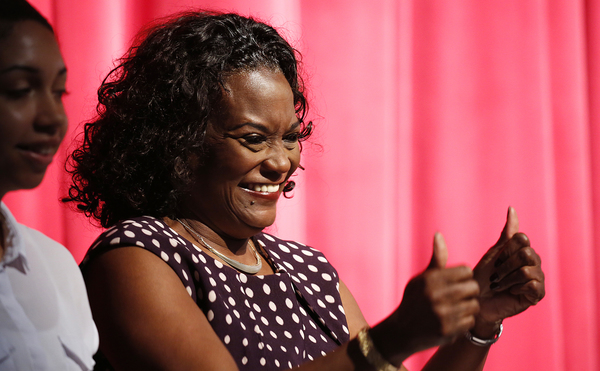
Superintendent Michelle King announced the school system's highest ever graduation figure in her first "state of the district" speech, an annual address from the superintendent that typically takes place a week before the start of school.
"This is exceeding expectations of those who said our students couldn't do it," King said during the speech at Garfield High School.
King, a former L.A. Unified principal and deputy superintendent, took over the district in January.
The graduation rate King announced comes in the same year that more difficult academic requirements took effect. One result was that in December, about half of seniors were in danger of failing to earn a diploma.
Then came a remarkable and almost immediate turnaround through a variety of new "credit-recovery" efforts, which include both online classes and teacher-led programs during and after school. Critics have speculated about whether the record rate could be a result of lowered standards in those remediation programs.
Although officials have defended district academic integrity, they appear to have limited data on credit-recovery efforts. They say they are still trying to determine which students took advantage of which credit-recovery options.
"We know our kids and we know what they are capable of," school board President Steve Zimmer said during remarks that preceded King's.
The new graduation standard is for all students to earn a "D" or better in courses required to apply to a four-year state college. Even that standard is not sufficient for these colleges, which mandate a grade of "C" or better in those classes. The set of courses is called the "A to G" requirements.
The classes include Algebra 2 or its equivalent, as well as two years of foreign language and a year of a college-preparatory elective, such as geography or statistics.
"We know 100 percent of all kids can graduate fully passing the A to G," Zimmer said.
The formulas for tabulating graduation and dropout rates have evolved over time, so it is difficult to go back more than several years to make a reliable comparison and confirm whether the graduation rate announced Tuesday is in fact the district's highest historically.
Except for the graduation-rate announcement, King's speech was a substantially familiar recounting of district accomplishments. And among an audience of administrators, this approach was exceptionally well-received.
"We have done so much more than survive," said the career L.A. Unified employee, who rose through the ranks. "We have thrived in difficult times, overcome obstacles and continued to produce steady gains year after year after year."
Her points of progress included increasing the number of students in the modern, higher-tech equivalent of vocational education and also boosting the number of students gaining fluency in multiple languages.
"Multilingualism will no longer be simply a good skill to have, but instead, it will become a prerequisite for the globally flattened world," King said.
She also talked about plans to let more high school students complete community college credits while still in high school, and a project, being developed with Los Angeles Mayor Eric Garcetti, to provide one year of free community college to all district graduates.
"This was the cheerleader-in-chief, which is a very important role," said former school board member David Tokofsky, who attended the gathering. "It reminded me of a shopping list. It was short on substance and metrics and timelines."
But it worked for Patricia Lyons, a retired administrator who has come back to serve as an on-call interim principal.
"I loved every bit of it," Lyons said. King's list of examples and goals "answered so many of the problems we were facing."
Without saying so, King, in her speech, repeatedly alluded to elements that are part of her three-year strategic plan, which is currently being circulated as a confidential draft.
That draft, obtained by the Los Angeles Times, commits to increasing student enrollment by expanding programs that are popular with parents and by better publicizing district successes. King repeatedly checked that latter box on Tuesday, calling out schools and principals by name, and reminding them to tout their successes as well.
The rate of academic improvement proposed in the draft, which is dated July 25, is relatively modest. It projects the percentage of students who meet or surpass academic targets on state tests to rise in English from 35 percent to 36 percent to 37 percent over the three years. In math, the rise is from 27 percent to 28 percent to 29 percent.
These numbers suggest that L.A. Unified has failed to reverse last year's relatively low scores on new state standardized tests in math and English. The state has not yet released these scores to the public, although school districts have them.
Even on test scores, King found a positive, saying that in some grades the scores increased by as much as seven percentage points.
She barely alluded to looming budget problems _ mainly noting that the district would receive needed additional funding if it could improve student attendance and enrollment.
Much of the enrollment loss is to independently operated charter schools, which have proved popular with many parents.