
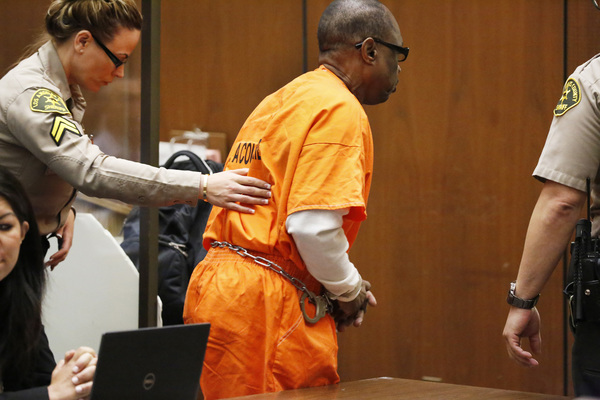
LOS ANGELES _ A former Los Angeles garbage collector convicted in the so-called "Grim Sleeper" slayings that spanned more than two decades was sentenced to death on Wednesday, capping a lengthy case that centered on the gruesome deaths of more than a dozen women in South L.A.
"This is not a sentence of vengeance," Superior Court Judge Kathleen Kennedy told Lonnie David Franklin Jr. as relatives of his victims looked on, some of them in tears.
Franklin, 63, was convicted earlier this year of killing nine women and a teenage girl from 1985 to 2007. During the penalty phase of his trial, prosecutors connected him to five additional slayings. But detectives believe he may have killed at least 25 women.
The judge read the names of the 10 victims Franklin was found guilty of killing. In each case, Kennedy told him, "You shall suffer the death penalty."
Some of the victims' relatives cried. Some sighed. Others repeated: "Amen, amen, amen."
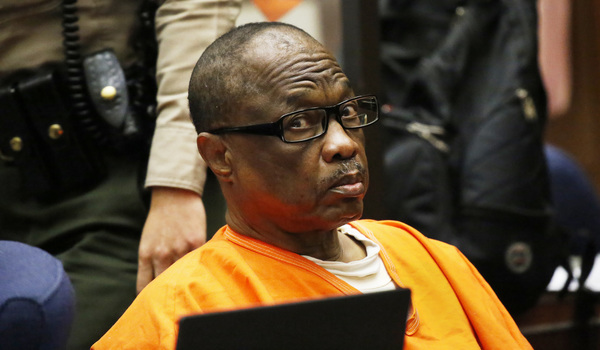
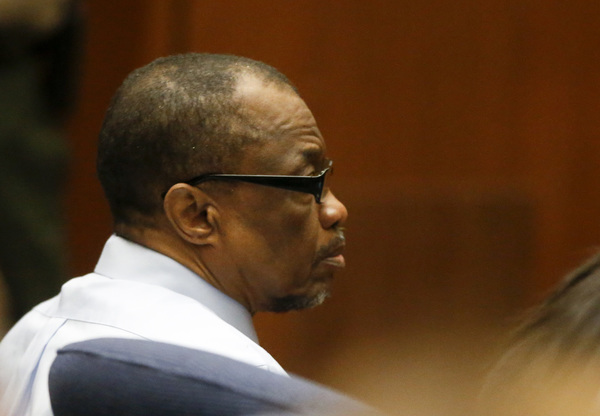
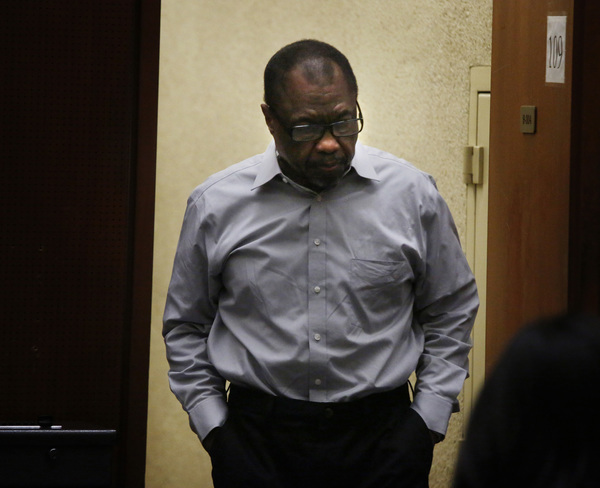
Franklin sat stoically as he had all throughout the trial, though he did turn around briefly to respond to a victim's relative earlier in the morning.
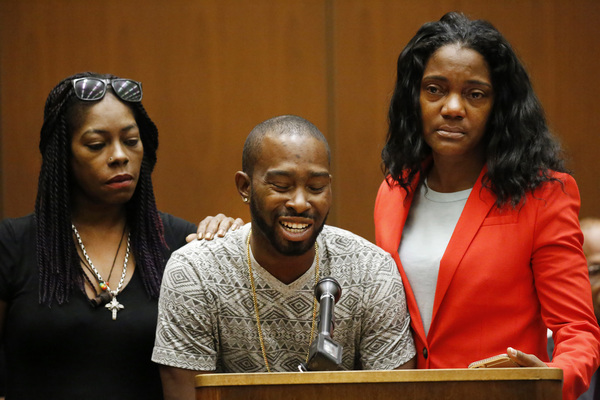
The sentence came toward the end of an emotional hearing where 17 family members of victims read statements, many of them repeatedly asking why Franklin chose to attack members of his own community.
"The defendant took my daughter, murdered her, put her in a plastic bag _ a trash bag _ like she was trash," Laverne Peters, whose 25-year-old daughter was found in a dumpster in 2007, told the court before Franklin was sentenced. "My hope is that he spends the rest of his glory days in his jail cell, which will become his trash bag," her mother said.
"Amen," other family members in the audience said.
Mary Alexander, whose 18-year-old daughter was murdered, spoke directly to Franklin.
"I'd like for Mr. Franklin to turn around and face me," she said.
Franklin turned his head slowly, locking eyes with Alexander.
"I'd like to know, why?" Alexander asked, gripping the lectern.
Franklin whispered something in response.
She repeated her question, louder: "Why?"
Again, he whispered, although it was impossible to make out what he said.
"I know she didn't do anything to hurt you," Alexander told Franklin, "I know that."
Franklin's face softened and he nodded.
Alexander told Franklin that she had thought a lot about forgiveness, but said she was finding the concept extremely difficult.
"I'm still battling that," Alexander said.
Franklin nodded once more and turned back toward the judge.
The killer, one of California's most prolific, targeted victims who were generally young, vulnerable and, at times, ignored. The attacks failed to raise alarms the way other famous serial slayings by killers such as the Hillside Strangler or the Night Stalker did.
The deaths in the mid- to late '80s coincided with a surge in slayings linked to the crack cocaine epidemic. In addition, several other serial killers were operating in the same area in those years. Michael Hughes was convicted of killing seven women; Chester Turner of 14 women and a fetus. Both are on California's death row.
But the Grim Sleeper proved to be the most persistent. He targeted women who were drug addicts or prostitutes, and often dumped their naked bodies alongside roads or in the trash. Many of the women were initially listed as Jane Does. The deaths drew little, if any, media attention.
Police kept the slayings quiet despite suspicions that a serial killer was stalking black women _ a decision that led to outrage and condemnation from many who attribute Franklin's longevity as a killer to police indifference.
Authorities were able to link the slayings through ballistic and genetic evidence at the crime scenes that pointed to a single killer. But identifying the DNA proved difficult.
A break finally came in the case in 2010, when a search of state offender records turned up a partial match. The person wasn't the suspected serial killer, but his close relative was.
Before long, investigators focused on the convict's father, Franklin. After tailing him to a pizza joint in Buena Park during the summer of 2010, police collected a slice of partially eaten pizza. They tested it for DNA and, finally, had a match.
A search of Franklin's home on 81st Street _ not far from the South L.A. corridor where many of the victims' bodies were found _ turned up a .25-caliber semiautomatic handgun. Two criminalists testified at trial that it was same weapon that killed one of the victims.
Franklin's attorney, Seymour Amster, told jurors that DNA from other men was found at some crime scenes _ a sign, he said, that someone else could have played a role in the slayings.
In May, a jury convicted Franklin of 10 counts of murder. His victims, in the order of their deaths, were: Debra Jackson, 29; Henrietta Wright, 35; Barbara Ware, 23; Bernita Sparks, 25; Mary Lowe, 26; Lachrica Jefferson, 22; Alicia Alexander, 18; Princess Berthomieux,15; Valerie McCorvey, 35; and Janecia Peters, 25.
Most of the women were shot to death. Berthomieux was strangled.
Franklin was also convicted of attempted murder in connection with an attack on Enietra Washington, who survived and testified against him.
Franklin initially earned the "Grim Sleeper" nickname because a gap in the killings between 1988 and 2002 suggested he had gone dormant. But detectives believe Franklin never really slept.
After the initial conviction, prosecutors presented more evidence against Franklin during the penalty phase of the trial. A woman testified that Franklin, as a U.S. Army private stationed abroad, was one of three assailants who gang-raped her in Germany in 1974.
Franklin stared blankly after hearing the jury's opinion that he should be executed.
The high-stakes trial devolved, at times, into bitter back-and-forths between attorneys _ and the discord continues.
Amster filed a motion asking for a new trial, arguing that Deputy District Attorney Beth Silverman had committed prosecutorial misconduct and influenced the jury. The motion included a declaration from a woman _ who worked with the defense _ who said she saw Silverman roll her eyes during the trial and mumble phrases she interpreted as attempts to mock Franklin's defense attorneys.












