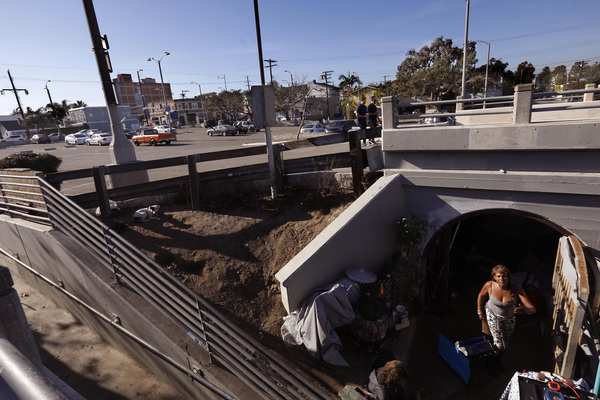
LOS ANGELES �� In the decades after World War II, when the suburbs were young and the car was king, Los Angeles went on a land-buying spree.
The city bought parcels in every size and shape, demolished any buildings on them and opened parking lots to serve emerging commercial districts.
By the 1970s the buying had mostly stopped, and today the119 public lots blend into the urban quilt all but indistinguishable from their free-market competitors.
But now the city is cultivating plans that could transform much of that land again, this time from asphalt to multistory apartment buildings to house chronically homeless people.
Plans are to develop housing on large public lots in Venice and Hollywood, while officials review the rest to determine which could support housing.
Advocates of the conversion see it as more than a solution to homelessness.
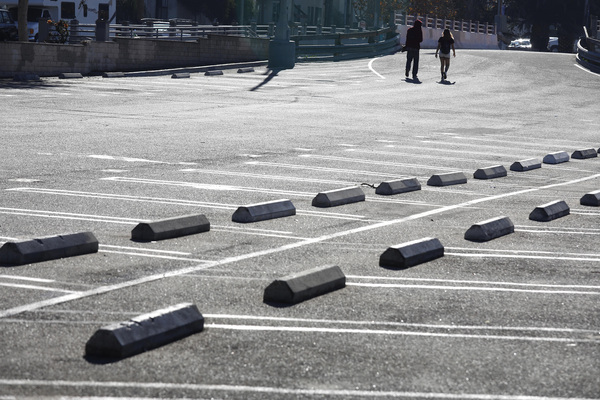
"These opportunities ought to be evaluated in terms of the next vision of what the city ought to be," said Eric Moss, the architect on a project that would squeeze 140 units onto the Venice parking lot, with a parking garage to preserve all the spaces there now. "Those lots belong to a completely different history and a completely different time."
But how many of them prove viable will depend on many unknowns, among them the reaction of council offices and neighborhood groups and the ingenuity of architects in making the most of parcels that in many cases are small, oddly shaped and represent a prized resource.
"I think we're going backwards," Lincoln Heights real estate broker Steven Kasten said about a proposal to build on lots there. "Merchants are not going to have parking. People are going to move out. It's going to hurt business."
The idea of converting public parking to housing has been around for decades in L.A. but has gained little traction. In the 1980s, Mayor Tom Bradley proposed leasing rights to developers to build multifamily housing, but there was no follow-up.
L.A. Councilman Gil Cedillo revived the idea in 2008 with a plan to build 80 units on three city lots in Highland Park.
That plan fell into limbo after a neighborhood group, Friends of Highland Park, sued, alleging that the environmental review approved by the city was inadequate. A trial court's ruling for the city was overturned on appeal. The city chose not to appeal further, and the project remains stalled.

The new parking lot review grew out of an urgency to implement Proposition HHH, the $1.2 billion bond issue approved by the voters to help fund the construction of 1,000 permanent supportive housing units each year.
With public money committed, a new obstacle emerged. The scarcity of suitable land in the city's highly competitive real estate market could add years to the startup time for new projects.
Mayor Eric Garcetti and the City Council have promised that the city would speed up construction by providing land from its portfolio of surplus property.
After sifting through more than 500 prospects, the City Administrative Office has narrowed the field to 129 sites that are potentially large enough and in suitable zones. All but 10 are public parking lots.
The city's Housing and Community Investment Department is also planning to offer affordable-housing developers 24 city-owned lots, most acquired from the Community Redevelopment Agency when it was dissolved by the state in 2012.
Combined, the properties could support thousands of new units. Some would go to low-income renters, whether they are homeless or not. But even if only half the units were set aside for homeless people, it would make up a substantial boost to the 10-year building goal.

But the hope that using city properties would dramatically speed the pace of construction is being tested by the realities of city procedures.
Yolanda Chavez, an assistant city administrative officer, said the office is reviewing lots a few at a time and will confer with the Department of Transportation to determine their suitability and the number of spaces that need to be preserved.
Then a motion from the City Council office is required to proceed with a planning report. After that the lot can be offered for bidding.
Chavez said she hopes to offer several properties for proposals in February and then a few more twice a year.
Because the process incurs costs, such as appraisal fees, Chavez said she requires a show of support from a City Council member in the form of a motion before she will begin it.
Though there are city parking lots in almost every council district, only a handful of motions have been introduced so far.