Twice they interrupted Luis Enrique, first with a whisper from the back of the room, then with a shout from beyond the wall, but he didn’t mind. After all, they came bearing good news. Barcelona’s manager was about to explain what shape his team were in for the trip to Munich when he found out that, never mind Europe for a moment, they were about to win the Spanish league. Well, maybe not win it exactly, not yet at least, but almost. A fifth title in seven years, a seventh in 11, was close now. The following morning’s nearlies and one win aways were the small print while CHAMPIONS was writ large. And not without reason.
It was after 8pm on Saturday evening and Barcelona had struggled but they had eventually beaten Real Sociedad 2-0 at Camp Nou while 600km away Valencia were leading 1-0 against Real Madrid at the Santiago Bernabéu, with a goal from Paco Alcácer. Luis Enrique had seen the first 20 minutes of the Madrid game on television before heading into the Barcelona press room. “How important were these three points … and Madrid are losing” he was asked. “Vital” came the answer. But, he added quickly, “until the referee blows [the final whistle], there’s nothing to say. Madrid have hit the post three times already.”
The very next question came from the right of the room. “What kind of physical shape are the team in?” There was no time to answer. From the back, someone with an ear piece muttered “goal” and Luis Enrique looked up. “Let’s see whose [goal],” he said. Just then, a roar came from the dressing room out the back, beyond the sponsor-splashed board and down the orange corridor under the main stand, where the TV was running a fraction behind the radio. Barcelona’s players were shouting, celebrating, clearly audible here. Luis Enrique gestured behind himself with his thumb. “That confirms it,” he grinned.
Javi Fuego had just put Valencia 2-0 up. Stay that way and, with two games left, Barcelona would be five points clear; even if Madrid equalised, it would be four points, the title virtually theirs. And so it was that, nine minutes later, the final question of the press conference was asked: “Do you feel like completing this phrase: ‘not winning the league would be … ’.” “I don’t feel like completing this phrase,” Luis Enrique replied, getting up, waving and heading out the door with a big grin on his face. He had to dash; he had a game to watch. Heading to his office, Real Madrid versus Valencia wouldn’t wait for him.
It wasn’t easy viewing. Madrid were trailing 2-0 and needed three goals now, sure. Valencia had been impressive, true. But it was not over. Madrid had already hit the post three times Luis Enrique had rightly said, albeit one of those had been ruled out anyway, and they were about to do so again. This time, it was Chicharito’s turn. And then, in the last minute of the half, they got a penalty. Cristiano Ronaldo stood over the ball. The comeback could start here.
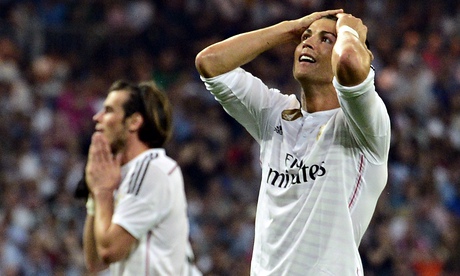
The problem for Ronaldo was that standing 12 yards away was Diego Alves. “You’re going to go right and I’m going to save it,” the goalkeeper told him and he was entitled to be confident. There may never have been a better penalty saver: he has let in fewer than 50% of the spot-kicks he has faced in Spain, saving 43% of them. “You’re going to go right and I’m going to save it,” he said and that’s exactly what happened. Alves had stopped Leo Messi, Diego Costa and Fredi Kanouté before; now he had stopped Cristiano Ronaldo … twice. No one else had ever done so. Up in the north stand, Valencia’s fans cheered their goalkeeper; around the rest of the stadium, Madrid’s fans jeered theirs. No goal had been Iker Casillas’s fault, but no matter. “Up yours,” he muttered, snapping at last. The contrast was cruel.
In the back page cartoon of the Catalan daily paper Sport – humor gráfico, they call it, which is usually half right – declared that Alves had given Barcelona half the title while “Penaldo” had given them the other half. But if the title was slipping away, if that chance had gone, it still wasn’t over yet. Madrid kept on coming. Pepe headed in a corner to make it 2-1 after 55 minutes, 35 minutes to get two more. Isco curled in a beauty on 83. And when the board went up, there were five more minutes on it. A few metres away, a security guard clenched his fist in celebration. This was it.
Only it wasn’t. The whistle went and back in his office at Camp Nou Luis Enrique clenched his fist, just like the security guard before him. Madrid had given everything and created chances but another comeback win was beyond them. They’d taken 29 shots but there was no way past Diego Alves, who made a handful of exceptional saves, even if the best of them – a dive to his left, sending the ball back up off the post and the bar, a touch of Gordon Banks about it – came after the referee had blown his whistle for an infringement, though it was unbeknownst to him. “He has something,” Valencia’s manager Nuno said; “something special.”
At the full time whistle, an ovation went round the Camp Nou dressing room and the Bernabéu stands, Madrid’s fans appreciative of the effort. “They died on their feet,” AS’s headline ran; “Goodbye, with heart,” Marca said. “Three posts, a missed penalty … I’ve never seen anything like it,” insisted the club’s institutional director, Emilio Butragueño. “It’s a bad result, but the performance was quite the opposite,” Carlo Ancelotti claimed.
He had a point. Madrid could, and probably should, have got more and it was certainly a bad result. Just two points down, Atlético Madrid were Real’s hope, against Barcelona next week. Now, four points down, Barcelona need one win; they could lose at the Calderón and still take the title by beating Deportivo at Camp Nou the following week. Nor, though, should luck alone be allowed to explain Madrid’s results, even if two games against Valencia seem to encapsulate that feeling: Valencia’s captain Dani Parejo missed a penalty against Barcelona, while Valencia’s goalkeeper Diego Alves saved a penalty against Madrid. Yet in their six games against the other teams in the top four (Barcelona, Atlético, Valencia), Madrid have won just once.
Rotation has been rare, their physical condition declining. Injuries have done damage: injuries to Luka Modric and James Rodríguez, especially. And the absence of Xabi Alonso, or a central midfielder the coach trusts, may not always have looked like a major problem but was felt eventually: ignoring Sami Khedira, Lucas Silva and Asier Illaramendi to play Sergio Ramos in midfield is telling. On Saturday, chasing the game, Ancelotti changed his two full-backs. Looking at the bench, there weren’t many other options. Looking further back invites other conclusions: if Madrid do not win this league, as now seems almost certain, they will have won just one in the last seven years – in 2012 under José Mourinho, while Ancelotti’s record reveals a coach better in the cups than in La Liga.
This year, Madrid seemed certain to win it. Some idiots even suggested that they would win the league with games to spare. At Christmas, Madrid were top, recently crowned world club champions, and had a game in hand. More than that, their two defeats, in weeks two and three, appeared to have been left way behind them. They had won 12 league games in a row, and 22 in all competitions. Barcelona, meanwhile, had won only three of their last eight in the league and Luis Enrique was under pressure.
Madrid lost their first game after Christmas, at Valencia, but so did Barcelona. And that defeat at San Sebastián, with Leo Messi sitting on the bench, provoked a crisis that saw the sporting director sacked, his assistant walk, the club look for a replacement for the coach, and the president call elections “to reduce the tension”. Messi was unhappy and Luis Enrique was, by his own admission, unprotected. Crisis was served. As it turned out, though, crisis was averted; it became cathartic, as if they needed to look into the abyss to get going. And, boy, did they get going.
This weekend, Barcelona completed an entire vuelta, playing everyone in the league, since that loss at Real Sociedad. Of 19 matches, they have won 17, drawn one and lost one. In all competitions, that record reads: played 29, won 27. Fitter, stronger, more varied than ever before, their aggregate score over the last seven games reads: 25-0. They are in the Copa del Rey final, they lead 3-0 from the first leg in the Champions League semi-final, with Real Madrid likely to await them in Berlin, and now they watched from Camp Nou as Valencia helped them take a giant step towards the title.
Ancelotti admitted that it was harder now but insisted that Madrid would fight on and most of his players said the same. But then Dani Carvajal appeared. “We’re disappointed because it slipped away from us at home,” he said. “We’ve said goodbye to the league.”
Talking points
• Dani Carvajal might not be the only one. We might all have said goodbye to the league. And the Copa del Rey final. And the second division. And the play-offs. And God knows what else. The Spanish Football Federation, the RFEF, has announced an “indefinite” stoppage to football, starting on 16 May. Meanwhile, the players union, the AFE, have announced a strike too.
Their announcements come after the league (the LFP) and the government put together a new decree to regulate the sale of TV rights, laying the foundation for a collective deal. The RFEF and the AFE are not opposed to a collective deal, despite the LFP’s attempts to make it look that way, but they do have problems with the way the new decree has been worded and with it due before congress this week, the clock is ticking, hence them acting now with just two weeks left of the season.
At heart, this is a battle for power, a turf war. With the government, the LFP have sought to take power from the RFEF (and enshrine that in law). And while diminishing the power of the RFEF may be no bad thing, both the RFEF and the AFE are essentially complaining that they have been played: not privy to drafts of the decree, reluctant (in the case of the RFEF) to negotiate with those they do not trust, they have been confronted with a text that reduces their influence, shifting jurisdiction to the LFP instead; cuts them out of the running of the game; and reduces their share of the money made on any future deal.
They’re all talking about dialogue but there is little sign of that yet. The LFP says the stoppages are “illegal”, something that didn’t worry them when they threatened the government with the same a couple of months back, and says that they will sue. Brilliantly, their statement also turns all Helen Lovejoy to note the problems it causes for clubs, fans … and children. Who they don’t seem to have been worried about before, either.
The president of the LFP, Javier Tebas, and the president of the RFEF, Ángel María Villar, have been at war for ages. And Tebas likened the players union meeting to a Bildu announcement – in other words, in his mind, he was likening them to terrorists. The players union president, José Luis Rubiales, responding by recalling Tebas’s fascist past. So, no, dialogue is not exactly simple. Although there is an arbitration meeting on Tuesday. There has been no word yet from Uefa or Fifa.
So far this season, the LFP, the RFEF and the AFE have all threatened to strike. That only leaves the one group of people who would be entirely justified in striking: the fans.
• Two. Granada have now won as many games under José Luis Sandoval as they did under Abel Resino and Joaquín Caparrós. Sandoval has only been in charge for two games.
• For the first time this season, Eibar are in the relegation zone. And this was supposed to be a game they could win, too. Instead, they lost 2-0 to Espanyol. Both goals were a shambles defensively, although the first was brilliantly finished by Sergio García.
• Villarreal are back in Europe. At long last, they won again … and a game when they didn’t even play particularly well. Injuries eventually derailed them, knocked out of the cup semi-final and the quarter-final of the Europa League, the goals drying up, but they did eventually get over the line. “Considering everything, this has been a brilliant campaign and the players deserve all the recognition for it,” said the Villarreal manager, Marcelino.
• A last-minute equaliser for Deportivo at Athletic kept them out of the relegation zone this week, but they were still complaining about a refereeing robbery. Well, what did they expect from a referee called Jesús Gil?
• Relegated last week, angry this. The Córdoba striker Florin Andone was not holding back, describing his team as “ridiculous” and “awful” in their game against Granada. “We haven’t even had a shot on goal,” he said. “I’m annoyed because I’m awful. I can’t even play a fucking pass, and the team’s the same. I’m sick of everything, mate. It’s like we’re all here thinking about next season and we’re not even trying to rescue some dignity in these last three games. If we’re bad, we’re bad, but we’ve at least got to show some fucking attitude and try. We can’t just go out there and let them laugh at us.”
Results Eibar 0-2 Espanyol; Granada 2-0 Córdoba; Barcelona 2-0 Real Sociedad; Real Madrid 2-2 Valencia; Athletic Bilbao 1-1 Deportivo; Levante 2-2 Atlético Madrid; Villarreal 1-0 Elche; Almería 1-2 Málaga; Celta 1-1 Sevilla.
Monday Rayo Vallecano v Getafe.
Latest La Liga table here