Anyone embarking on a crash-course in the literary politics of the 1980s is advised to begin with an article that Salman Rushdie contributed to the New Statesman on the eve of the 1983 general election. The tone, as Rushdie concedes, is practically Spenglerian, its basis the idea that all that is worst in a nation’s identity will ever so often slither to the surface and express itself in government. “There are, of course, many Britains, and many of them – the sceptical, questioning, radical, reformist, libertarian, non-conformist Britains – I have always admired greatly,” Rushdie declares. “But these Britains are presently in retreat, even in disarray; while nanny-Britain, strait-laced Victorian values Britain, thin-lipped jingoist Britain, is in charge. Dark goddesses rule; brightness falls from the air.”
It sounded stirring at the time, but unlike, let us say, the late Stuart Hall – a paid-up anti-Conservative who was sharp enough to comprehend Margaret Thatcher’s appeal to a substantial percentage of the electorate – Rushdie is less interested in trying to establish why more than 13 million people, not all of them thin-lipped jingoists or the handmaidens of dark goddesses, would go on to vote Tory a few days later than in simply venting his disapproval. At the same time, nothing could be more redolent of the literary landscape of the early 1980s, a deeply divided and monumentally contested age, in which for the first time in nearly half a century writers found their political opinions a subject of consuming interest to the world at large.
It was the era of Rushdie’s own “Mrs Torture”, as featured in The Satanic Verses (1988) – Rushdie, as he admits in his memoir Joseph Anton, got the idea from hearing an Indian TV presenter talking about “Mrs Margaret Torture”; of a Sunday Times editorial ticking off Ian McEwan for his anti-Conservative views; of mass-signatory letters to this newspaper and earnest colloquies amid the elegant furniture of Lady Antonia Fraser and Harold Pinter’s house in Campden Hill Square, London, where the “June 20 Group”, as it was christened by newspapers, began to hold its meetings in the summer of 1988; of bitter and personal attacks on the PM by many feminist writers. Part-nanny, part-Elizabeth I as Gloriana and part-Countess Dracula, Angela Carter pronounced, adding, for good measure, that Thatcher “coos like a dove, hisses like a serpent, bays like a hound”.

But it was also a time in which politics maintained a tangible presence in much of the mainstream fiction and drama of the day. If anything unites such variously themed and outwardly discrete works as Malcolm Bradbury’s novella Cuts (1987), David Lodge’s Nice Work (1988) or Margaret Drabble’s A Natural Curiosity (1989), James Kelman’s 1980s short stories or Hanif Kureishi’s screenplay for My Beautiful Laundrette (1985) it is that, transparently and unrepentantly, they are written in the very considerable shadow of Thatcher.
Naturally, British writers had been taking an interest in practical politics long before the arrival at No 10 of the grocer’s daughter from Grantham. The 1880s and 1890s had been awash with literary liberalism just as the 1930s had danced to the tune of leftwing “commitment”. But there are two factors that combine to separate the 1980s from, say, the inter-war age of Auden and Spender. One was their focus on a single politician. The other was the ability of the right to make much of the running.
***
Early in the evening of 29 March 1985 Anthony Powell left his bolthole at the Travellers Club in Pall Mall and headed south down Duke of York steps and across Parliament Square to a dinner engagement at 10 Downing Street. Here, in an ante-room on the building’s upper floor, glass of champagne to hand (“well-iced non-vintage … extremely drinkable” the veteran oenophile was pleased to note), flunkies in respectful attendance, he discovered a galère of distinguished literary figures. Most of them were men, with the exception of Iris Murdoch, several of them senior academics (Anthony Quinton, Hugh Trevor-Roper, Raymond Carr), and all of them presumed to be, if not paid-up members of the Conservative party, then at least sympathetic to the politics of its leader.
It is a mark of Powell’s fascination with the scene that the telegraphic terseness of his diaries altogether deserts him: the entry describing the dinner extends to several intently realised pages. Seated next to Thatcher, with VS Naipaul on the other side, he is instantly absorbed by her physical appearance (“fair skin; hair-do of incredible perfection, rather dumpy figure”), nervous of chatting with her (“She only likes talking of public affairs, which I never find easy to discuss in a serious manner”) and somewhat daunted by the rigour of the post-prandial conversation (“It ranged over East Germany, to the condition of young people in this country, topics on which I am not outstandingly hot.”). Still, assured by his fellow guest Max Egremont, “It’s like one of your books”, and waved off into the night by the prime minister herself, his final verdict was: “Much food for thought. Very enjoyable evening.”
But this, it turns out, was not the first time that Thatcher had brought together a collection of what might be called rightwing intellectuals with the aim of discussing the issues of the moment. A previous gathering, featuring Mario Vargas Llosa and Isaiah Berlin, had been staged in October 1982 at the Ladbroke Grove home of Hugh Thomas, Thatcher’s chef de cabinet. Powell, again, provides a lavish description, but the sharpest account of the proceedings was filed by Philip Larkin, who reported to his friend Kingsley Amis that “the worst part was after dinner when old Thomas initiated a ‘conversation’, and everyone talked about fawn [foreign] countries and fawn politics, just like the College Essay Society.” As for Thatcher’s take-no-prisoners debating style, Larkin decided that “watching her was like watching a top‑class tennis-player; no ‘uh-huh, what do other people think about that’, just bang back over the net”.
And out beyond the dinner table ellipse of distinguished novelists and diffident poets (Larkin, by all accounts, stayed mute and was rebuked with a cry of “You haven’t said anything yet”), there were other observers quietly taking notes. One of them was Thomas’s 14-year-old daughter Isabella, who recalled the excitement of the evening, with security details turning up to inspect the premises, famous names queueing meekly on the doormat, the prime minister arriving unannounced having for some reason failed to ring the doorbell (“We didn’t know she was there. She was let in by someone and then she just came into the room. Everyone had their backs to her so no one looked up. They were all deep in conversation, so she went up and tapped my father on the shoulder.”)
It all sounds like a Punch cartoon by HM Bateman – the self-engrossed phalanx of conversing notables; the forceful, incoming figure determined to make her presence felt; consternation; embarrassment; terror; reparation. Isabella remembered trying to usher her father’s strangely hesitant guests into a dining room in which the main attraction had already been installed: “It seems I am in splendid isolation,” Thatcher grandly observed, before the throng crept bashfully forward. Yet over both entertainments lurked the question of motive. However grateful for the opportunity to hobnob with the PM, more than one of the participants wondered exactly why he had been invited and what aims the dinners were meant to achieve. “What do you think lay behind the party?” Trevor-Roper inquired of his friend and fellow guest Noel Annan in the wake of the second gathering. “Did someone say, ‘We must improve your public image, especially in universities and places where they brainwash the young! Get some dons and writers to dinner?’ But what an odd collection.”
The irony of the 1985 soiree, which included the historians John Vincent and Theodore Zeldin, would not have been lost on its host, who only a few months before had been denied an honorary degree by her alma mater – a snub that, as her biographer Charles Moore notes, “was one of the most upsetting things for her personally” of everything that happened in her premiership. Neither would she have dismissed Trevor-Roper’s musings about her public image, for this was an age in which, for all its parliamentary majorities, the right was supposed not only to have lost the intellectual high ground but positively to glory in the reputation for philistinism that this forfeiture entailed.
Margaret Drabble remembered dining at the Savoy at around this time with a party that included a Tory arts supremo and, to resuscitate a conversation that seemed in danger of flagging, mentioning that Arnold Bennett had enjoyed the hotel’s cuisine so much that he had had an omelette named after him. “And is Arnold Bennett here tonight?” this cultural behemoth blandly inquired of a writer who had died in 1931. In this context it made perfect sense for Thomas to wish to expand his employer’s horizons, encourage her to meet people who might be useful to her and with whom she could discuss ideas that, however indirectly, might have some bearing on future government policy.
***
All this naturally raises the question of what the literary right – never a very populous demographic at the best of times – amounted to in the 1980s, who Thatcher’s sympathisers were in the world of books and what drew them to her. Powell was a natural Tory (“In answer to your question, I shall be voting Conservative”, ran his habitual rejoinder to election time inquiries from weekly magazines), but many members of the band of 80s literary rightists had spent several decades in anguished transit across the political spectrum. One of the features of British intellectual history in the period 1964-79, after all, is the regularity with which hitherto distinguished ornaments of the left publicly jumped ship. Kingsley Amis was the author of a Fabian Society pamphlet entitled Socialism and the Intellectuals (1957), which predicted that he would continue to vote Labour “to the end of my days, however depraved the Labour candidate may be and however virtuous his opponents”. Thomas had begun his career as the editor of an iconoclastic symposium entitled The Establishment (1959). Paul Johnson, whose rightward march began in the early 1970s, had edited the New Statesman. By 1968, Amis could be found testily assuring the editor of Encounter that “Yes, quite a number of people have progressed from left to right as they grew older. Not enough to satisfy me, though.”
There were several reasons for this abandonment of socialism, even socialism of the shrimp-paste tint associated with Harold Wilson and James Callaghan. Some of it had to do with a general dislike of the liberalising attitudes of the 1960s, for which a reforming Labour home secretary, Roy Jenkins, was partly responsible. Rather more stemmed from an instinctive mistrust of what were seen as the robber barons of the TUC – the “enemies of society” of Johnson’s 1977 polemic. The ambivalence of the domestic left’s attitudes to such litmus tests of right-wing opinion as the situation in south-east Asia and the blighted hopes of the shortlived Prague spring of 1968 was roundly disparaged. But quite as close to the heart of this contempt for the Wilson years was a conviction that they had helped to bring about a collapse in standards, not least in the worlds of secondary and especially higher education. As early as the 1950s, Amis had suggested that, in the field of university admissions, “more will mean worse”, but the idea that the left had presided over a wholesale betrayal of the nation’s young continued into the 1990s with JL Carr’s novel Harpole and Foxberrow General Publishers (1992). This contains an uncannily prophetic chapter in which an irascible schoolteacher named Shutlanger, sacked by his local educational authority, establishes “The Margaret Thatcher Academy”, whose principles are summarised thus: “Special terms for intelligent hardworking pupils. No reduction of fees for families supposing themselves to be deprived. Idlers, bullies and backsliders assaulted daily. New educational theories unwelcome.”
If the literary right had been unenthusiastic about Edward Heath, Tory leader since 1965, then his deposition by the Thatcher falange in February 1975 stirred general agreement that she was, as Powell was later to put it, “the answer”. Amis’s correspondence from the later 1970s echoes the steady drip of approbation. “Bloody good about Margt Thatcher,” he remarked to the historian Robert Conquest, an expert on the Soviet regime, in January 1976 after a virulently anti-communist speech from the recently installed opposition leader. Taken to dinner with her by Conquest in November 1977 he reported to Larkin: “I thought her bright and tough and nice, and by God she doesn’t half hate lefties.” Larkin was, if anything, even more enthusiastic. “Thatcher’s team seem as bad as she is good,” he announced of the Conservative shadow cabinet in 1978, while two years into the first Tory administration, the University of Hull’s long-serving librarian, showing no solidarity at all with his academic colleagues, noted that “la divine Thatcher is planning to slim the universities. None is to be closed (shame!) … ”
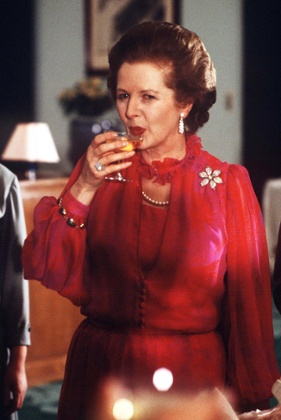
It was not just that the literary right approved of Thatcher’s assault on the trade unions and her plans for higher education; their admiration was enhanced by the fact that, almost to a man, they found her physically attractive. “What a superb creature she is – right and beautiful,” Larkin declared in December 1984, after declining her offer of the poet laureateship. “I find Mrs Thatcher very attractive,” Powell recorded after the first dinner of October 1982, “if not at all easy.” Making “covert inquiries” as to how the other guests felt, he noted that “physically desirable was the universal answer among all those questioned, including Vidia [Naipaul]”. Three years later, Powell returned to the chase, deciding that her general appearance seemed to justify a comment recently dropped by the French president François Mitterrand to the effect that “she has the eyes of Caligula and the lips of Marilyn Monroe”. Wilting in the heat of her dinner-table conversation, Powell confessed himself “taken back to the age of 19, sitting next to a beautiful girl, myself quite unable to think of anything to say”.
***
But non-Conservatives were quite as fascinated by Thatcher’s physical presence and the shockwaves sent out by her personality whenever she walked into a room. Catching sight of her for the first time as an 18-year-old student, when the then secretary of state for education came to dinner at her college hall of residence, Hilary Mantel remembered “a space opening around her as people stood back to look because she was a phenomenon. We knew we were seeing something extraordinary.” The temptation is to assume that this is a retrospective judgment nudged into being by information not available at the time, but Mantel, who wrote the episode up in her 1995 novel, An Experiment in Love, is sure that this “was when you knew she moved in a sphere of her own”, and that the seeds of her short story “The Assassination of Margaret Thatcher” were sown here, around a college dinner table, all of 45 years ago. “It seemed to me extraordinary that at this time in my life this extraordinary creature had breezed through,” Mantel recalls. “I simply couldn’t forget it.”

It was one thing for the literary left to identify Thatcher as a political opponent. But how did they see her in strictly cultural terms? The temptation was to deride her as anti-intellectual, a philistine, entirely uninterested in the life of the mind. The words put into her mouth by Michael Dibdin in his novel Dirty Tricks (1991) are entirely typical of the tenor of the time: “And don’t for Christ’s sake talk to me about culture. You don’t give a toss about culture. All you want to do is sit at home and watch TV. It’s no use protesting. I know you. You’re selfish, greedy, ignorant and complacent. So vote for me!”
In fact, much of the evidence suggests that Thatcher was a great deal more culturally astute than the left ever gave her credit for. How many modern prime ministers, for example, would be able to greet a distinguished poet by quoting one of his poems back at him (as she did to Larkin) or take the trouble to appoint a bona fide writer – in this case Lord Gowrie – to the post of arts minister? Powell, at the first dinner, overheard her talking about Helen Gardner’s study of TS Eliot’s Four Quartets. At the second he and the prime minister discussed Dostoevsky. Could Tony Blair have done this? Or Gordon Brown? Thatcher may have read books because people whose opinion she respected counselled her to (Moore confirms that she began The Possessed on the advice of Malcolm Muggeridge, who told her it would help her understand Russia), she may have scorned the kind of mid-80s artistic “happenings” sponsored by the Greater London Council, but of all her failings, real and supposed, philistinism comes well down the list. Neither was she content to bask in the admiration of her rightwing literary acolytes if she disagreed with them. Amis, presenting his hero with a copy of Russian Hide-and-Seek (1980), a dystopia that imagines a future England under Soviet control, was sent off with a flea in his ear. “Not a very accurate prophecy,” Thatcher supposedly told him.
Although there were one or two late‑80s attempts to give the literary left some kind of organisational focus – the June 20 Group, for example, whose meetings were attended by McEwan and Rushdie – the main assaults on Thatcher’s position were carried out in print. From an early stage, novelists were eager to grasp at some of the creative possibilities offered by what, to most of them, seemed an almost monstrous figure, bestriding the political landscape of her day like some malign superhero. “We were jealous – we could never have invented a character like this,” McEwan believes, while conceding that “a lot of writers monstered her in the imagination”. And here, it might be argued, looms the great difficulty in pinning down someone so divisive, so self-evidently larger than life and yet at the same time so indisputably real, in a form as open-ended and provisional as the novel. As Alan Hollinghurst, who gave her a telling cameo in The Line of Beauty (2005), paying particular attention to what he calls the “gracious scuttle” of her walk, has said, it is “difficult to write about her without writing what would simply be a political novel”.
Nonetheless, political fiction was what most of the literary left burned to write in the Guardian-scandalising, miner-quelling, public-service-defying world of the mid-80s, and the “Thatcher novel”, or rather the anti-Thatcher novel, starts making its presence felt on the bookshelves from an early stage. Julian Rathbone’s Nasty, Very (1984), whose ghastly hero Charlie Bosham surfs into parliament on the back of the 1983 general election landslide, is a highlight, to be followed by David Caute’s Veronica: Or The Two Nations (1989), McEwan’s The Child in Time (1987), Pete Davies’s The Last Election (1986), Terence Blacker’s Fixx (1989) and Tim Parks’s Goodness (1991). What distinguishes nearly all these novels, and others like them, is the whiff of caricature. The Child in Time, so acute on the intimacies of marriage, is much less plausible in its lurid projections of third-term conservatism. Livi Michael’s Under a Thin Moon (1992), a heartfelt indictment of 13 Conservative years, maroons itself on the reef of symbolism at the point when its heroine arrives at the flat of the couple who will rob and exploit her in the middle of a prime ministerial broadcast.
“It’s all monetarist policies now,” low-life Kev helpfully explains, which ignores both the suspicion that this is not being faithful to the idiomatic line the novel had hitherto pursued and the fact that monetarism, most analysts agree, was first introduced to the British political lexicon by the Labour chancellor Denis Healey three years before Thatcher arrived at No 10. But it is the same with Thatcher-man, who starts muscling his way on to the fictional scene at about the time that his inspiration saw off Arthur Scargill, almost without exception a corrupt, prole-exploiting, Darwinian suburbanite gleefully transporting his neuroses and inadequacies into a world where they will be properly appreciated. Caute’s Michael Parsons, a home secretary in waiting, has no qualms at being ripped from his expensive boarding school and sent to a more plebeian establishment in the London suburbs, for here “there was no idleness, no affectation … and no pretence that anything counted more in life than doing better than the next boy.” Rathbone’s Bosham arranges an abortion for a friend’s sister; Blacker’s Jonty Fixx runs the school brothel; Parks’s George Crawley declines to support his soon-to-be bankrupted father and skips family funerals.
Disreputable, heartless, upwardly mobile, Thatcher-man’s negative vitality ends up working against the novels in which he features, for his ultimate effect is to confuse the moral landscape in which he is supposed to be operating. Intended – you infer – as satires of Thatcherism, novels such as Fixx, Nasty, Very and Goodness very often come uncomfortably close to glorifying the thing they seek to disparage. The most convincing fictions about a certain kind of British life in the 1980s – The Line of Beauty, Piers Paul Read’s A Season in the West (1988) or Jonathan Coe’s What a Carve Up! (1994) – are, it might be argued, those in which Thatcher’s spirit is not clumsily embodied in mean-spirited and venal characters but where she looks on from the sidelines, swells a scene or two or is merely a ghostly, validating presence – see, for example, Justin Cartwright’s Look At It This Way (1990), a razor-edged account of the deregulated and newly Americanised late-80s City of London.
As for the woman herself, her most effective fictional appearances are nearly always oblique – in Philip Hensher’s novel about a disaffected House of Commons clerk, Kitchen Venom (1997), which she ends up half-narrating, or Mark Lawson’s novella Bloody Margaret (1991), where she is glimpsed through the eyes of hangers-on, security men and the political small fry who sizzle in her coruscating presence. Even in Mantel’s “The Assassination of Margaret Thatcher”, she is – literally – a walk-on. (“high heels on the mossy path. Tippy tap. Toddle on. She’s making an effort but getting nowhere fast.”) If her achievement was, as McEwan puts it, “to make politics matter, both for those who loved her and those who opposed her”, then there is a feeling among those interested in her creatively that most of the existing representations of her are merely provisional, faint outlines of a portrait still waiting to be completed.
Perhaps it is just that mythical power of this sort, as Moore observes, needs close attention, defies the certainties of the instant response. Egremont, a survivor of the 1985 dinner, is adamant that Thatcher fiction has “never quite worked”, but that at some point someone will achieve the necessary combination of distance and comprehension to bring it off. Mantel admits that Thatcher “probably haunts my imagination”, and that she “wouldn’t be surprised” to find herself writing about her again. If social historians are just beginning to get to grips with the grocer’s daughter from Grantham and the extraordinary reconfigurations of the national fabric that she brought about, then the general feeling seems to be that novelists still lag far behind. A quarter of a century after she left Downing Street, though the fuel lies stacked up on all sides, one of the house of fiction’s most promising bonfires awaits its authenticating spark.
• A version of DJ Taylor’s essay, broadcast this week on BBC Radio 4, can be downloaded here.