It is April 1953. In Mexico City the final preparations are being made for the private view of a retrospective of the work of the painter Frida Kahlo. A few miles away in the bedroom of La Casa Azul, her famous house in Coyoacan with its azure-blue walls, the artist sits chatting cosily with death. The stench of gangrene is already upon her. "Senora Kahlo's 'body of work' is rotting away," she jokes. Death hardly raises a smile.
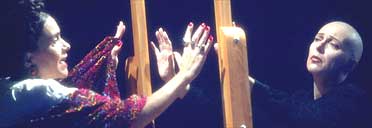
In Frida Kahlo's life the extraordinary and the ordinary rubbed shoulders. They do in Robert Lepage's production too, which takes its style from Kahlo's intimate diaries - not so much written but assembled like collages with drawings, doodles and text layered upon each other. Here straightforward biography is superimposed with the visual, as the paintings of Kahlo and her husband Diego Rivera appear and dissolve, eclipses of the sun and heart take place simultaneously, and death can climb through a mirror to stake her claim.
Although it makes use of the language of visual art, Lepage's production is also steeped in the language of theatre. Diego's betrayal of Frida with her sister Christa is symbolised with the passing of a dress from one woman to the other; when Diego is treated for penile cancer the nurse takes a gun from his genitals and simply removes a bullet.
It is all very beautiful, but too well-bred and lacking real emotional intimacy. Pain - both physical and emotional - is well-mannered and restrained. You are too busy admiring the image to feel anything, and the white gauze in front of the stage that is used as a screen has a distancing effect and adds to the general air of coolness.
Sophie Faucher, who also wrote the text, is terrific as Kahlo, but surely the earthy Mexican woman might have laughed heartily to have found her life and work transformed into such a self-conscious piece of art.
· Until October 26. Box office: 020-8741 2311.