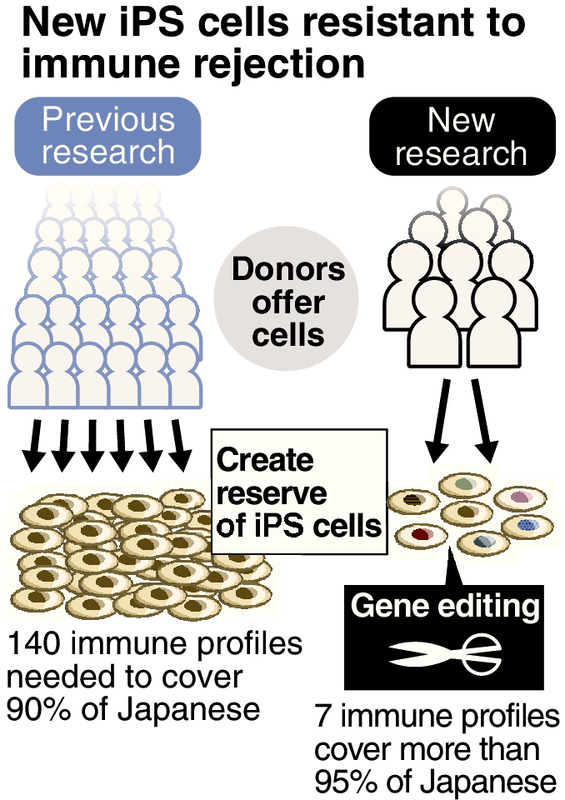
Kyoto University's Center for iPS Cell Research and Application announced it has used gene editing to develop new induced pluripotent stem cells (iPS cells) that are more difficult for the immune system to reject.
According to the center, the creation of seven types of iPS cells with differing immune profiles could limit rejection by the immune system after transplantation in more than 95 percent of Japanese. Its findings were published online in the journal Cell Stem Cell on Friday.
iPS cells are not rejected as a foreign substance after transplantation if they are made from the cells of the patient receiving the transplant. However, iPS cells made from the cells of a donor who does not match the patient's immune profile are rejected. Junior Associate Professor Akitsu Hotta, an expert on biogenetics, and other researchers used gene-editing techniques that involved using enzymes like scissors to cut and paste genes in a cell. By destroying the part of the gene that decides the immune profile of the cell, they developed a method for creating iPS cells that are difficult for the immune system of many people to reject. In an experiment using mice, they confirmed that the new iPS cells are less likely to be rejected than conventional iPS cells.
The center has promoted a project aimed at creating iPS cells from donors with an immune profile that matches a relatively large number of people, storing the cells for future transplant. The center currently supplies iPS cells with three types of immune profiles, but would need to prepare 140 types to cover 90 percent of Japanese. The project is facing difficulties in terms of costs and other factors.
Hotta's technique still faces obstacles to practical use, including fears it could cause unexpected adverse effects if a gene that is not the target of editing is affected, or increase the likelihood of contracting an infectious disease.
"We want to create a technique that ensures safety and develop iPS cells through this technique for use in medical treatment by as early as fiscal 2020," said Hotta.
Read more from The Japan News at https://japannews.yomiuri.co.jp/