KYOTO -- The Kyoto city government began levying a tax this month on stays at hotels and other accommodations, seeking to capitalize on robust visitation by foreign tourists to support the city's finances.
Municipalities with major tourist sites have increasingly adopted similar taxes as the nation's shrinking population is expected to result in diminishing tax revenues.
On Oct. 1, Kyoto Itoya Hotel in Shimogyo Ward, Kyoto, displayed a tablet device on its front desk notifying guests of the new tax. Through the new scheme, all guests at hotels and other accommodations in Kyoto are subject to a tax of 200 yen to 1,000 yen per night depending on the accommodation rate, except for students visiting on school trips.
"The cost isn't light if you stay more than one night," said a 59-year-old homemaker from Izunokuni, Shizuoka Prefecture, visiting Kyoto to see her eldest son, who lives in the city.
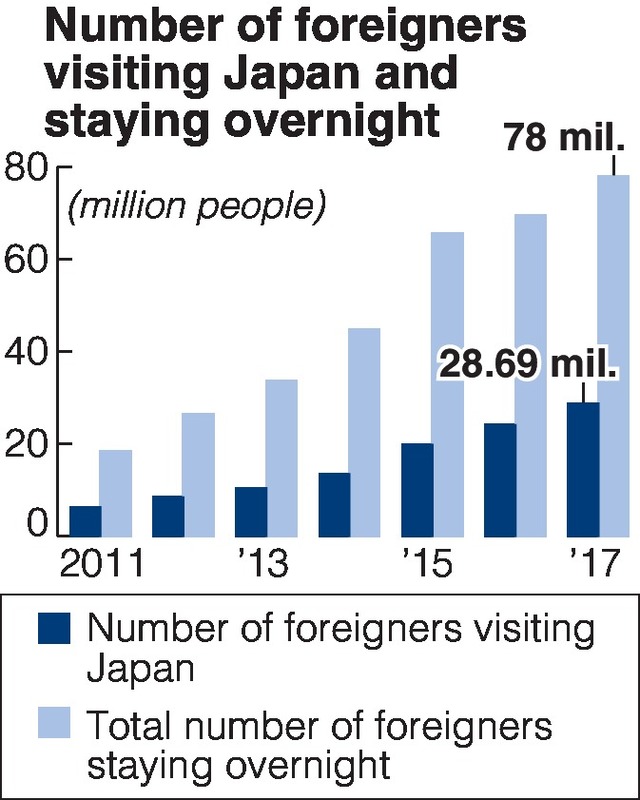
The number of tourists to Kyoto topped 50 million for the first time in 2008, with the number of foreign tourists staying overnight reaching 3.53 million in 2017, a roughly fourfold increase over 10 years.
Growing pains
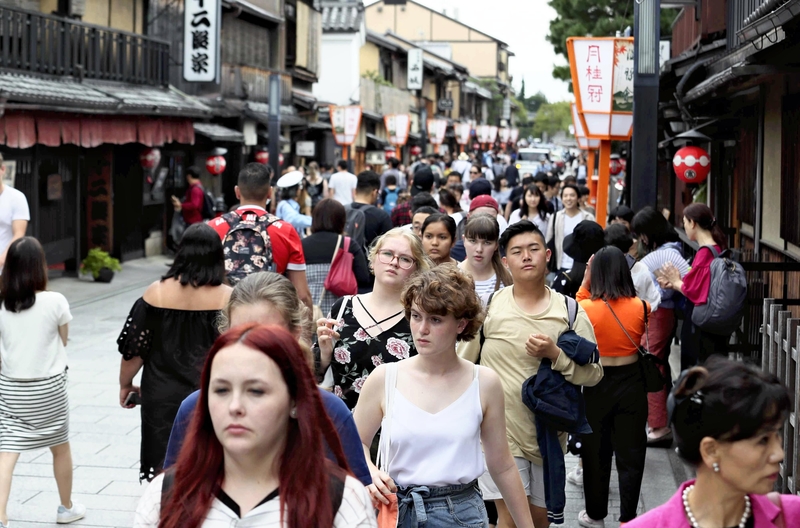
However, the increase in tourists has resulted in such problems as overcrowded municipal buses and excessive noise from minpaku private lodgings.
Meanwhile, municipal tax revenues have stagnated despite the tourist boom as hotels and other accommodations pay most of their corporate taxes to the Kyoto prefectural and central governments. These circumstances prompted the city to introduce an accommodation tax as a source of additional revenue to combat problems related to tourism.
In 1985, the city government introduced a "tax to preserve the ancient capital," which added 50 yen to the entrance fees for the city's shrines and temples. The city was eventually forced to repeal the tax due to opposition from shrines and temples.
However, the latest accommodation tax has not encountered major opposition.
Zenzo Ono, 67, head of the association of hotels and ryokan operating in Kyoto Prefecture, expressed understanding for the new tax, saying, "The increase in tourists has caused problems for residents, so some measures need to be taken."
The city government plans to use the estimated 4.6 billion yen in new annual revenue for such purposes as refurbishing municipal bus stops, which will allow passengers to more easily board and exit buses, and increasing the number of experts who advise minpaku operators.
Revenue used for Wi-Fi
The Tokyo metropolitan government introduced an accommodation tax in 2002, and the Osaka prefectural government followed suit in 2017. The Kanazawa city government plans to introduce such a tax in April 2019, while the municipal governments for Kutchan, Hokkaido, and Atami, Shizuoka Prefecture, are also considering adopting similar taxes. The new revenues are used by local governments to improve conditions for receiving tourists.
Since imposing the tax, the Tokyo metropolitan government has seen an increase in revenue as a result of booming tourism, with revenue in fiscal 2016 nearly doubling to about 2.2 billion yen. The revenue has been used for such purposes as improving tourist information facilities and expanding Wi-Fi services.
However, new accommodation taxes do not always generate the amount of revenue expected. The Osaka prefectural government projected additional revenue from the tax to be 1.093 billion yen in fiscal 2017, but only collected about 750 million yen -- roughly 70 percent of the initial estimate -- as an increase in the number of hotels resulted in greater price competition and more guests spending less than 10,000 yen per night, the minimum threshold for the new tax. The prefectural government subsequently moved to lower the threshold to 7,000 yen.
Prefecture, city at odds
In Fukuoka Prefecture, both the prefectural and Fukuoka city governments are considering introducing an accommodation tax, possibly resulting in double taxation. In a written statement submitted to the prefecture in mid-September, the city government urged careful consideration of the matter, stating double taxation would burden both guests and accommodation operators.
The statement prompted a backlash from Fukuoka Gov. Hiroshi Ogawa, who said the city government is "ignoring the efforts made by the prefecture thus far, which is very regrettable."
In Kyoto, minpaku guests are also subject to the accommodation tax, but at least 122 unauthorized minpaku facilities operated without a city license as of the end of August. The city therefore faces a challenge to collect the tax from every operator.
"Residents basically don't pay the accommodation tax, lessening the likelihood they'll oppose it. Moves to introduce the tax are likely to expand," said Hiroaki Hayashi, professor of finance at Kansai University. "To earn the understanding of those paying the tax, [local governments] should clarify how the revenue will be used and come up with schemes that will be welcomed by tourists."
Read more from The Japan News at https://japannews.yomiuri.co.jp/