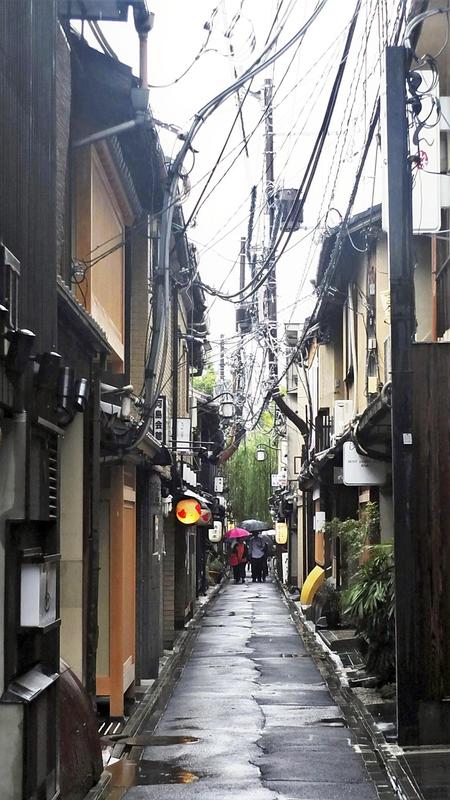
Work is under way to eliminate utility poles along Pontocho alley, an entertainment district in Nakagyo Ward, Kyoto, where about 140 shops including teahouses and restaurants stand side by side. In an effort to lure back customers driven away by COVID-19, local shop owners are using social networking posts to show off the alley's spruced-up look.
Pontocho alley, about 490 meters long and running north and south, originated in the Edo period when embankments were built to prevent flooding from the Kamo River, which runs through Kyoto. The area grew crowded with teahouses and developed into an entertainment district. After World War II, the number of restaurants increased, and with the rapid growth of the economy and the spread of consumer electronics, electrical cables soon crisscrossed the sky above the 2- to 4-meter-wide alley.
As efforts to preserve the townscape progressed throughout Kyoto City, the shop owners set their own rule in 2011 to ban signs "sticking out in the alley." Thanks to that rule, which is stricter than the city ordinance, signs that disturbed the scenery disappeared. However, the abundance of unsightly electrical cables became more visible.
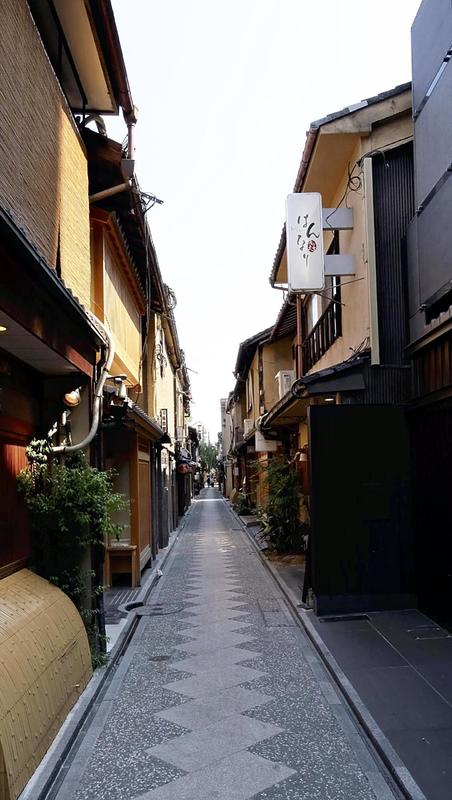
In the wake of the Great East Japan Earthquake, concerns grew over the possibility of utility poles collapsing in the event of a disaster. In 2013, shop owners asked the city government to eliminate utility poles, and work to bury electric wires and communication cables began. By March this year, eight utility poles on the north side had been removed, and the raggedy asphalt alley was repaved with attractive blocks. The remaining utility poles on the southern end will be removed by the end of the year, and the project is expected to be completed by next spring.
A group of shop owners calling itself the Pontocho Town Planning Conference created an Instagram channel in late May to post images of the alley. Akira Kambe, 43, secretary general of the group, said: "Although business has hit bottom, [the period] provided an opportunity to reimagine our town. I can't predict yet when our customers will return, but I want to sustain this wonderful district."
Ritsumeikan University Prof. Hideki Endo, who specializes in tourism sociology, said, "It is meaningful that townscape improvement and disaster countermeasures have been facilitated based on local demands." He added, "Amid concerns over COVID-19 infections, new forms of tourism should be considered, such as utilizing digital technology to introduce local culture and scenery to impress people, rather than merely waiting for visitors."
Read more from The Japan News at https://japannews.yomiuri.co.jp/