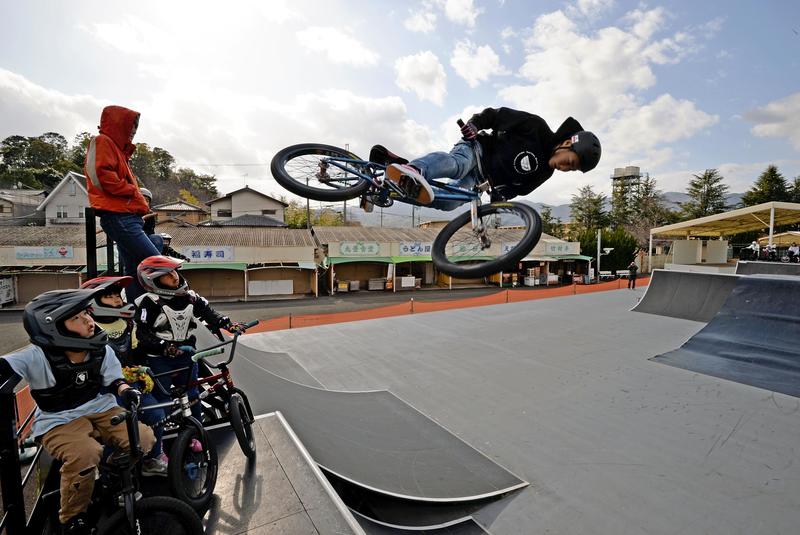
KYOTO CITY -- A biker pedals a steep slope standing more than two meters high. Suddenly, he executes a jump with the bike, fliping and turning the handlebars midair. He and other bikers are trying out their moves at Cycle Park Kyoto in Muko, Kyoto Prefecture. This activity, known as BMX freestyle park, is gaining attention as a new official event for the Olympics, set to make its debut at the Tokyo Games.
BMX freestyle park is an event where riders compete on a course with multiple jumping platforms and are graded on the level of difficulty and execution of their techniques. It has gained popularity as an urban sport that encompasses music, clothing and other style aspects.
Cycle Park Kyoto was built on the site of the Kyoto Mukomachi Keirin bicycle race track, which originally opened in 1950. A betting ticket booth is nearby. As older fans also drop by, the park sees a wide range of generations visit.
In 2017, Tokyo-based Japan Photo Finish, which operates government-sanctioned competitive sports events where gambling is allowed, was commissioned by Kyoto Prefecture to operate the bicycle race track. The company wanted to change the track's conventional image, creating a different kind of bicycle race from the previous one with BMX. Cycle Park Kyoto was completed in 2018 at a cost of about 28 million yen.
Meanwhile, BMX freestyle park was adopted as a new official event for the Tokyo Olympics, following the debut of BMX racing at the 2008 Beijing Games. The success of Kyoto City native Rim Nakamura, 18, in BMX freestyle park has also drawn more fans to the sport.
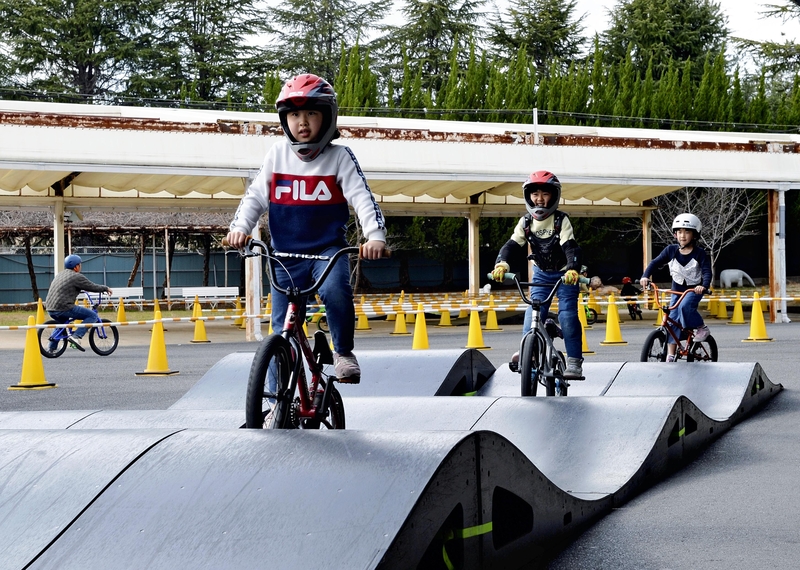
Cycle Park Kyoto's main course is for riders at the intermediate level and above. The course measures 40 meters long and 15 meters wide with three large jumping platforms, making it one of the largest in the country. Additionally, there are courses for children lined with cones so beginners can also take part.
Bicycles and helmets can be rented for 500 yen so visitors can come empty-handed. People can also bring their own bike.
A man in his 50s from Kyoto City visited the park for the first time in February with his children. "They love to be outside and be physically active," he said. "It's nice to be here and play all day long."
The park is one of the few facilities in the country where official competitions can be held and top players sometimes train there, such as Akira Takahashi, 15. The teenager from Kyoto Prefecture ranked sixth in Japan in BMX freestyle park last season. As soon as he started riding, children watched, savoring his performance.
One of the features of this facility is that both experts and beginners can improve their skills at the same place.
"I think BMX is going to get a lot of excitement from places like this," Nakamura said. "I'm happy that it has been built in Kyoto."
According to the Japan Freestyle BMX Federation, only 60 to 70 men and women, a small number, are registered to compete in official competitions. However, the number of devotees is said to be in the thousands, and if someone wins a medal at the Olympics, there is the possibility of an immediate boom.
"We hope to make the facility a base for promoting BMX," a Japan Photo Finish employee said.
From the ancient city of Kyoto to the world: The day when this park is known as the "Holy Land of BMX" may not be far off.
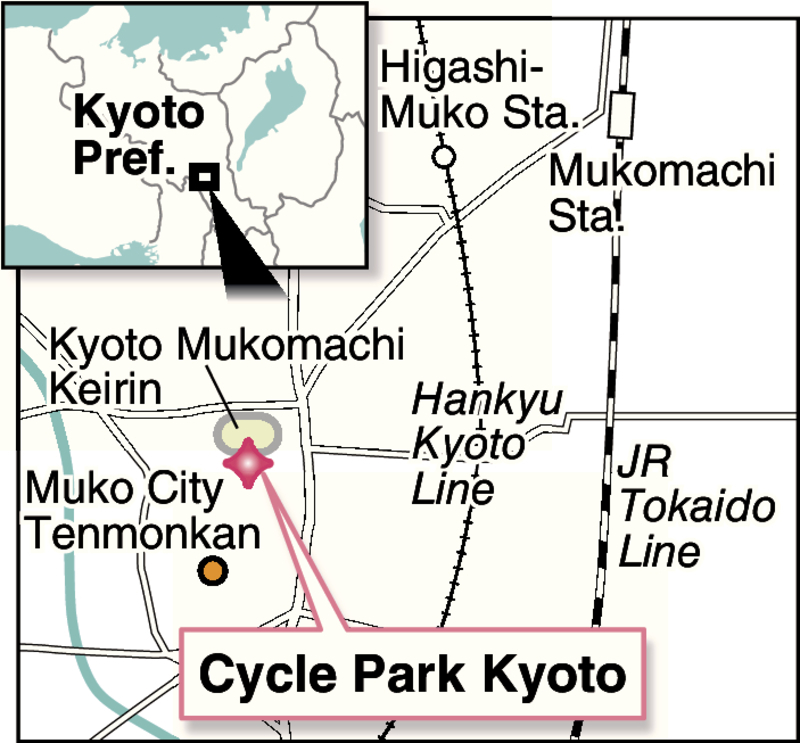
From Hankyu Higashi-Muko Station or JR Mukomachi Station, Cycle Park Kyoto is a 15- to 20-minute walk.
It is open from 10 a.m. to 3:30 p.m. on Saturdays, Sundays, national holidays and some long holidays. Facility fees are 500 yen for adults, 300 yen for high school students and 200 yen for junior high school students and younger.
When using the area with jumping platforms, an annual insurance premium that must be renewed yearly is charged, at 1,850 yen for high school students and older and 1,450 yen for junior high school students and younger.
When you want to extend your trip, the Muko City Tenmonkan is recommendable.
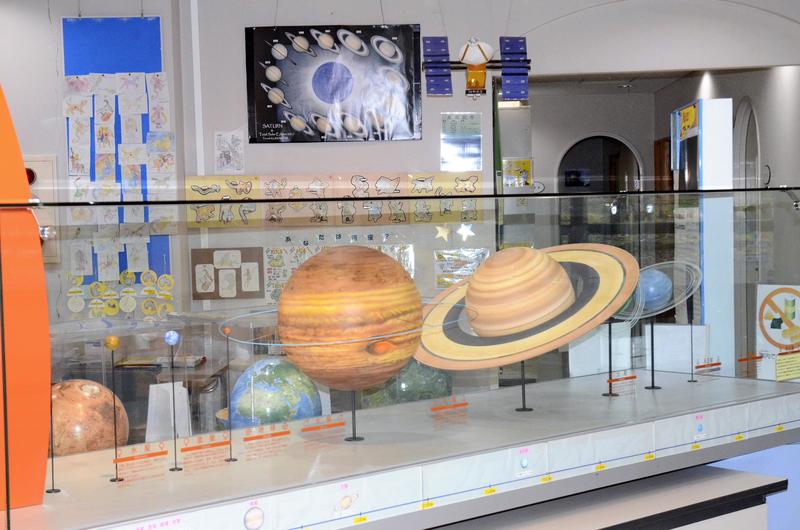
At the astronomical observatory, visitors can try on a replica of an astronaut's training suit and learn about astronomical objects through the models exhibited. It is free and open to the public.
There is also a planetarium with shows priced at 100 yen for elementary and junior high school students and 200 yen for those older.
It is closed on Mondays, Tuesdays and national holidays. Astronomical observations are held on the second Saturday night of every month. It may be temporarily closed due to the spread of the novel coronavirus.
Read more from The Japan News at https://japannews.yomiuri.co.jp/