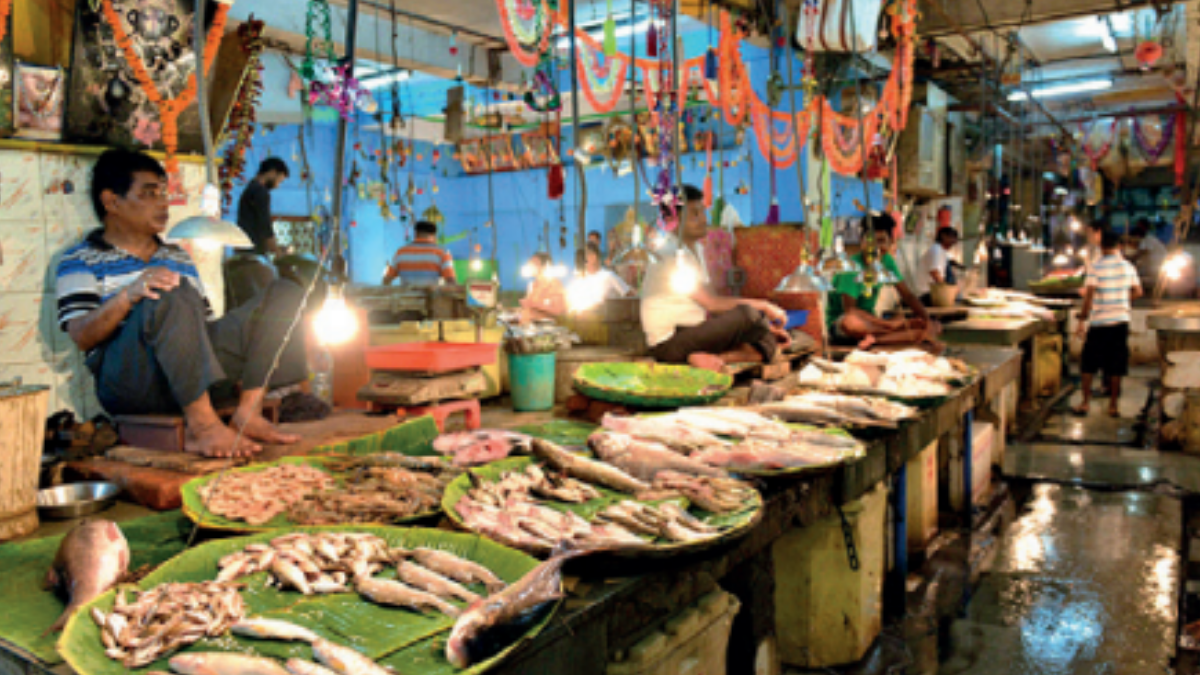
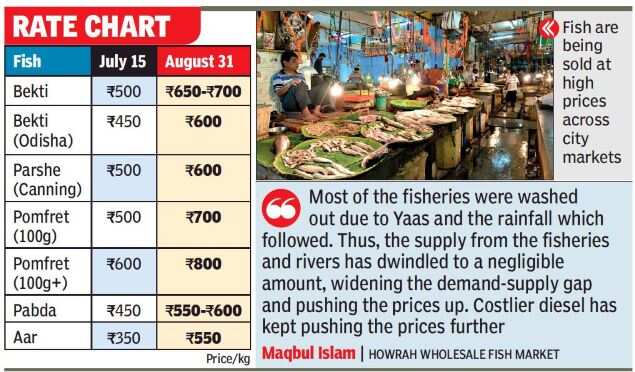
KOLKATA: The city’s retail fish markets have seen an unusual gap between demand and supply, with the flow of supplies from Bengal’s numerous bheris and rivers drying up due to the cyclone in May and the flood. Fish sellers of Kolkata are now overwhelmingly dependent on supplies from Andhra Pradesh and Odisha. The demand-supply gap and costlier diesel have pushed up the prices of the regular varieties by Rs 150 to Rs 200.
“Most of the fisheries were washed out due to Yaas and the massive rainfall which followed the cyclone. Thus, the supply of fish from the fisheries and rivers has dwindled to a negligible amount, widening the demand-supply gap and pushing the prices up. Costlier diesel has kept pushing the prices further,” said Maqbul Islam of Howrah wholesale fish market.
This is the time when supply of various varieties, including tangra, topse, pabda and hilsa, surges significantly, pulling prices down. But the vagaries of weather have hit fishermen hard. “In most of the bheris, we have started from scratch, right from fish seedlings. It will take at least a year to restart supply to markets,” said Shankar Ghosh, a fishery operator in East Midnapore.
“The demand-supply gap is here to stay for some time with our production suffering a jolt. But we are trying to nurture a few unaffected bheris to keep the supply line alive,” said Bengal’s fisheries minister Akhil Giri. The fishery department has helped suppliers optimise the supply from Andhra Pradesh and Odisha.
“We are tired of eating the same rohu and katla, though their prices are shockingly high. But other varieties are scarce now. And even if they are available, the prices are beyond our affordability. Mostly, we are eating egg and chicken,” said Anurag Guchhait, a banker who lives at Chetla.
The supply line from Canning now plays a pivotal role in meeting the demand in the retail fish markets across the city.
“We have managed to maintain the supply line despite constraints. But costlier diesel has pushed prices up,” said Chandan Maity, president, fishermen association of Gosaba and Basanti.
The dearth of hilsa and other sea fish is also affecting the prices. The availability of hilsa around this time always cools off prices of other varieties. But the supply of hilsa remains extremely erratic and scanty compared to other seasons. “The bekti which should have been Rs 400 a kg is selling at Rs 650-Rs 700 a kg. Parshe, which should not exceed Rs 500, is selling at Rs 600-Rs 650,” said Amar Das, a fish trader at Lake Market.