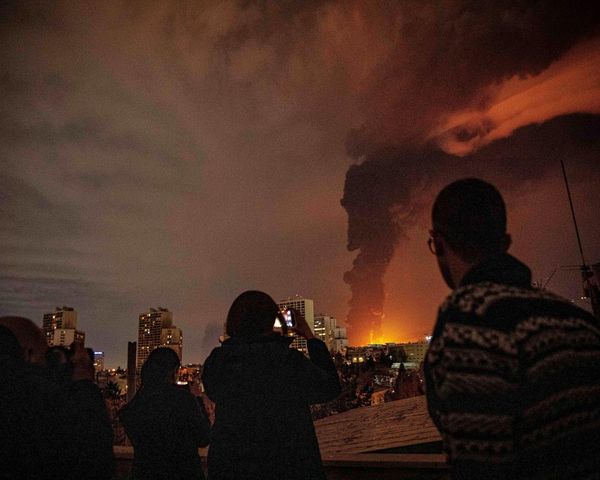
Firefighters are attempting to save the prominent north London music venue Koko, as flames were seen billowing out of its roof on Monday evening.
The London fire brigade said it was called to the scene in Camden, in north London, shortly before 9pm. It said eight fire engines and about 60 firefighters were present.
About a third of the roof of the nightclub, which in previous incarnations was known as The Music Machine and Camden Palace, was alight as firefighters tried to save the rest of the venue.
The former theatre is covered in scaffolding as part of a renovation. Georgia Gould, a Labour councillor in the Kentish Town ward and the leader of Camden borough council, tweeted images of the burning building.
Heartbreaking watching the Camden Palace / Koko up in flames this evening, a building that holds so many memories and means so much to us in Camden. Incredible how quickly @LondonFire got under control, we owe them so much for their swift and courageous response pic.twitter.com/tLPS5cLwnN
— Georgia Gould (@Georgia_Gould) January 6, 2020
Labour leadership hopeful and local MP Keir Starmer added his voice too, tweeting: “Awful news in Camden tonight. Incredible response from our firefighters.”
A 2014 Guardian guide described Koko as the London venue that “bands play when they’re too big for the clubs and not big enough for Brixton Academy”. However, it has hosted some of the world’s biggest acts, including Madonna, Ed Sheeran and Prince.
The venue was due to reopen in spring 2020 after a “major state-of-the-art” refurbishment, after the purchase of two adjacent buildings.

It first opened in 1900 and was listed as a Grade II building in 1972. Historic England describes it as having a “symmetrical facade in Baroque pastiche style”. The organisation also fetes the “elaborate foyer” and the “mixture of baroque and rococo ornament” inside the building.
And it notes the plaque of Ellen Terry, the celebrated turn-of-the-century British actress who opened the venue in its original guise. In its early years it was used to show a wide range of productions from Shakespeare to pantomime, and opera to musical comedy, and later became a cinema and a BBC recording studio, according to its listing, before finally becoming a club and gig venue.