Campaigning for Tokyo governor starts Thursday when the gubernatorial election is officially announced.
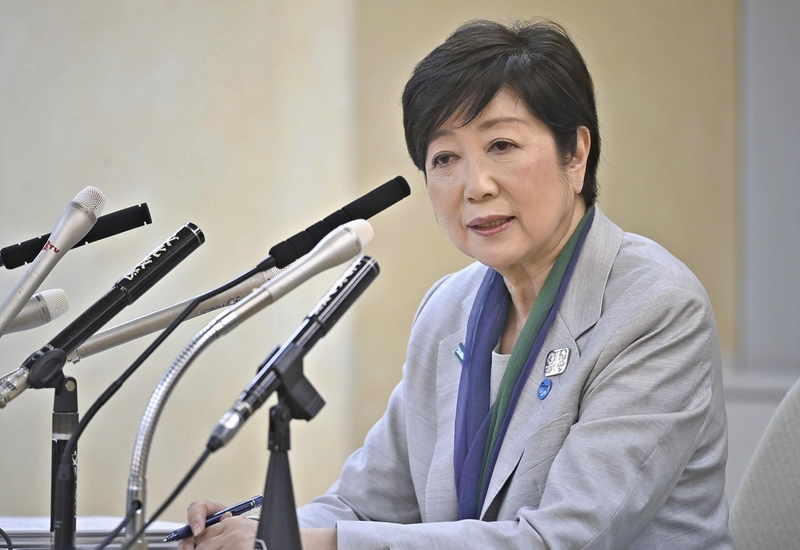
Tokyo Gov. Yuriko Koike, 67, is seeking reelection. Since taking office in July 2016, she has been focused on revising plans for the Tokyo Games and dealing with the novel coronavirus pandemic.
At times over the past four years, her Koike-esque statements and actions have created controversy.
--Toyosu Market
"The Koike administration will not approach things with a predetermined route," she said in August 2016.
Immediately after taking office, Koike froze the move of a central wholesale market from Tsukiji to Toyosu, which was supposed to happen in two months' time.
An investigation by specialists and others was conducted due to "lingering safety and other concerns." This revealed there was no soil base underneath the Toyosu Market site.
Toyosu Market finally opened in October 2018, two years behind schedule.
Under the slogan "protect Tsukiji and make the most out of Toyosu," a plan was floated to build a new market to function as a food theme park at the former site of Tsukiji Market. This did not come to pass and instead it was decided to build an international conference center and other facilities.
--Tokyo Games
"We will build the required legacy with wise spending," Koike said in September 2016.
To cut costs for the Tokyo Olympics and Paralympics, Koike reopened plans to build three new competition venues and launched a search for existing facilities that could be used instead.
However, she tried to coordinate with the International Olympic Committee or other entities but could not reach agreements. The effort was led by a group of "special consultants" that included outside experts and other figures brought in by Koike.
After the metropolitan assembly criticized the group for lack of transparency in its decision-making process, the group was scrapped in March 2018. Still, some have praised the effort for helping reduce venue construction costs by about 35 billion yen.
--Political parties
"I intend to strictly reflect on myself and once again concentrate on the metropolitan government with the residents of Tokyo as my first priority," she said in December 2017.
After her regional political party Tomin First no Kai scored a major victory in the Tokyo assembly election in July 2017, she formed the Kibo no To party to venture into national politics.
However, momentum was lost after Koike said that, regarding a merger with another party, some Diet members would be "excluded." Kibo no To suffered a major defeat in the House of Representatives election that October, leading to her apology in the metropolitan assembly.
Koike has built good relations with Liberal Democratic Party Secretary General Toshihiro Nikai, members of Komeito and other figures, and brought stability to the metropolitan government. Despite lingering rumors she will return to national politics, at a press conference this month she denied the possibility, saying, "I'm not considering that at this time."
--COVID-19
"There is a possibility that strong measures such as a lockdown will have to be taken," she said in March 2020.
On March 23, with COVID-19 cases spiking in the capital, Koike held an emergency press conference to sound the alarm.
With no legal basis for a lockdown, some in the central government pushed back against her statement. However, the number of cases surged after her remarks and the government declared a state of emergency about two weeks later.
While Koike actively pressured businesses to close temporarily and clashed with the national government over her authority as governor, she was successful in getting her message out through catchphrases such as "stay home week."
"The governor excels in her ability to get things across in an easy-to-understand manner," a senior Tokyo official said. "Sometimes her statements go too far, but her 'sense of the game' is sharp and how people view that aspect is an important question."
--'Seven zeros'
In the previous gubernatorial election, Koike pledged to aim for "seven zeros," including no more euthanasia of pets, no more children on day care waiting lists, and no more crowded trains.
According to the Tokyo metropolitan government, 203 dogs and cats were euthanized in fiscal 2015, but zero in fiscal 2018. While there were 8,466 children on waiting lists in fiscal 2016, this had fallen to about 2,300 this fiscal year.
Regarding reducing crowded trains, while more companies are allowing remote work due to the novel coronavirus pandemic, clear results have not been achieved in this area.
Read more from The Japan News at https://japannews.yomiuri.co.jp/