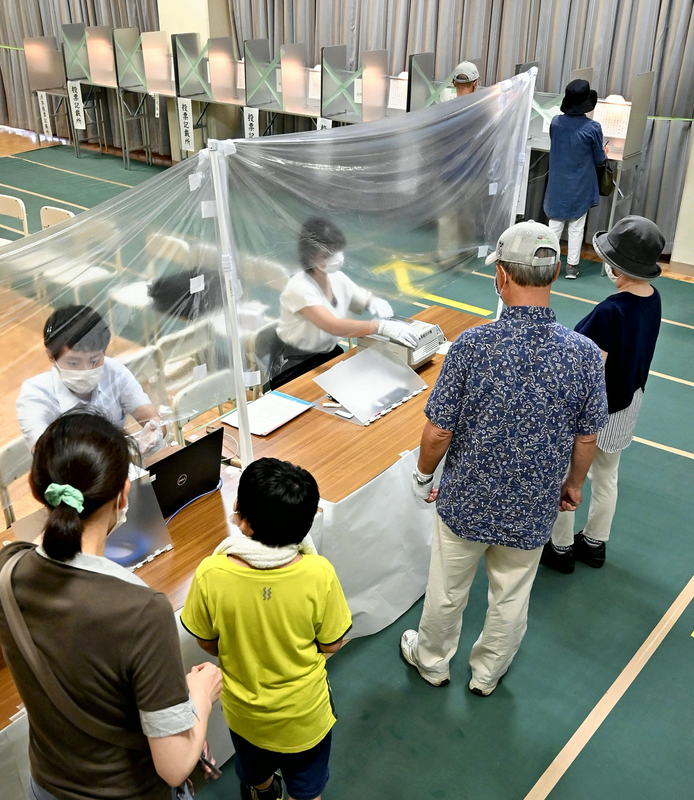
In her successful bid for reelection, Tokyo Gov. Yuriko Koike won the support of the capital's voters by strategically bringing to the forefront the image of herself as a strong leader in a crisis through her handling of the new coronavirus pandemic.
Koike's victory looks to give her more influence in the Tokyo metropolitan assembly election next year.
That said, the daily number of new cases of coronavirus in Tokyo continually exceeded 100 over the final days of the election campaign, adding to the mounting problems that the incumbent will face in her second term.
Koike, 67, made it clear she would continue to work diligently on virus countermeasures as she was informed of her projected victory immediately after voting closed at 8 p.m. on Sunday.
According to an exit poll by The Yomiuri Shimbun, 73% of Liberal Democratic Party supporters voted for her, as did 89% of supporters of the LDP's coalition partner Komeito. She even gained the support of 52% of nonaffiliated voters.
In contrast, voting by opposition supporters was split. The Constitutional Democratic Party of Japan backed Kenji Utsunomiya, 73, but only 38% of its supporters voted for him, while Koike drew 36% of their ballots. Also endorsed by the Japanese Communist Party, Utsunomiya won 55% of that party's supporters, yet quite a few JCP supporters noticeably voted for either Koike or Taro Yamamoto, 45. Votes by the Nippon Ishin no Kai were split between the candidate it endorsed, Taisuke Ono, 46, and Koike.
As the virus' toll on the economy grows more and more serious, 24%, or the largest number, of respondents in the exit poll cited economic or employment policies as the most important factor in voting for a candidate, followed by 17% who chose medical measures.
In another poll by The Yomiuri Shimbun conducted June 25-27 during the campaign, as many as 70% of respondents supported the Tokyo metropolitan government's measures against the virus, well above the 25% who did not. Those who rated Koike's first term favorably reached 75%.
Koike made her presence felt at the time of the central government's state of emergency declaration by appearing in streaming videos on the internet and other media on consecutive days to herald her measures against the virus.
Koike opted to give no speeches on the streets during the election campaign, prompting one rival candidate's campaign official to comment, "In the time of an emergency, the incumbent leader who handles public affairs tends to get all the attention. We could not break down that advantage."
--Difficulty in simplifying Olympics
In her second term, Koike faces the urgent task of preparing for a possible second wave of new coronavirus cases.
Koike, speaking at her regular press conference as governor on Friday, indicated that if the central government declares a state of emergency again, she would consider again issuing a request to suspend operations for certain areas and businesses.
However, the metropolitan government has already invested more than 1 trillion yen in coronavirus countermeasures alone, including about 200 billion yen in subsidies to businesses that have closed down in response to the government request. The metropolitan government's financial adjustment fund, which used to contain more than 900 billion yen, has been reduced to about 10% of that level, giving the government little leeway in its finances.
On Saturday, Koike requested that Tokyo residents refrain from making trips to other prefectures deemed unnecessary and nonurgent.
"If she fails to contain the spread, it may have repercussions in terms of her political responsibility," a high-ranking metropolitan government official said,
With only one year remaining until the start of the postponed Tokyo Olympics and Paralympics, there have still been no concrete plans made on how to simplify the Games. And it can't yet be seen that the virus will be contained by the start of the event.
"If infections continue to spread, there is a possibility that the controversy over the cancellation or further postponement of the Games, which some other [gubernatorial] candidates campaigned for, will flare up again," said a senior Tokyo metropolitan government source involved in the Olympic bid.
Read more from The Japan News at https://japannews.yomiuri.co.jp/