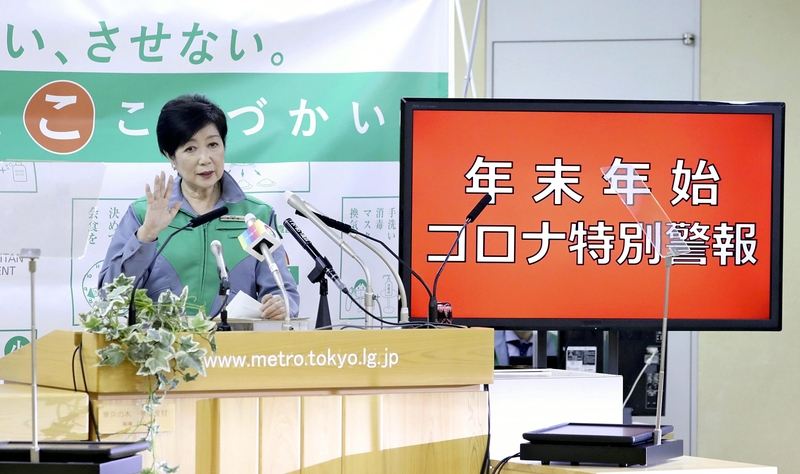
With the year-end and New Year holiday season approaching amid the spread of the novel coronavirus, Tokyo Gov. Yuriko Koike on Monday urged citizens to refrain from nonessential, nonurgent outings, invoking the "stay-home" theme that was used during the state-of-emergency period in spring.
On the same day, Shigeru Omi, who chairs the government's subcommittee on the novel coronavirus, and economic revitalization minister Yasutoshi Nishimura also held a press conference to ask people for cooperation by listing measures needed to be taken during the holiday period.
"The future of the coming year will be determined by how you spend the year-end and New Year holidays. We can't afford to say 'We are tired of voluntary confinement to prevent coronavirus infections,'" Koike said at an extraordinary press conference held at the Tokyo metropolitan government building in the Nishi-Shinjuku district of Tokyo on Monday. She called on people to refrain from such actions as gathering for year-end and New Year parties and returning to their hometowns, urging them instead to stay at home with their families during the Christmas and New Year holidays.
In Tokyo, a record 822 new coronavirus infections were reported on Dec. 17. For the week ending Monday, the average daily number of new infections rose to its highest level of 615.4 people. According to the Tokyo government, if coronavirus infections increase at the current rate for the coming four weeks, the daily number of new infections will soar to about 1,100.
Koike's extraordinary press conference came just four days after Dec. 17, when Tokyo's healthcare alert was raised to the highest level on its four-level scale for the first time and Tokyo issued its original "special alert for the year-end and New Year periods."
"Despite the fact that the coronavirus is spreading so widely, some areas were still crowded with people over the last weekend. We needed to make a strong appeal to citizens again," a senior Tokyo government official said.
The Yomiuri Shimbun compared pedestrian traffic on Saturday and Sunday in Tokyo with that of the previous weekend of Dec. 12-13 based on data from Agoop Corp., an information technology company affiliated with Softbank Group Corp. According to the comparison, pedestrian traffic on Center-gai street in Tokyo's Shibuya district was unchanged, while the Kabukicho district in Shinjuku Ward, Tokyo, saw only a 4% drop.
At the press conference, Koike announced that Tokyo would increase the number of lines for telephone consultation at the Tokyo Fever Consultation Center to 60 from the current 35 for a period from Dec. 29 to Jan. 3.
Furthermore, as a measure to strengthen support for medical institutions under increasing pressure, Koike unveiled a plan to provide subsidies for medical institutions admitting patients infected with the new coronavirus during the same period. These will be 300,000 yen a day per patient in severe condition and 70,000 yen a day per patient with mild or moderate symptoms. Tokyo also will provide 150,000 yen per four hours for medical institutions conducting tests and 30,000 yen a day for pharmacies that remain open in cooperation with medical institutions for the same period.
To protect elderly people who are at increased risk for severe illness from infections, Tokyo provides subsidies to cover testing costs for residents and workers at special elderly nursing homes and long-term care health facilities.
Koike announced at the press conference that the Tokyo government will make fee-based nursing homes and other facilities eligible for the subsidy. "It will become more difficult to secure beds for severely ill patients during the year-end and New Year periods. We will take measures to ensure the safety of Tokyo citizens," Koike said.
Read more from The Japan News at https://japannews.yomiuri.co.jp/