KOBE -- Thanks to the growing popularity of Japan as a tourist destination among foreign visitors, there has been a surge in cruise ships making port calls in the nation.
There have been more and more cruise ships anchoring at Kobe Port over the past three years since 2015. However, with many passengers funneled to Kyoto and Osaka for sightseeing, only a few tend to travel around Kobe.
To encourage more visitors to spend time in the city, the Kobe city government is promoting tours that allow visitors to experience traditional Japanese culture at sake breweries and confectionery shops, among other places.
The local government hopes to restore the popularity of Kobe and make known its hospitality as a port town where visitors can enjoy both the mountains and the sea.
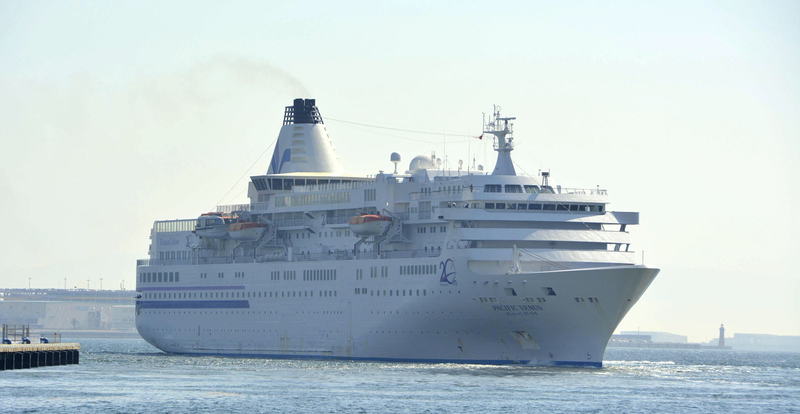
Shortly after 9 a.m. on Feb. 27, the white-hulled Pacific Venus, a 26,600-ton passenger vessel, docked at Naka Pier Cruise Terminal in the port.
On a return trip following stops at several places, including in the Philippines, the vessel left for Yokohama after unloading passengers at Kobe. The Pacific Venus has become a familiar sight at the port.
Described as an "offshore paradise" offering a "journey of glory" on the official website, the luxury cruise ship offers musical performances and facilities such as a casino and a swimming pool.
With more cruises for less than 10,000 yen per night available in recent years, such trips have become extremely popular, mainly among visitors from China, Europe and the United States.
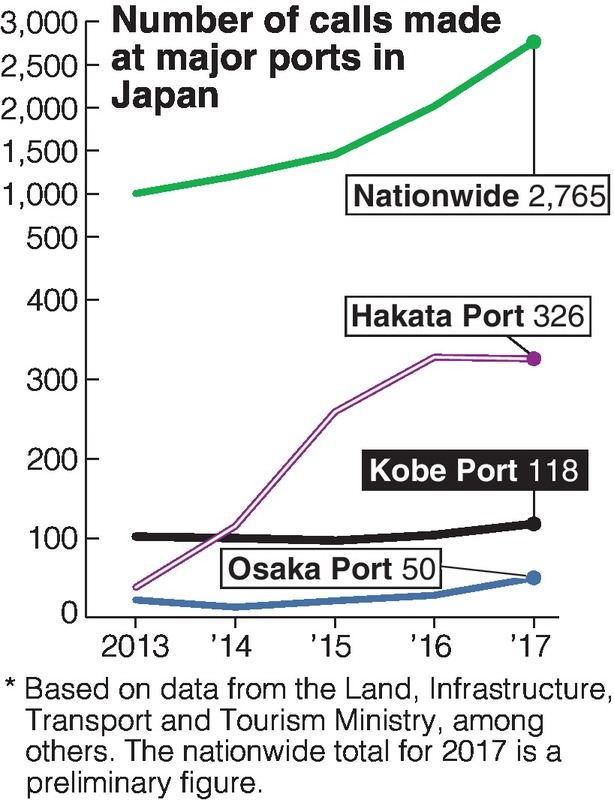
Japan has a number of popular ports for cruises. Port calls across the nation surged to 2,765 calls at 130 ports in 2017 compared to 1,454 calls at 104 ports in 2015, about a 90 percent increase, according to the Land, Infrastructure, Transport and Tourism Ministry.
In 2015, the government introduced a system to allow cruise ship passengers to disembark in Japan for sightseeing and simplified immigration procedures, making it unnecessary for such tourists to have their photo taken or apply for visas. The move also served as a tailwind for the growing number of port calls.
The central government is working hard to attract more cruise passengers as they are expected to vitalize the local economies and stimulate the overall economy.
"Each person [after disembarking at a port] will spend about 30,000 yen to 40,000, yen on average, in the port area," said an official of the city's Port and Urban Projects Bureau. As a result, each municipality is paying close attention to port calls of ships carrying between 600 and 3,000 passengers into their areas.
Although the number of port calls at Kobe Port increased to 118 in 2017 from 97 in 2015, the city has yet to receive a positive response from passengers.
Of foreign visitors arriving at Kobe Port, "Only less than 10 percent stay in Kobe for sightseeing, while most of the tourists head to Kyoto and Osaka," said an official of travel agency H.I.S. Co. "Osaka and Kyoto, with its World Heritage sites, are well known overseas," he said.
Taking this into consideration, the city government began working to encourage tourists to stay in Kobe for as long as possible.
The local government began a free shuttle bus service into the city center, placed multilingual guides on the Motomachi shopping street and other locations, and offers hands-on calligraphy and kimono-wearing lessons.
In the last fiscal year, the city government introduced a subsidy system in which it gives a grant for buses sent from travel agencies that arrange tours to more than two sightseeing spots in the city.
From September last year to the end of January, the city government received applications for only 13 buses. It plans to continue the system this fiscal year, hoping to receive applications for 90 buses.
Cruise ship passengers staying in the city for an average of about five hours showed a preference for experience-oriented tours, which combine visits to various spots with hands-on classes to make kamaboko fish paste and Japanese confectioneries, according to a survey conducted with tour participants. Spots include the Ijinkan Street district, sake breweries in harborside Nada Ward, Mt. Rokko and the Arima Onsen hot spring.
The survey also found Kobe beef was king among preferred cuisines.
"We'd like to propose a tour to promote the attractions of a city where the sea and mountains are so close to one another," said a city government official in charge of tourism.
Nobuo Akai, a professor of public economics at Osaka University, said, "One of the advantages of Kobe is that it is close to urban areas and train stations, so visitors can visit both Himeji Castle and Kyoto, which are popular among foreigners."
He added, "By increasing the number of departure and arrival slots at Kobe Port, visitors may spend extra nights in the city."
Read more from The Japan News at https://japannews.yomiuri.co.jp/