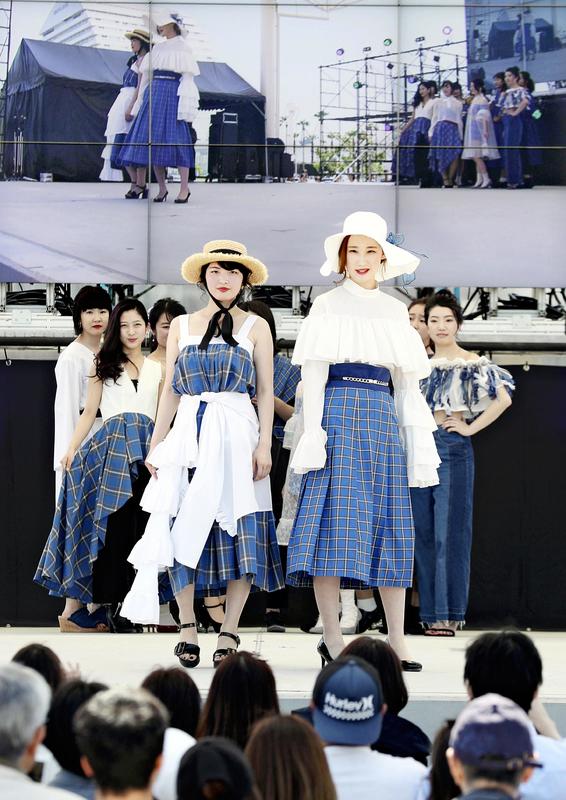
KOBE -- Blue tartan clothes are becoming a common sight in the port city of Kobe, which straddles the sea and mountains.
"It's a fashionable and fitting souvenir from Kobe," a 57-year-old female company employee from Kitakyushu said cheerfully as she looked at a handkerchief at a shop in JR Shin-Kobe Station.
The handkerchief's checkered pattern is called Kobe Tartan, and was created this year to celebrate the 150th anniversary of the opening of Kobe Port. The design is locally produced and incorporates local symbols: The blue base color symbolizes the sea, the green lines represent Mt. Rokko, and the white lines evoke historically important Western-style buildings in the city.
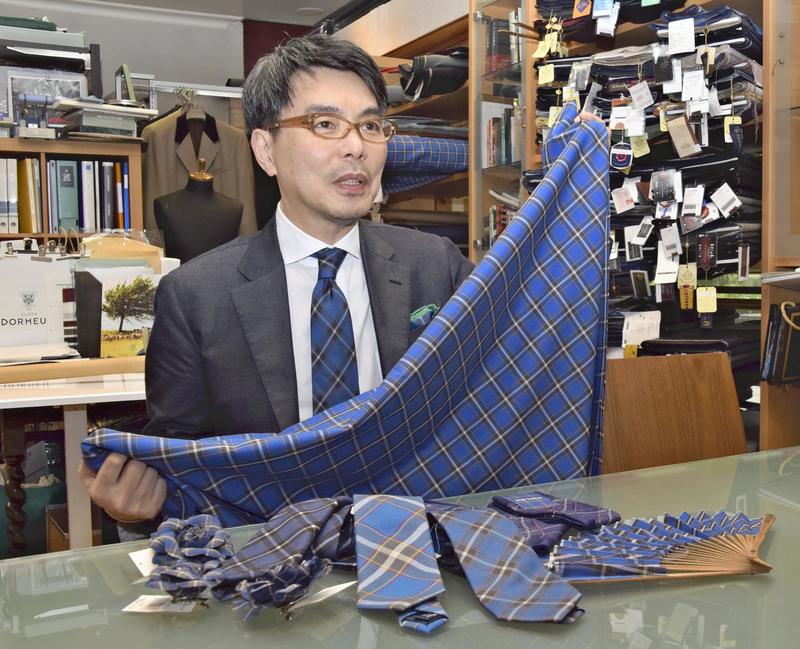
The city's municipal government, together with local industries and educational institutions, is promoting the tartan as a symbol of Kobe.
The project was started by Hiroshi Ishidahara, 62, who has run a menswear store in Kobe since 2000.
Kobe Port opened in 1868, and the city has developed while incorporating various foreign cultures. It also has ties with Scotland, the birthplace of tartan: In 1970, for example, a Scottish businessman supported the city's development by opening a sports club.
In late 2015, Ishidahara pitched the tartan as "something more than a mere event, something that will live on for ages" at a meeting of local shop owners and others to discuss an event commemorating the port's opening.
Ishidahara is a native of Osaka Prefecture who followed his forebears into the apparel business. His grandfather was a tailor and his father a wholesaler of clothing fabric.
After World War II, Kobe was considered the fashion capital of Japan. As a child, Ishidahara visited the city with his family on shopping and dining excursions. Attracted by its chic atmosphere, he decided to open his store there.
However, apparel stores in the city have decreased by more than 20 percent from the roughly 4,000 that operated in the early 1990s, mainly due to the Great Hanshin Earthquake in 1995 and competition with mega stores. Kobe is also widely regarded as less lively than nearby Kyoto and Osaka, which both attract more foreign tourists.
Ishidahara wants to reinvigorate Kobe.
He had long considered promoting tartan through his store. In October 2016, he and 13 other people, including local shop owners, set up the Kobe Tartan Council to create and manage the city's tartan brand. To encourage the widespread use of tartan, the council decided that anyone could use the design for a yearly membership fee of several tens of thousands of yen.
The council's executive members hold monthly meetings to discuss how to promote and popularize tartan. As of the end of May, the council had about 150 member companies and shops.
"Some people buy [items with Kobe Tartan] as a personal memento of Kobe after a work assignment here ends," said Tomohiro Hashimoto, 35. He manages the men's apparel shop Adam, which sells about 10 Kobe Tartan items including ties and T-shirts.
The council has come up with more ideas on how to use tartan such as wrappers for Western-style cakes and hotel wallpaper.
In late April, university students put on a fashion show featuring tartan at a park near the port. The students proudly walked the runway wearing tartan clothing they had designed.
"So there's this cute checkered pattern that has the name of my city -- that makes you a little proud," said Ai Kurokawa, 21, one of the students who took part in the show.
Clothing and small products with tartan are increasingly visible at shops in Sannomiya and other districts in central Kobe. Yet the extent of the spread has been limited.
To make tartan better known, the council and other entities sent items with the fabric to an event in Tokyo's Ginza district for promoting Kobe products in November last year. About 40 kinds of products, from handkerchiefs to pencil cases, were sold at an event in Aomori in April, and in May, the council uploaded a page to its website from which tartan greeting cards can be downloaded for free.
Kobe Tartan has already been registered with the Scottish Register of Tartans.
"I'd be glad if people all over the world think of Kobe when they see this pattern," Ishidahara said.
Building on the past
Many regional communities across the country have created clothing and textile brands as a means of invigoration.
Hamamatsu, Shizuoka Prefecture, boasts a thriving weaving tradition that dates back to the Edo period (1603-1867), when it was part of then Enshu county. Traditional Enshu tsumugi cotton fabric patterns for kimono have become popular again under the brand Enshujima. The pattern is used for ties, shirts, cushion covers, bags and other products made of the fabric.
In Ojiya, Niigata Prefecture, a local textile association is using traditional fabric called Ojiya-Chijimi to make dresses and jackets.
Kurashiki, Okayama Prefecture, which claims to be the birthplace of domestically produced denim pants, presents a unique case. The city not only promotes small items made of denim, but also "denim gourmet," denim-themed food such as hamburgers with blue powder kneaded into the dough for buns.
Background
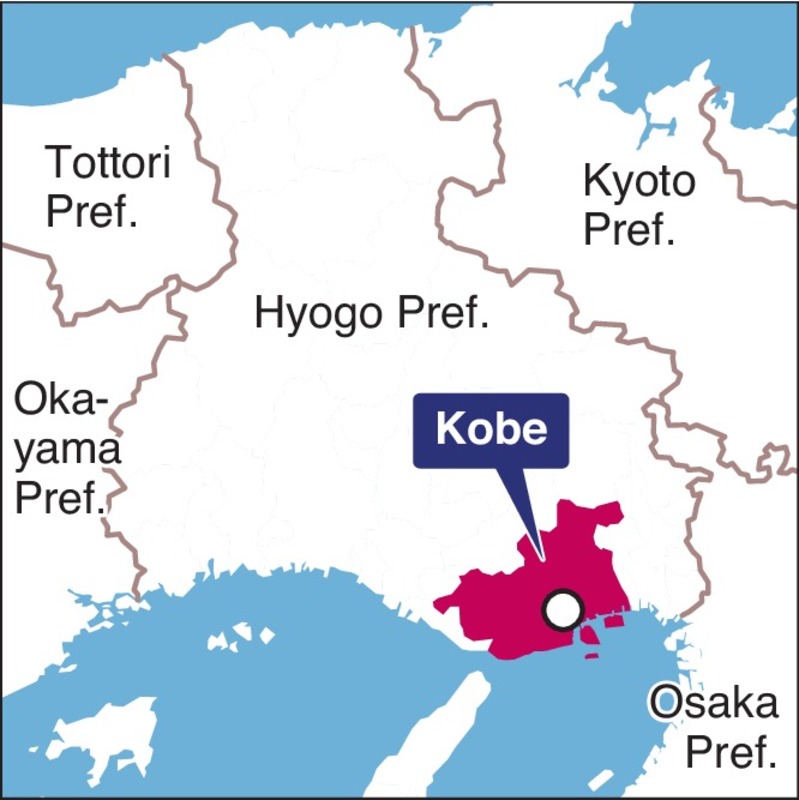
Kobe is one of the five municipalities formerly known as the five major Japanese cities other than Tokyo. Along with Osaka and other cities, Kobe became an ordinance-designated city in 1956. Located in the southern part of Hyogo Prefecture, it had a population of 1,527,481 as of April 1, making it the sixth-most populous municipality in the country.
Until the end of the Edo period, Kobe was a small hamlet called Kobe-mura (the village of Kobe). It underwent rapid development following the opening of Kobe Port in 1868. Part of the city was converted into a settlement for foreigners with many western-style houses, some of which still stand today. It was praised as the most beautiful city in the East. The peak of Mt. Rokko, with an altitude of 931 meters, offers a stunning nighttime view of the city and its port.
Read more from The Japan News at https://japannews.yomiuri.co.jp/