Is this Kobe Bryant’s last season in the NBA? Sports media seems obsessed with the debate, attempting to make sense of Bryant in 2015 while juxtaposing his apparent defiance against the reality of his play this season. Kobe’s spent almost every recent interview indulging in linguistic gymnastics to avoid directly answering the question, but to the rest of the world it appears that his performance on the court has been doing the talking for him. And it’s saying: it’s time.
It’s obvious that the 37-year-old Kobe Bryant is aeons away from the dominant force of a decade ago. In fact, he’s even far removed from the 2013 edition, when he mustered up every last ounce to will the underachieving Lakers (with a hobbled Steve Nash and Dwight Howard) to the eighth seed, before an Achilles injury ended not only his season, but perhaps in hindsight his career as we knew it.
Still, this enduring attempt to define and decipher Kobe’s NBA swansong plays into our fascination with athletes’ careers and the stark realization when our heroes actually begin to appear human.
Kobe is currently averaging 16.3 points per game, 5.3 rebounds and 2.7 assists – figures well below his career averages. He’s shooting a dreadful 32% overall and an even poorer 21% from behind the arc. Interestingly, he has fallen in love with the three-pointer, shooting a career-high eight per game, further proof that he’s none be too eager to venture into the lane. A few games ago, in what may have been the most explicit evidence of Kobe’s declining impact, he airballed two shots against Denver, harkening back to the days when he caught air against the Utah Jazz in the 1997 NBA playoffs.
But forget stats. Kobe is failing the eye test: he’s far slower on defensive rotations, he can hardly muster any lift in his jump shot, and he seems to be overcompensating for what his body simply can’t do any more. This post expertly disseminates the mechanical nuances of Kobe’s changed shot. But even for the casual fan, Kobe’s performances have been … puzzling.
This isn’t attempt to slate Bryant, but the man himself has acknowledged his decreased level of play. It appears that after missing the bulk of the last two seasons Kobe’s realized how far he’s fallen. “I’m the 200th best player in the league,” he told reporters after a 3-15 night early in the season against the Mavericks, a team Kobe’s routinely torched throughout his career. The ultra-competitive NBA waits for no one, not even legends. “I freaking suck,” he continued; a remark met with laughter from the reporters yet laced with the harsh acknowledgement that his age had finally caught up with him.
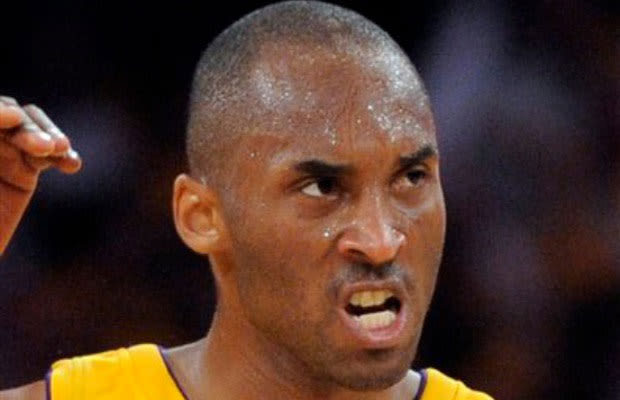
Bryant’s been oddly jovial this season, at least by his usually stoic standards. Instead of the “Kobe face” – his signature scowl that became the physical manifestation of that moment in the game when Bryant decided to take over – there’s instead been this almost accepting smirk as he drops his head and runs back on defense after clanking another jumper.
Bryant still won’t bring himself to admit it, though he’s even reportedly hired cameras to follow him around this season, giving further credence to the fact he’s very aware of the possibility. Perhaps he views a public acknowledgement as the ultimate defeat. Still, his actions point to this being his last season.
In what could have been his last appearance at Madison Square Garden, a place where he dropped 61 on Mike D’Antoni’s Knicks back in 2008, Kobe was rather retrospective. Late in the game, with the clock running down and the hapless Lakers desperately in need of a bucket, Kobe found himself in a familiar position. But unlike his heroics of old, his attempt was swatted away by Carmelo Anthony. As Kobe prepared to inbound the ball he started joking with Melo, with a smile on his face, seemingly unbothered by the fact that the Lakers were going to lose and instead determined to soak up every last moment on an NBA court – good or bad.
Earlier this week he sat out a game against Miami with a sore back. Back injuries can, of course, be debilitating, but this is a player who repeatedly defied doctors to stay on the court, taping broken fingers, writhing in pain, but doing everything possible to keep going. “I had trouble walking,” Bryant said. “I hurt the back a little bit during training camp … It’s just 20 years of running on the back. It’s not back spams or anything like that. Just wear and tear.” For the first time Kobe can’t will himself to do the impossible, nor does he really want to. Imagine that: the same Kobe who’s spent his career as the league’s ironman, willingly sitting out due to a bad back.
It seems as though Bryant vacillates between two mindsets: an enduring belief that he still has something to offer (though his body will only grant him diminishing returns at this point) and a more reflective one, simply happy to still be around the game, enjoying the grind for one last hurrah. He’s now fully capable of embracing it, soaking up every last part of the game, even in the midst of a disaster of a season for the Lakers. Finally, after a career focused on being great, he actually seems content.
This is a player who’s come to define a generation of the NBA. While Tim Duncan and LeBron James may have been more dominant, Bryant’s impact on the game has deep roots. A generation of kids adopted his “hero-ball” mantra, counting down fictional game clocks and attempting fadeaway jump shots in their driveways. The stories of his work ethic reached almost mythical proportions – Kobe practicing without the ball or the 40-mile bike ride in the middle of the night, among a host of other tales. That’s Kobe – there’s a reason you toss paper into your waste basket and shout his first name like a ritual.
Father Time remains undefeated, yet it’s always fascinating to see how an athlete manages their decline. Some players attempt to fight the inevitable by refusing to accept a lesser role: see Allen Iverson. Some don’t, and thrive: Grant Hill and Vince Carter. Some ring chase, hoping for one last shot of glory or attempting to bolster their resume: see Ray Allen. Some even avoid it altogether: Tim Duncan. But for the likes of Dirk Nowitzki and Bryant – captains of ships mired in mediocrity and transition – just being around the game is enough.
It’s perhaps not how Kobe envisioned the end of his career, on a failing Laker team careening towards another lottery pick without a semblance of structure, although recent news of his desire to play in next year’s Olympics could offer him a respite. But Bryant, who’s always maintained a sense of self-importance, seems to have accepted his fate.
And while his play on the court may no longer merit accolades, just seeing him out there competing, offering advice to rookies, or just chatting with his competitors, should bring a smile to face of even the most ardent Kobe haters.