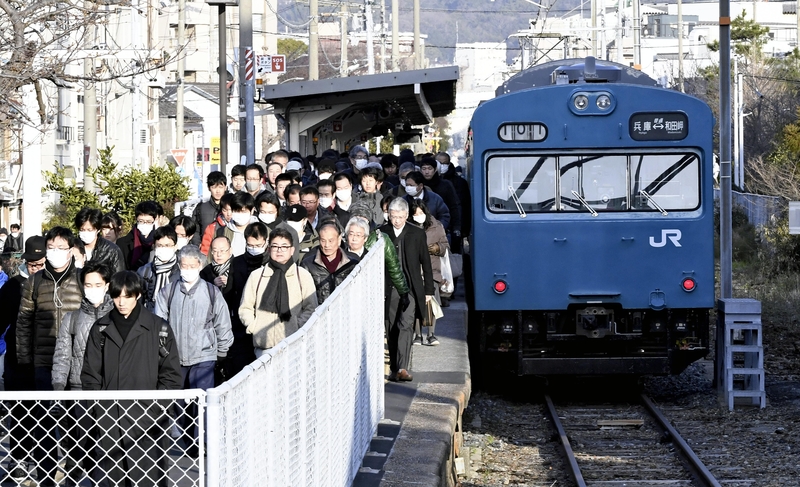
KOBE -- The JR Wadamisaki Line in Kobe, which is a short line leading to a dead-end, is called Mocho-sen (Appendix Line) because of its shape.
The 2.7-kilometer line, linking Hyogo and Wadamisaki stations, is notable for a variety of reasons, including that it serves only one section, it has only one station and runs strictly in the morning and evening hours. These rarities are why this line has attracted railroad fans. It is also a lifeline that has long sustained the people working in the community and the lives of local residents.
A sky blue 103 series train car pulled into Wadamisaki Station shortly past 7 a.m. The cars of this series were used for commuter trains on such lines as the Osaka Kanjo Line and the Yamanote Line of Tokyo when they were operated in the 1960s by the now-defunct Japanese National Railways. The cars of this series currently run on only a few lines, including the JR Kakogawa Line and Nara Line.
As the doors opened, passengers got off and filled the station platform. Almost all of them started walking in the same direction.
The line has slightly less than 10,000 passengers a day. Most of them commute to the Mitsubishi Heavy Industries, Ltd. and Mitsubishi Electric Corp. factories, and their related firms.
Katsuya Hashio, 57, of Mitsubishi Electric, who has used the line for about 40 years since he joined the company, said with a smile, "The passengers on the train that I use to commute to and from the factory are all my colleagues."
The train schedules are unique, with 17 shuttle services on weekdays and 12 on Saturdays. The train schedules are concentrated in the morning and evening rush hours, and trains do not run during the middle of the day. There are only two shuttle services available on holidays, one in the morning and one in the evening. It is really "a secluded station in a city."
The surrounding area has developed as an area for such industries as shipbuilding, and the Wadamisaki Line began commercial operation in 1890 as a branch line of what is now JR Sanyo Line.
Formerly, the railroad line was extended to the coast, with multiple stations such as one in front of the former Kanebo factory, but because of such factors as a decrease in the number of factories, the line has become what it is now.
The number of passengers using the JR Wadamisaki Line decreased sharply because of the opening of the Kobe municipal subway Kaigan Line in 2001, leading to the dismantling of the station building and the emergence of opinions in favor of abolishing the line.
However, residents strongly urged for the line to remain operational and were concerned that the area along the line "will otherwise become deserted" if the train was no longer running. West Japan Railway Co. (JR West) said it "has no plans to abolish the line at the moment."
Transport hub for new cars
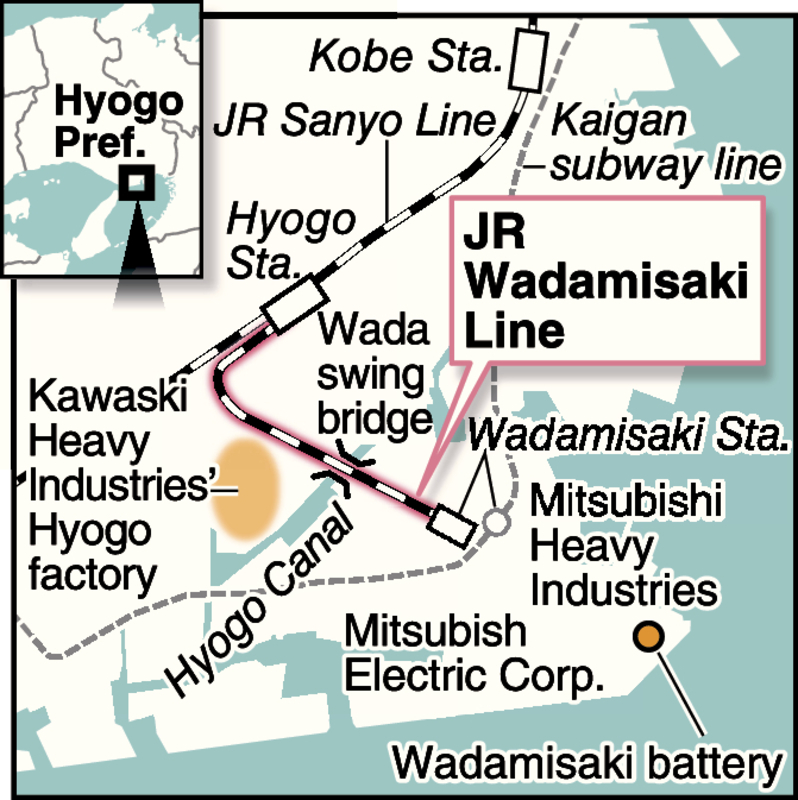
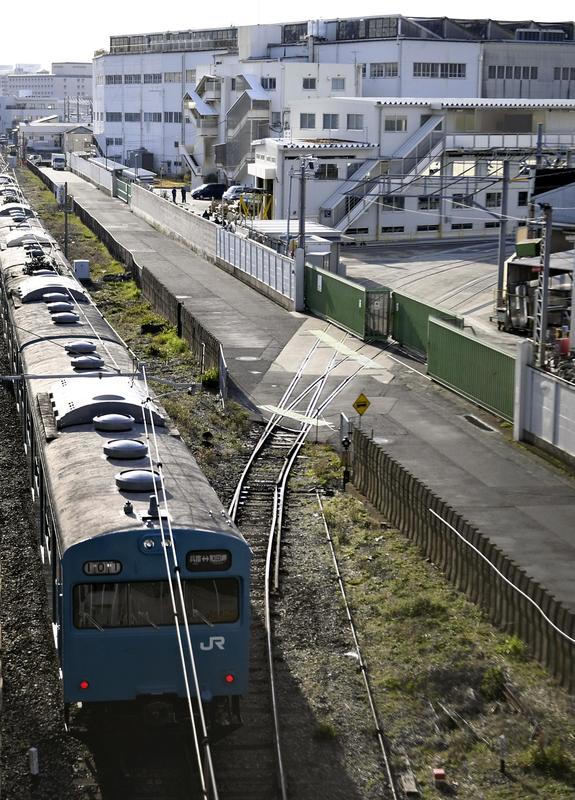
The Wadamisaki Line also serves another purpose. There is a site near Hyogo Station where the railway branches off into the Hyogo factory of Kawasaki Heavy Industries, Ltd.
The factory is one of the nation's rolling stock production centers, manufacturing train cars of Shinkansen such as Tokaido and Hokuriku lines, those of JR and private railway companies and luxury sleeper train "Mizukaze" of JR West.
Finished cars are towed by a train onto the Wadamisaki Line and delivered to railway firms nationwide. According to Kawasaki Heavy Industries, 60% to 70% of the cars manufactured annually are transported via Wadamisaki Line, and the rest by ship or other means of transport.
By taking advantage of the line's hallmark of an empty track during the middle of the day, the line is used for JR companies' in-house training of accident prevention and response measures.
Makoto Tamehiro, 61, station master of Hyogo Station, said, "The Wadamisaki Line has played an important role in a few eras, including as a means of commuting."
I saw railway enthusiasts photographing trains at stations and railroad crossings even though it was a weekday early morning. What was the draw?
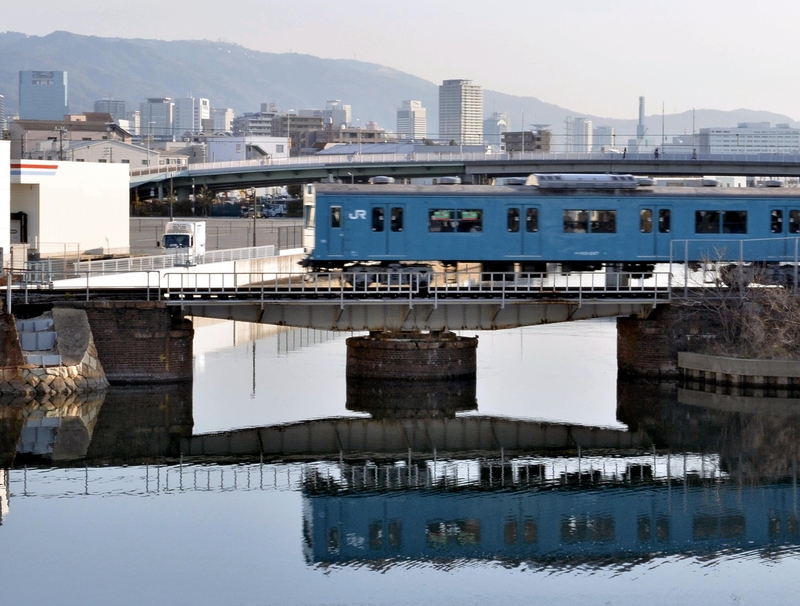
Photographer and writer Kageri Kurihara, 48, who wrote many railway-related books, talked about the charms of the Wadamisaki Line, saying, "There are many appendix lines that make us idealize the edge of the world, but this line is notable for such things as 103 series train cars, a cluster of historical factories and canals, which are profoundly reminiscent of the Showa era."
It takes a mere four minutes each way by train. The appendix line still carries passengers today with its long history condensed in landscapes seen from a train window.
If you want to extend your trip, the Wadamisaki battery is recommendable.
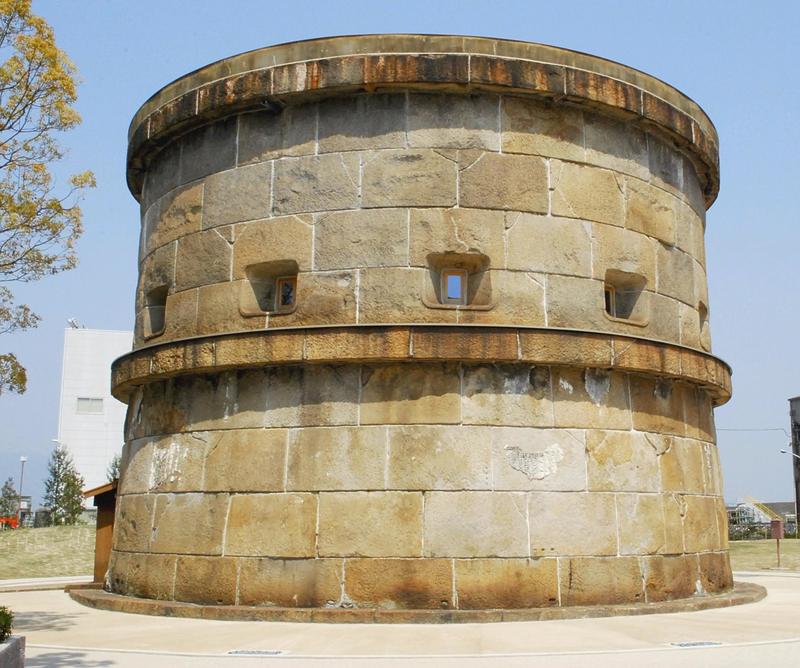
The remains of a battery are still existent on the premises of the Mitsubishi Heavy Industries' Kobe shipbuilding yard. The battery was built in 1864 in the late Edo Period (1603-1867) to protect the coast from foreign ships. Designed by Katsu Kaishu (1823-1899), the battery is cylindrical in shape and is about 15 meters in diameter and about 11 meters tall. Its exterior is made of stone and its two-story interior is made of wood.
There is an ammunition chamber on the first floor while gun ports are installed on the second floor and the roof. Periodically, tours of the battery are held.
Read more from The Japan News at https://japannews.yomiuri.co.jp/