Members of the British royal family are known to be long lived, so the death of Elizabeth II may not come soon. But it is easy enough to imagine: the procession and the crepe, the tear-streaked faces, the plastic-wrapped bouquets mounded at the gates of Buckingham Palace.
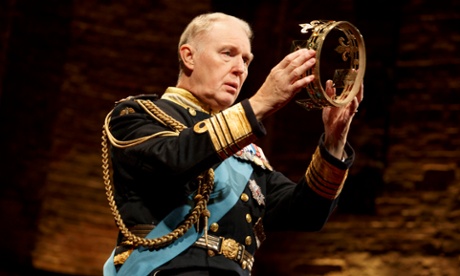
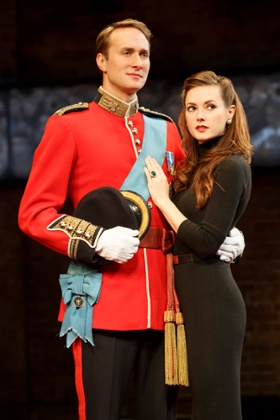
Mike Bartlett’s King Charles III, a “future history play”, is a splendid provocation and a really fine play which imagines much more. In the weeks before his coronation, Charles (Tim Pigott-Smith) chafes at the strictly ceremonial role of the monarchy. When Parliament passes a press bill of which Charles disapproves, he rather improbably refuses to give his assent. When Parliament attempts to enact the bill anyway, Charles dissolves Parliament. Soon there is a tank parked on the palace lawn. Civil unrest threatens. Meanwhile, after a romp with an art student, Harry (Richard Goulding) desires to live among the common people, while Kate, (Lydia Wilson), who has a calculating mind beneath those lustrous locks, plots decisive action for herself and Will (Oliver Chris).
Bartlett has written his play in blank verse and has modeled it on Shakespeare’s history plays, though there are significant echoes of the tragedies, too – Macbeth most particularly. (There are also plentiful echoes of George Bernard Shaw’s The Apple Cart.) I don’t think it will surprise anyone, least of all Bartlett, to say that he lacks Shakespeare’s gift for figuration and metaphor. One of the better bits of imagery compares frozen dinners to a home-cooked organic meal (a sly jab at the Duchy biscuit empire?), but most of the symbolism is predictable and limited. This blank verse gets the job done, but without the imaginative lift or quicksilver shifts that draw us to the Jacobeans.
That said, the play, under Rupert Goold’s typically clever direction, feels like more than a reasonable pastiche. It is a tragic work in its own right, about a man who has too long been denied power (“My life has been a ling’ring for the throne,” Charles says, in one of Bartlett’s better lines) and finds that once he gets it, he wants even more. If some of the middle feels workmanlike, the ending has poignancy and heft. There is a moment in the final scene that invites and earns audience gasps.
The acting is of a regal order. Pigott-Smith doesn’t look a thing like the actual Charles, but he movingly conveys the strength and weakness that war within Bartlett’s conception of the man. And boy, does he have a deft way with a soliloquy. (I don’t need to see Lear again, but I’d see his.) Wilson knows how to replace Kate’s simper with steel while Goulding, appropriately ginger-haired, nicely conveys Harry’s blokeish yearning.
Who knows if Charles will be a good king or a bad one? Who knows if he’ll get to be king at all? His mother might outlive him. Republicanism might somehow prevail. But Bartlett’s dark vision of a monarchy no longer content with being quite so ceremonial deserves a long Broadway reign.