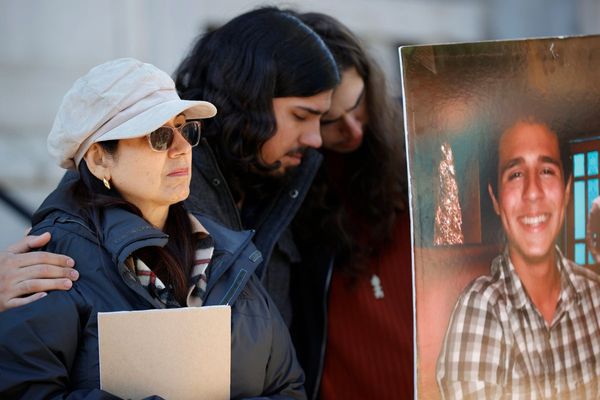
I am a refugee. When I was six years old, the Nazis occupied my home and changed my world forever.
I survived thanks to the compassion of one man and the humanity of the country he came from. Nicholas Winton, a British stockbroker who arranged for the Kindertransport to bring mainly Jewish children to the UK, saved my life and those of 10,000 others. The love and gratitude a refugee feels for the country that saved them is like no other. I feel it to this day for the country that has been my home for the past 82 years.
The arrival of the Kindertransport children in the UK was not without controversy. But leading politicians of the time appealed to the British sense of fairness and its proud humanitarian tradition to persuade the public to offer children like me sanctuary. In the words of the Conservative home secretary at the time, Samuel Hoare: “We have a splendid opportunity of raising our own level and rising to be worthy of our own standards in carrying out this task of relief and salvation.”
Sadly, it is impossible to imagine such high ideals being expressed by the home secretary today. The rhetoric of Priti Patel is designed to appeal to baser instincts and paints an unpatriotic picture of a Britain that doesn’t care about human rights, upholding the law or decency, all qualities that defined the Britain that gave me sanctuary. Far from offering today’s refugees “relief and salvation”, they are detained in camps and our doors are closed to lone child refugees stranded in Europe, even those whose only family is here and desperate to offer them a home. These policies, which leave the most vulnerable at the mercy of traffickers and keep families apart, along with talk of floating walls in the Channel and of deportation to islands in the South Atlantic, do a disservice to this country’s history.
There is nothing illegal in being an asylum seeker – those who seek asylum are exercising a legal human right that is protected by the 1951 Geneva convention. Asylum seekers have usually experienced trauma, war, torture, persecution and then endured long journeys to reach what they hope will be safety in the UK. In comparison, my two-day journey across Europe by train was a walk in the park.
The home secretary’s cruel rhetoric increasingly looks like a mask for bad decisions, in breach of the Geneva convention. This month, the high court ruled the home secretary’s policy of detaining asylum seekers in prison-like conditions at barracks in Kent was illegal. The court also found that the UK government breached the human rights of the asylum seekers who had been detained in what the judge described as “squalid” conditions.
The home secretary’s new plan for immigration, published in March, prompted a wave of complaints after the press release equated asylum seekers with “child rapists”. And once again, judicial review proceedings were issued last month against the Home Office. According to solicitor Jeremy Bloom: “The Home Office’s plan… contains a number of deeply worrying proposals, many of which may well be in breach of the UK’s international legal obligations to asylum seekers and victims of trafficking.”
Most strikingly, human rights advocates have pointed out that a claim to refugee status should not depend on the journey taken to reach safety.
The Home Office is now facing legal challenges from Conservative-run Kent council, prompted by its decision to close all legal routes to the UK for refugee children stranded in Europe. The consequence has been that those who survive the Channel end up on Kent’s shores.
This raises another problem with the Home Office’s immigration policies – they’re not only cruel, they’re not working. Closing legal routes doesn’t stop desperate people from trying to make it to the UK, especially if they have family here. Nor does it stop the people traffickers. It simply pushes refugees into the hands of criminals and into dangerous boats or refrigerated lorries.
When the Conservatives assumed control of the Home Office, the asylum process was eight times faster than it is today. These interminable delays can be devastating for refugees and they are costly to UK taxpayers. The minority of asylum seekers whose claims are rejected are supported by UK taxpayers for many months, sometimes years, before they are returned, if they are ever returned. Since the start of the year, all forms of return, either enforced or voluntary, have plummeted, which suggests that while the Home Office’s hostile environment may be making the lives of refugees miserable, if its objective was to force people out of the UK, it is not working.
Contrary to the home secretary’s claim that the Home Office is “collapsing” under the number of asylum claims, the problem lies with the Home Office, not asylum seekers. In 2019, there were approximately five asylum applications for every 10,000 residents in the UK. Compare that with the EU average of 14 asylum applications per 10,000 of the population. There are 16 EU countries whose asylum systems were able to process more asylum applications per head of population than we manage here.
Our numbers are dropping. Last year, there were 18% fewer applications for asylum in the UK than the previous year. In 2020, the UK received 29,456 asylum requests. In contrast, Germany processed four times that number (121,955), France and Spain processed three times as many (95,600 and 88,530) and Greece, with a population of just 10.7 million, processed 40,560. At its peak in 2002, the UK processed 103,000 asylum applications. Blaming refugees, who have fled war and torture, only to languish, sometimes for years, in a system that is not fit for purpose, is a failure of governance and leadership.
• Alf Dubs is a member of the House of Lords and patron of the Refugee Council
This article was amended on 23 June. Germany processed four times as many requests for asylum as the UK, not seven.