Takuya Kimura and Kazunari Ninomiya play two prosecutors fiercely opposing each other in the film "Kensatsugawa no Zainin" (Killing for the Prosecution), which opened in theaters on Friday.
What is justice? What is crime? Director Masato Harada has created a serious and entertaining work that addresses these social issues.
A murder-robbery occurs in Tokyo. Elite prosecutor Mogami (played by Kimura) thinks Matsukura (Yoshi Sako) is the most suspicious of the suspects and tells younger prosecutor Okino (Ninomiya) to investigate him. In fact, Matsukura is a material witness to an unsolved murder case that has passed the statute of limitation. Mogami, who knew the victim in that case, assumes Matsukura is the culprit in the new case as well. But Mogami's words and deeds soon cause Okino to have doubts.
The film is based on a novel of the same title by mystery writer Shusuke Shizukui. But Harada did not intend to make a mystery film. Instead, he thought he would be able to incorporate into the film various themes he was interested in, such as prosecutors going too far, false accusations and what happens to juvenile offenders later on. He was also interested in the reality of prosecution.
"Things are changing within the system. For example, more and more interrogations by prosecutors are recorded on video. I did a lot of research with the help of specialists as advisers," Harada said.
As a result, the interrogation scenes in the film show realistic one-on-one confrontations. While questioning Matsukura, Okino changes his calm attitude and bluntly accuses the suspect, raising his voice.
"I wanted to see to what extent he [Ninomiya] could lose it. We rehearsed up to the point where Okino goes berserk, and after that I let him go on his own. He has very good instincts as an actor. We filmed the scene five times, and he even added some ad-libbed phrases in the course of that," Harada said, praising Ninomiya.
The director drew earnest performances from both Kimura and Ninomiya, throwing them into one-on-one confrontations with other main cast members, including Yutaka Matsushige, Takehiro Hira and Koji Okura.
Harada said he had been paying a lot of attention to Kimura for a while.
"The good thing about him is that he's natural," the director said, citing the actor's casual delivery of remarks in the film "2046" and his off-the-cuff reactions on TV variety shows.
"If he were a soccer player, he would be a commanding midfielder," Harada said of Kimura. "He is like a commander watching not only his performance but also those of the people around him. He has a wealth of experience, so he gave me various good ideas."
Ninomiya would be a forward, in the director's opinion.
"He goes all the way forward by himself, and that was good [during filming]," Harada said.
Harada was born in 1949. He first made his name by offering serious entertainment in films about social issues, such as "Kinyu Fushoku Retto: Jubaku" (A Business Panic Movie: Jubaku). In recent years, he has widened his range of genres by turning to period drama with films such as "Kakekomi Onna to Kakedashi Otoko" and "Sekigahara."
In "Sekigahara" -- his most recent film before this one -- he cast Junichi Okada and Kasumi Arimura as the leads.
"I'm always trying to add some surprises in casting. I want to appreciate a new ensemble of actors, and there must be some joy for the audience in finding something new," Harada said.
In 2015, the 70th anniversary of the end of World War II, he directed a film about the end of the war, "Nihon no Ichiban Nagai Hi" (The Emperor in August).
In this film, he referred to the Battle of Imphal during the war even though the novel does not mention this infamously reckless operation.
"It is the most symbolic incident among all the unrighteous deeds of Japan during World War II that this country has not quite resolved," he said.
Harada has a strong belief that history must be told accurately and reckons that the major turning points in Japanese history are the Battle of Sekigahara in 1600, the Meiji Restoration in 1867 and the end of World War II in 1945.
"I've done [films on] two of them, so I'd like to work on the Meiji Restoration as well," said Harada, whose creative drive knows no end.
The Yomiuri Shimbun
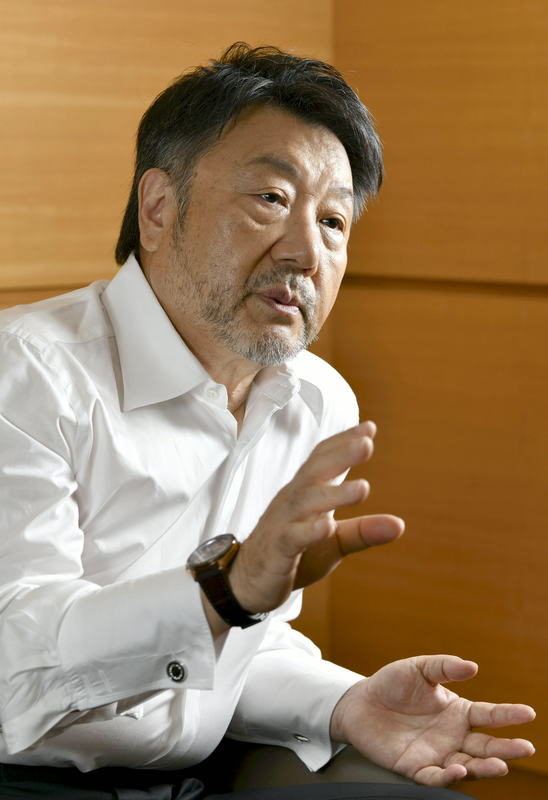
Masato Harada speaks in an interview.
©2018 TOHO/JStorm
A scene from "Kensatsugawa no Zainin" shows Takuya Kimura as Mogami, front, and Kazunari Ninomiya as Okino. Okino, who had regarded Mogami as his mentor, gradually begins to feel something is not quite right with what he says and does.
Read more from The Japan News at https://japannews.yomiuri.co.jp/