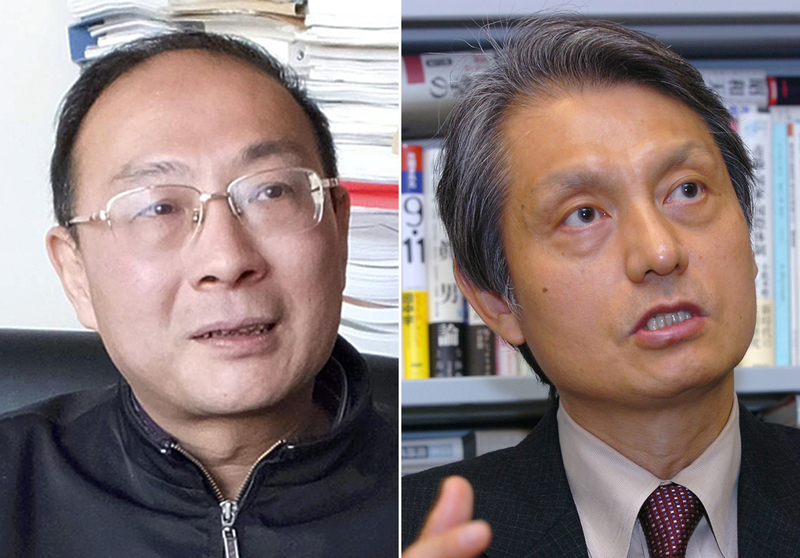
After about three weeks of media silence on his movements, it was officially announced Wednesday that North Korean leader Kim Jong Un had visited China and held talks with Chinese President Xi Jinping. This was Kim's first visit to a foreign country since he took power in 2011. How will the situation on the Korean Peninsula develop, including the U.S.-North Korea summit scheduled to be held before the end of May? The Yomiuri Shimbun asked two experts from Japan and China for their insights. The following are excerpts from the interviews.
(From The Yomiuri Shimbun, March 29, 2018)
===
China-N. Korea ties not all rosy yet
Jin Canrong / Associate Dean at School of International Studies at Renmin University of China
Although Workers' Party of Korea Chairman Kim Jong Un's visit to China was slightly surprising, it was also within the realms of what could have been expected. China not only borders North Korea geographically, it is also its largest economic partner. Historically, they have had a close, "inseparable" relationship.
North Korea is currently seeking to improve ties with South Korea and gearing up for direct talks with the United States, so it needed to strengthen its position ahead of these negotiations. If Pyongyang can hold dialogue and work closely with Beijing, it will benefit North Korea in its negotiations with both Washington and Seoul.
In the United States, John Bolton, a foreign policy hawk who has made hard-line comments about North Korea, has been announced as U.S. President Donald Trump's new national security adviser. This presents a huge risk for North Korea. Kim's visit to Beijing was, in part, an attempt to tame this risk by improving ties with China.
Seen in that light, Kim's visit at this time makes perfect sense. China is extremely important to North Korea. No nation can sideline China from any attempt to resolve issues on the Korean Peninsula. Future development of the peninsula will also be impossible without China playing a role.
Top leaders of China and North Korea had not visited the other for almost seven years, since Kim's father, Kim Jong Il, went to China in 2011. In recent years, bilateral ties had chilled. The reason for this was North Korea's firm adherence to its possession of nuclear weapons. China has come to oppose North Korea having a nuclear arsenal. After the talks, the Chinese side released a statement containing the word "denuclearization," which was not mentioned in the North Korean announcement. This indicated China firmly called on North Korea to abandon its nuclear weapons, and that this position will not change in the future.
As Kim emphasized in the statement released by the Chinese side after the summit talks, his father and his grandfather, Kim Il Sung, had actually wanted to ultimately rid the peninsula of nuclear weapons.
If Kim Jong Un did not show a similar attitude on this issue, there would be limits to how much relations with China could improve. For this reason, Kim probably ensured China saved face on the denuclearization problem. However, we do not know just how sincere Kim really is on this issue.
Kim's visit to China and his indication that he is willing to move toward denuclearization should positively help bilateral ties. Even so, China remains unable to loosen the sanctions imposed on North Korea anytime soon.
These sanctions were adopted in a resolution unanimously passed by the U.N. Security Council, so China also agreed to them. These sanctions will remain in effect until the Security Council adopts a resolution to lift them, so China will continue to implement them.
Taking all these factors into consideration, it is not realistic to expect Kim's visit to China will lead to an immediate, substantive improvement in ties between Pyongyang and Beijing.
--This interview was conducted by Keiichiro Azuma, Yomiuri Shimbun Correspondent based in Beijing.
--Jin Canrong
Born in 1962. After graduating from Fudan University, he got his Ph.D. from the School of International Studies, Peking University. He is an expert on Chinese foreign policy and U.S.-China relations.
===
Japan needs more agile approach
Lee Jong Won / Waseda University Professor
Kim Jong Un's visit to China for talks with President Xi Jinping was deftly timed ahead of his upcoming summit meeting with U.S. President Donald Trump.
North Korea's ties with China had become strained over sanctions and other issues, which had left Pyong-yang in a weak position. However, North Korea put itself in a stronger position by finding a path to summit talks with South Korea and the United States, even by excluding China from this process.
North Korea could not afford to keep China out of its corner any longer, so it quickly sought a closer relationship. Although Kim's visit was unofficial, China warmly rolled out the red carpet and treated it like a state visit. Kim's choice of China for his first foreign trip since becoming leader also saved face for China.
North Korea's biggest objective is to improve ties with the United States.
However, Kim only has a few cards he can play during summit talks with Trump. Gaining China's support gives North Korea an "auxiliary engine" to weaken U.S. attempts to pressure and fluster Pyongyang in the lead-up to the talks, and it also means North Korea can expect China to provide a "safety device" if talks with the United States collapse.
North Korea's stance on denuclearization is that the process should be done gradually and in stages. China has consistently emphasized this since last year. Denuclearization that begins with a freeze [on nuclear development] should proceed in tandem and in stages alongside improved U.S.-North Korea ties and the normalization of diplomatic relations. Kim will engage in talks with the United States knowing he has China's support on this point.
A series of developments on the peninsula have unfolded very rapidly since January. Kim has been front and center in arranging strategic moves in this diplomatic offensive. Rather than using a diplomatic policy that moves in a single direction, North Korea has taken an overall, interconnected approach as it attempts to build a major framework that will deliver economic benefits and militarily guarantee its national security.
Extremely tough international sanctions have been imposed on North Korea.
Simply leaning on a certain nation to try and glean additional economic assistance or have the sanctions eased will be unlikely to improve the situation that North Korea faces. I think we will also see some movements in North Korea's relations with Russia. At a time when North Korea is seeking to boost relations with countries concerned, it is difficult to consider that Japan would be completely frozen out. North Korea will also likely make some sort of approach to Japan.
Resolving the abduction issue remains a major problem in Japan-North Korea ties. There is an excessively strong tendency within Japan to view dialogue and diplomatic contact itself as a "concession" to North Korea. Japan's diplomacy toward North Korea has become too rigid. South Korea, the United States and China have all planned diplomatic contact with North Korea while maintaining sanctions. If Japan waits until the results of the U.S.-North Korea summit become evident, it will be too late. Japan must nimbly deal with North Korea.
The Stockholm Agreement on the abduction issue, which at the moment has been shelved, could be a beginning for diplomatic contact between Tokyo and Pyongyang. Neither side has completely abandoned the agreement. Whether the agreement is revived or axed, it should be used as a chance to communicate with North Korea.
--This interview was conducted by Yomiuri Shimbun Staff Writer Akika Abe.
--Lee Jong Won
An expert on international politics and contemporary Korean Peninsula studies. He has written many books, including "Higashi Ajia Reisen to Kan-Bei-Nichi Kankei" (U.S.-South Korean Relations and Japan in East Asia's Cold War). He is 64.
Read more from The Japan News at https://japannews.yomiuri.co.jp/