Kim Potter has been found guilty on both manslaughter charges over the shooting death of Black man Daunte Wright.
The Brooklyn Center police officer of 26 years was convicted of first-degree manslaughter and second-degree manslaughter in Hennepin County Courthouse on Thursday after she shot and killed the 20-year-old father-of-one during a traffic stop in Minnesota on 11 April.
She faces up to 25 years in prison on both charges and will be sentenced by the judge in February.
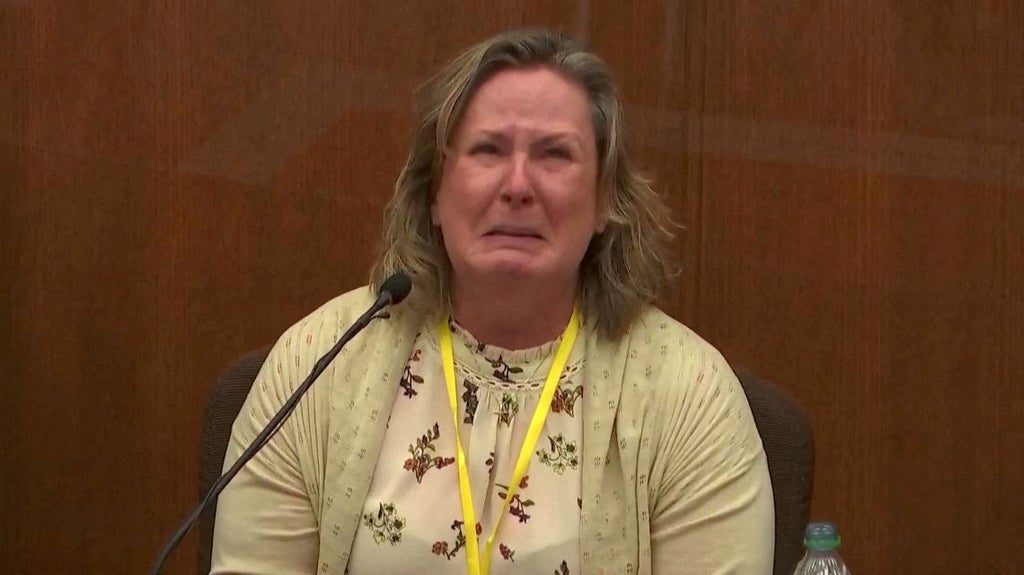
Ms Potter showed little reaction as the verdict was read out to the court, lowering her head briefly but showing none of the emotion that was seen during her testimony where she broke down in tears and said she was “sorry” for what happened.
She was flanked by her two attorneys, who stood next to her with a hand each on her shoulders.
When she sat back down she was seen clutching a chain in her hands while one of her attorneys Earl Gray put his head on the desk.
Ms Potter’s defence requested that she be released on bail arguing that it is the holiday period and she is a Christian and poses no danger to society.
The judge denied the request and the former police officer was led away in handcuffs minutes later.
The almost all-white jury reached the verdict after more than 27 hours of deliberations from the jury.
Ms Potter, a veteran police officer, shot and killed Mr Wright during a traffic stop in Brooklyn Center, Minnesota, back on 11 April.
The 49-year-old said she mistook her firearm for her Taser when she fired one fatal shot at Mr Wright.
Bodycam footage of the incident played in court shows her shouting “Taser! Taser! Taser!” before firing her handgun.
She was charged with first-degree manslaughter and second-degree manslaughter and had pleaded not guilty to both charges.
The more serious charge of first-degree manslaughter required the prosecution to prove that Ms Potter caused the death of Mr Wright while committing the misdemeanour crime of reckless handling of a firearm.
It carries a maximum sentence of 15 years in prison and/or a $30,000 fine.
The second-degree manslaughter charge required the prosecution to prove that she caused Mr Wright’s death through culpable negligence, meaning she created an unreasonable risk and consciously took a chance of causing death or great bodily harm when she used her firearm.
This charge carries a maximum sentence of 10 years and/or a $20,000 fine.
However, under Minnesota law, people with no prior criminal record - like Ms Potter - typically receive far lower than the maximum sentences. Sentencing guidelines recommend between 6 and 8.5 years in prison for first-degree manslaughter and between 3.5 to nearly 5 years for second-degree manslaughter.
Prosecutors told the court in October that, if she was convicted, they intended to seek a more severe sentence than the recommended arguing there were aggravating factors in the case.
During closing arguments, prosecutors told the jury that being a police officer does not mean having “a licence to kill” and that Mr Wright’s death was the result of a “colossal screw-up” by the veteran officer.
The case is about the “reckless handling of her firearm” and “culpable negligence” by the defendant, said Prosecutor Erin Eldridge, arguing that she put “four people directly in harm’s way” when she opened fire on the 20-year-old.
She added that something being “an accident” does not mean it isn’t a crime, with intent to kill Mr Wright not part of the charges.
In the defence’s closing arguments, attorney Earl Gray argued that Mr Wright “caused the whole incident” by failing to comply with the officers when they pulled him over.
He argued that Ms Potter also had the right to use deadly force because she believed her fellow officer was in danger.
Ms Potter took the stand at her trial as the final witness called for the defence.
She gave emotional testimony, breaking down multiple times and apologising for Mr Wright’s death.
“I’m sorry it happened. I’m sorry,” she sobbed. “I didn’t want to hurt anybody!”
Jurors - consisting of nine white people, one Black woman and two Asian women - deliberated across four days and more than 27 hours. By comparison, jurors deliberated for 10 hours back in April before finding another white Minnesota police officer, Derek Chauvin, guilty of the murder of Black man George Floyd.
The jury showed signs that the 12 were struggling to reach a verdict on Tuesday afternoon when they sent a question to the judge asking what they should do if they couldn’t reach an unanimous verdict.
“If the jury cannot reach consensus, what is the guidance around how long and what steps should be taken?” jurors wrote in one of two notes sent to the court that day.
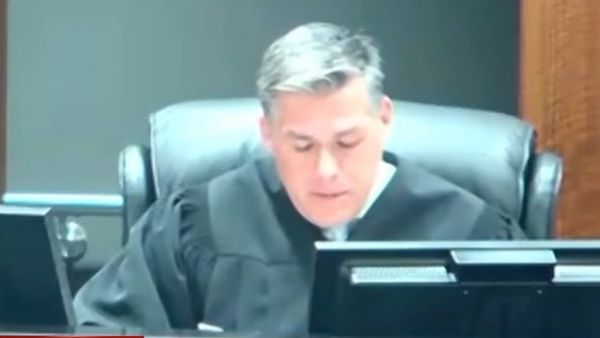
Judge Regina Chu responded by rereading the jury instructions that they should continue to “discuss the case with one another and deliberate with a view toward reaching agreement if you can do so without violating your individual judgment”. Jurors were then sent back to deliberate further.
The other note asked for the zip ties securing Ms Potter’s firearm to an evidence box to be removed so that they could handle it.
The judge granted the request and assured the court that the gun is fully secured and not loaded.
During deliberations, jurors sent only one other note to the court - a question on Monday afternoon asking for the date of Ms Potter’s interview with Dr Laurence Miller, a forensic pathology expert called as a witness for the defence.
The judge did not give the jurors the date instead telling them that “all the evidence is in. So you should rely on your collective memory as to what the evidence is”.
Jurors were ordered to be sequestered during deliberations, meaning they must stay at an undisclosed hotel and not return home until they reached a verdict.
The judge has said they would not be made to deliberate on Christmas Eve or Christmas Day and would return to deliberations after the holiday if they were yet to reach a verdict.
Jurors were permitted to communicate with their family members while the deliberations were ongoing so long as they did not discuss the trial.
The death of the Black man at the hands of a white police officer has drawn parallels with the murder of Black man George Floyd by white police officer Derek Chauvin in Minneapolis, Minnesota.
Mr Wright’s death came at a time when Chauvin’s trial was going on just 10 miles away in Hennepin County Courthouse, sparking renewed protests calling for racial justice and an end to police brutality.