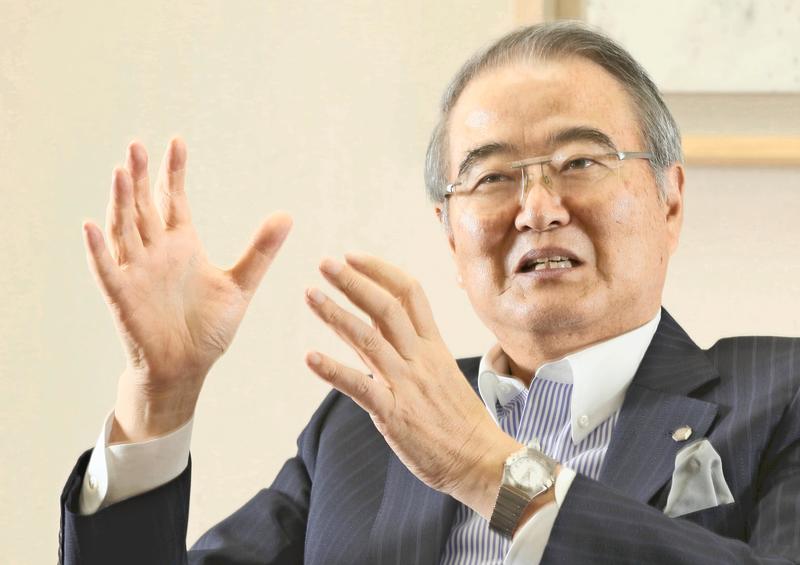
Having brought soy sauce to the United States and beyond, Kikkoman Corp. continues to successfully expand its overseas operations. Protecting a traditional Japanese seasoning, however, means the domestic market is also essential. How does one expand a mature market? For this installment of Leaders, a column featuring corporate management and senior executives, The Yomiuri Shimbun spoke with Kikkoman President and Chief Executive Officer Noriaki Horikiri.
What impacts the food manufacturing industry is the number of people and the size of their stomachs. The population in Japan is declining and as it ages the amount of food eaten also falls, making quantitative growth difficult. It's become necessary to shift from quantity to quality.
One way to do so is by matching individual needs through a variety of products in small quantities. It's also important to generate new demand.
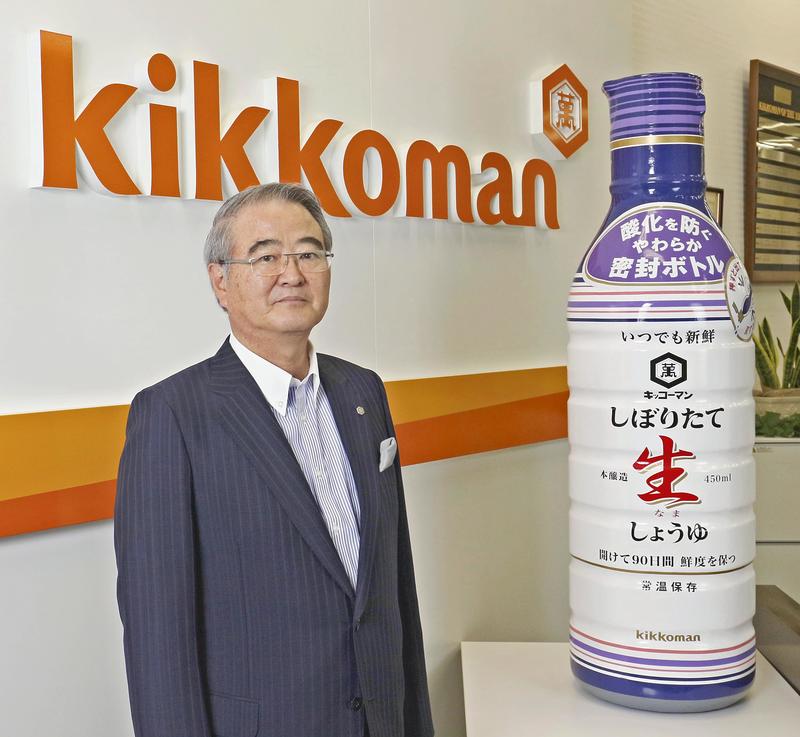
One of our company's hit products is the Itsudemo Shinsen (Always fresh) series. This includes Nama Shoyu (Raw soy sauce), which stays fresh for a long time.
Originally, when opening a bottle of soy sauce, it would start to oxidize upon coming into contact with air. This caused it to turn black and lose its aroma. Research into how to preserve its quality for longer took nearly 20 years. Developing the right container, however, proved difficult.
We achieved this with a dual layer, pouch-shaped, airtight container for the Nama Shoyu that went on sale in 2010. We started selling the bottled version the following year. Although air is sucked back into the soft container after you squeeze out the soy sauce, it enters without coming into contact with the soy sauce in the central pouch. The so-called non-return valve cap that makes this possible was jointly developed with a container manufacturer. We got the idea from how containers for cosmetics and other products are made.
Normally, in order to stabilize the quality of soy sauce, it is heated in the final process of pasteurization. By developing a new container, we were able to make unpasteurized raw soy sauce into a product. Compared to the regular product, it has a gentler aroma and milder flavor.
[The store price for Nama Shoyu is about 200 yen per 200 milliliters. That's about five times the unit cost of a 1-liter plastic bottle of regular soy sauce sold at a bargain price.]
With products like Nama Shoyu that use new containers, consumers don't need to keep using soy sauce after it has lost some flavor or throw it away before it is all used up because it has gone stale. Products like those you find in average plastic bottles are commoditized and make easy prey for price wars and special sales. Products with new added value like Nama Shoyu, however, are different.
Of course, soy sauce that has been pasteurized also has its advantages, but many of our customers have given their approval to the value of "raw" [unpasteurized soy sauce]. Nama Shoyu has accounted for 40 percent of our market for home-use soy sauce products. Moving forward, I think that it should grow to around half.
Evolving from basic product
It's also very important to meet changes in lifestyles.
Recently, cooking at home has been on the decline, and with more women entering the workforce, many people are looking for dishes that are easy to prepare. Our company has been evolving our seasonings business with new products based on soy sauce, such as tsuyu (mainly a noodle soup base) and tare (sauce for meat). One step beyond that, we have Uchi-no-Gohan (Our home meal), a series of quick and easy seasonings for making particular dishes.
[The Uchi-no-Gohan series went on sale in 2002 with the aim of breaking away from seasonings into new fields akin to food products. It is now one of the company's main products.]
It's a personal hobby of mine to look around the retail areas of supermarkets and convenience stores on my days off and when I'm out and about for work. Something I've recently sensed is the "outsourcing of food."
The areas for bento boxed meals and deli items are expanding more and more. There is a greater variety, and when you eat them, you can tell the quality is also high. These products need seasonings, too. Besides selling to the companies that manufacture such items, we are also expanding efforts to develop products together with convenience stores and other outfits.
"Healthy" is also an extremely important keyword. With soy sauce, our low-sodium variety is a big seller. In terms of Del Monte ketchup, which our company handles, we sell a product rich with a component called lycopene, which is said to have anti-oxidative properties. The development of products with functional components is a field with major potential.
Do something, even if it fails
The Horikiri family I was born into is one of the eight founding families of Kikkoman.
[Kikkoman has an unwritten rule that only one person per generation from each founding family can enter the company.]
I originally had an older brother, who was raised very strictly to be the heir to Kikkoman. I was raised nonchalantly as the second son. But when I was in my first year of junior high school, my brother died suddenly of heart failure. My father then passed away when I was a sophomore at university, and I knew that I would have to carry on the Horikiri family legacy.
A precious experience I had after entering the company came in my fourth year, when I was assigned to sales in Osaka. I was in charge of an area mostly comprising Osaka's shitamachi traditional downtown, where people would start drinking in the morning and sleep on the side of the road. But with so much local color and warmheartedness, it was an easy place to do business.
In order to promote new products, I went around to liquor shops [where soy sauce was often sold back then] in a company car. In areas with lots of households headed by office workers, however, the store owners wouldn't put new soy sauce in the store unless payday was near. I fretted that "I'll never make it back to the company like this." Then the shitamachi liquor store owners told me, "You can place it if it's such-and-such kind." That was so kind of them. I'm still in touch with some of those liquor shops.
In 1995, when we branched out into tsuyu and tare, I was put in charge of product planning and development. Kikkoman had been supplying soy sauce to manufacturers as an ingredient in their tsuyu and tare, so it was only natural that the manufacturers told me, "If you're going to do this for real, we can't work with Kikkoman anymore." The company's sales department was also strongly against it.
We did not know how to make tsuyu in a factory. When we came up with a good flavor in the lab that we thought could work, it didn't go well when we tried it in a factory. Even pros who can tell the difference between dozens of soy sauces had no experience with the dashi (soup stock) and umami taste that are part of tsuyu.
After it went on sale, we got feedback that it wasn't good, so we spent about half a year investigating why. The dashi flavor wasn't brought out well during the manufacturing process, but by focusing on the production line with temperature and other adjustments, we reexamined the process.
It was a series of tough battles, but Kikkoman has brand strength that was fostered through soy sauce, and the tsuyu came into its own. The grilled meat tare that we started selling in 1997 became popular from the commercials featuring Yomiuri Giants slugger Hideki Matsui.
I learned then that it is important to try new things. It was a chance to change a conservative company that was resting on its laurels as the "king of soy sauce." This experience provided the basis for the development of new products we do now.
Some people say, "Food companies are stable and so attract people who want to maintain stability." But now it's completely different. The population in Japan is definitely on the decline, so you can't survive if you keep doing the same things as in the past. Something I always say at the company is, "I prefer those who take on challenges and fail more than those who don't try anything."
Soy sauce still has a lot of potential for innovation. In order to protect its tradition as well, I want to continue taking on new challenges.
--Noriaki Horikiri / President and CEO of Kikkoman Corp.
Born in 1951. From Chiba Prefecture. Graduated from the Keio University Faculty of Economics in 1974 and entered Kikkoman Shoyu (now Kikkoman). An eighth-generation Horikiri, one of the company's founding families. After working in sales in Osaka, Chiba and Tokyo, he was put in charge of product planning among other areas. Has also served as general manager of the Corporate Planning Division. Became an executive officer in 2003, board member in 2008 and has been in his current position since June 2013.
--KEY NUMBERS
59%
The proportion of sales that overseas operations comprised in consolidated results for the business year ending in March 2018 was 59 percent. Seventy-one percent of operating profits came from overseas. Foreign operations have been growing as the company has popularized in the United States the teriyaki cooking style in which meat is coated with soy sauce and grilled. Sales in the domestic food product business during the same period saw strong growth of 3 percent. Founded in 1917, Kikkoman's total number of employees is 7,105 as of the end of March.
Read more from The Japan News at https://japannews.yomiuri.co.jp/