
WOOSTER TOWNSHIP, Ohio _ A teenager poked her hand into a hole cut in one end of a cardboard box and tentatively felt around at the contents she couldn't see.
"I know what this is!" she exclaimed, her face lighting in a smile. She raced off to a small waterfall nearby, picked up a stone and held it aloft. "Is this it?"
Nature, she had just discovered, can be experienced with more than just eyes and ears.
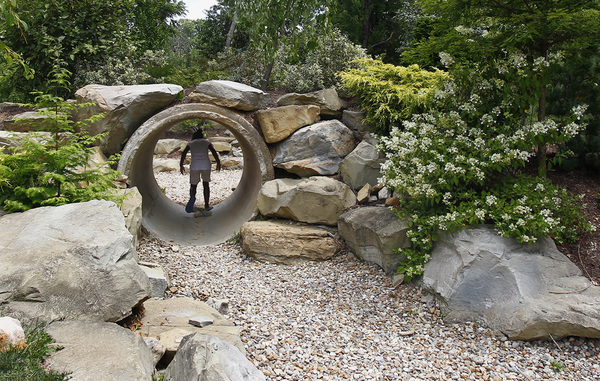
The teen was one of several dozen kids and parents from Akron homeless shelters who spent Tuesday at Secrest Arboretum, part of Ohio State University's Wooster-area campus. They were there to learn about their environment while they explored the carefully tended grounds.
The event was part of a summer enrichment program offered by Project RISE, which provides supplemental educational services to homeless youth in the Akron Public Schools. RISE stands for Realizing Individual Strength through Education.
For the participants, though, the day was mostly about fun. They planted kale. They tasted strawberries and broccoli. They gathered flowers into bouquets and made music with drummer Baba David Coleman.

At one learning station, plant material specialist Matt Shultzman introduced his young charges to the various plant parts people eat. When you're eating a berry or a tomato, you're eating the fruit, he told them. When you eat lettuce, you're eating leaves.
"Some plants, you eat the flower," he said.
"Ew!" came one startled reply.
At another station, Secrest program assistant Paul Snyder challenged the participants to find scraps of solid-color fabric hidden in the plants, a way of helping them understand how insects' colors help them hide from predators.
The treasure hunt proved more difficult than they expected. The colors blended so well with their backgrounds that the searchers sometimes needed some "you're getting warm" assistance from Snyder.
"I got it! Woo!" announced Lesley Anderson, a staff member from the Battered Women's Shelter of Summit and Medina Counties, as she plucked a small square of fabric from a shrub and waved it triumphantly.
This was the second year for the program, which was developed with help from a retired teacher.
The young participants benefit from the safe, outdoor setting, which neutralizes some of their negative experiences and helps them feel more relaxed, said Debra Manteghi, Project RISE's program manager.
That, in turn, makes them more receptive to learning.
Snyder said he hopes the program's effects will last long after the participants leave.
"We get to incite wonder, passion and discovery in these children," he told a group of volunteers before the program's start.
And just maybe, he said, the experience will ignite a desire in some of them to learn more.