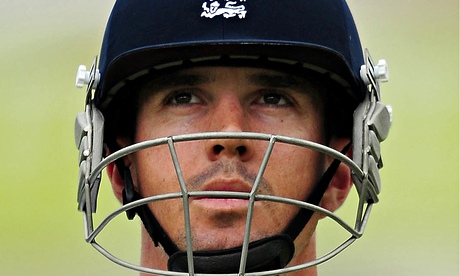
For almost 30 years, the passport of ex-King Constantine of Greece did not admit of a surname. It billed him simply as “Constantine, former king of the Hellenes”. I wonder if Kevin Pietersen may consider amending his British one so it reads simply: “Kevin, exiled England batsman”?
There are deathless stories, and then there’s the question of whether a way back to the England side can be found for Pietersen. None of us should rule out this discussion being the last thing we hear before we die – even if our expected checkout date is several decades away. Pietersen could be fielding in a Zimmer frame for the Jaipur Twilight Homers in the IPL seniors’ league, and people would still be arguing whether the door to an England return was truly shut.
The latest flare-up comes courtesy of the incoming England and Wales Cricket Board chairman, Colin Graves, whose decision to augment England’s World Cup by poking this particular hornet’s nest is certainly intriguing. Perhaps this is Mr Graves’s stab at the business that is known as “mind games”. Perhaps he seeks to create some Mourinho-style thunderstorm which will allow his malfunctioning players to get on with sorting themselves out offstage. Perhaps he’s finishing a course of anti-malarial pills and has forgotten to take them with food.
The only other possibility is that Graves has the nimble brain of the classic British sporting administrator, and that this week it’s cricket’s turn again to be the most stupidly run sport. Since the minute he made it, Graves’s intervention has dominated the English cricket headlines, spawning a typically confusing clarifying statement from the ECB, tweets from Pietersen – both excitable and incendiary – and a press conference in which Joe Root was invited to get bogged down in the whole KP issue yet again.
The only international retirement story with more twists and turns than this one was David Beckham’s, which went on for years, as you’ll recall, and would even have got its seventh consecutive fairytale ending had Stuart Pearce not mulishly refused to make Goldenballs the Team GB captain at the London Olympics. While there was always low-level carping at the attention given to Beckham’s extended finale, you wouldn’t find a player out there who really begrudged him his story. In fact, despite all the egos and hotheads and aggressors with whom he played, the only team-mate ever to have a bad word to say about Beckham was his sometime LA Galaxy captain Landon Donovan, who appeared to have decided that his small pond couldn’t accommodate a big fish and a blue whale without some friction.
However, that was Beckham. Pietersen is widely agreed to be … well, less lovable, if you wish for a euphemism. If you don’t, you may care to settle on Andrew Strauss’s verdict: “a complete cunt”. It is, of course, possible to be in the latter camp but still think England should have hung on to Pietersen at the time. That was my position, for what minuscule amount it’s worth – though I need hardly point out how little that has to do with the price of rice now.
We are where we are, in the parlance of a regional business manager. Attempts to restore Pietersen to England are like attempts to restore the Stuarts to the throne: once they were quite serious, now they ought really to have been commuted down to a single annual lunch in St James’s. These days, the Charles Edward Stuart Society has cheerfully admitted that were the Act of Settlement to be repealed, it’s a little too long after the event to bring back the Stuarts. The society confines itself to living history events, such as a weekend of real ale and re-enactments in Derby.
Unfortunately, the activities of the unofficial Kevin Pietersen Society feel nowhere so benign. So potentially damaging do they remain, in fact, that perhaps a better analogy lies elsewhere.
Doesn’t the Pietersen-England saga now have the feel of 1990s Tory yearnings to bring back Margaret Thatcher? Long after her defenestration, Thatcher remained the Queen Over the Water for some devoted backbenchers and a faction of rightwing journalists, a Bonnie Prince Charlie figure to whom they wistfully drank toasts. Maggobites, Geoffrey Wheatcroft called these Thatcher-devoted versions of Jacobites. There was never an actual plot, or anything so remotely realistic – instead, there was endless and destructive internal strife predicated on the perceived unfairness of her departure. “They pined for her return,” observed Wheatcroft, “actively undermined her successor and practised something like Leninist ‘revolutionary defeatism’.”
Isn’t there something of Thatcher to Pietersen? A towering figure, unquestionably, England’s leading run-scorer in all three elections – forgive me, all three formats – and in many ways about as lovable as the old girl was, without getting into the Strauss description again. Like Maggie, he refuses to go quietly; he can’t resist telling England where they’re going wrong. There’s certainly something of the Maggobites to his supporters. The means by which they could restore him to his former glory are as ill-defined as they are inherently doomed – yet they fight destructively on, and on.
For my part, I have raised my last glass to the Batsman Over the Water. Couldn’t those struggling to let him go start linking him to the vacant Kensington and Chelsea Tory seat instead, along with all the other sportsmen supposedly in the frame? He could go head to head with his old enemy, Strauss – surely a more entertaining battle than any of the endless re-enactments the Kevin Pietersen Society has to offer.