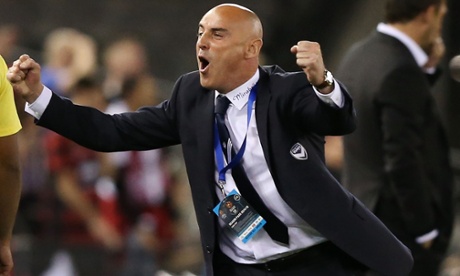
To the many people who would have delighted in seeing him fail as a coach, Kevin Muscat has been a big disappointment.
Promoted to coach at Melbourne Victory three games into last season, he’s not only done an impressive job– he’s done it without losing his cool. So has the man dubbed everything from the most-hated player in football to its dirtiest one changed? Yes, he admits, he has. Just don’t call him mellow.
“The fire in my belly still burns, and I’m just as eager and enthusiastic to win a game of football as I ever have been,” he says. “But as you take control, you realise you’ve got a responsibility to act in the right manner, and I’ve certainly worked out...” He trails off; pauses. Then resumes.
“When I’m calm I make better decisions. I do wear my heart on my sleeve, and finding that balance to be able to stay poised and stay in control is very important.”
It’s hard to pinpoint the exact moment when everything changed for Muscat. Was it the 84th minute in Brasilia last September, when Mark Schwarzer found himself picking the ball out of the Australia goal for the sixth time that afternoon? Or was it sometime in Paris the following week - in the 8th, 16th, 27th, 29th, 47th or 51st minutes?
At some point in those two matches, the fate of then-coach Holger Osieck was sealed. With heir-apparent Ange Postecoglou answering the Socceroos’ SOS, it was time for Muscat to trade up the assistant’s tracksuit for the gaffer’s suit and tie.
“I want to bring success back to this football club,” says the only man to have captained Victory to a championship (something he managed to do twice). “There’s no two ways about it. I want to bring success to this club. I know what that looks like and I know how that feels, and I want to bring that joy back to everyone involved.
“The fact that I’ve been given an opportunity at a football club that I’ve enjoyed so many good times at and made so many good friends at, it’s certainly not a burden. Quite the opposite. It’s a privilege.”
Finishing fourth, as Victory did last season, might only be a pass mark for a well-off and ambitious club like his; but it was enough to show why they’ve had him pencilled in for the top role for so long.
Another win and second spot was theirs; one more point and they would be returning to the Asian Champions League. The transition of coaches – even one as smooth as from Postecoglou to Muscat – might have been that difference.
“Everything I did last season was the first time I’d done it as head coach,” he says. “There’s different types of pressures and responsibilities that come with that [and] I intend to use last year’s experience to help me this year.”
Now that the team is his own, can we expect to see any major changes in the Victory of this season to one he inherited from Postecoglou? Muscat has brought new personnel to the club. Signings such as Besart Berisha, Carl Valeri and Daniel Georgievski have all won titles in recent years, and Muscat says they are contributing to the “great drive within the team” right now.
“You talk about the pressure. The football club itself creates a certain amount of pressure because of its history [and support]. But first and foremost, the greatest pressure comes from within – comes from your peers, comes from your team-mates, comes from your work colleagues. That’s your greatest pressure, because with all due respect, they’re the ones who probably understand more than anyone what it’s like being in the trenches.”
Some might say teaming up a hot-headed player like Berisha with a coach like Muscat is asking for trouble. Muscat doesn’t see it that way.
“I’ve realised looking back on my own time what was right and what was wrong. It puts me in the best position to give advice if [anything] ever happens. Bes is a really infectious character whose will to win is enormous. But he understands the responsibilities that weigh on his shoulders.”
Rights and wrongs? Is that a hint of regret? “I understand that interest [in my past], but I’m just looking forward. I’m focussed on my coaching career,” he says. “It’s a whole new chapter [and] I want to be judged on how I’m doing and how my team is playing.”
As we reach the end of the interview, I ask what the most difficult part of the job has been. He pauses again. “Ummm, there were one or two players who, ahmmm, aren’t here this season. You know having that conversation with them wasn’t the easiest thing to do.”
He gets lost in his thoughts for a second. Reflective, compassionate. This is not the Kevin Muscat many expect.
“You know, one thing I have gathered over the last 12 months is that ... it’s certainly made me realise my job is to deal with people, not players. And that certainly was a focus during our recruitment this year. We made sure that first and foremost we surrounded ourselves with good people.
“It’s a lot easier to create that environment of accountability and have a good culture around the place when that’s the case.”
How might he break career-ending news to Archie Thompson, who’s been with him at the club since its beginnings?
He can answer that with two words: “In private.” Full stop. A pregnant pause. Then a chuckle. “[But] why would I be thinking about anything [like that?] He’s trained and he’s done really well in pre-season. It’s the furthest thing from his mind and mine.”
As for Muscat’s own ambitions, he’s staying focussed on this season. But critics beware: “I’m comfortable wearing that suit. Yeah, without doubt.”