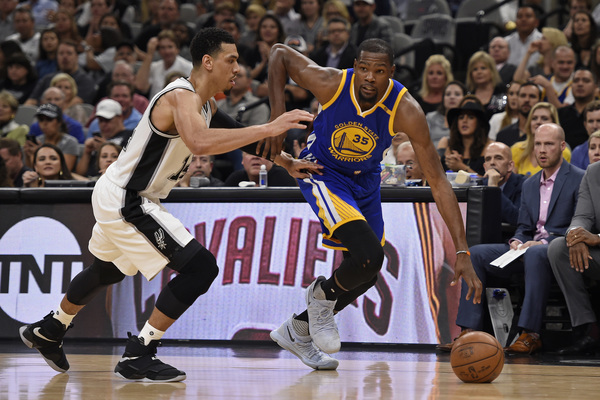
Kevin Durant walked into the north entrance of Oracle Arena ahead of Game 1 of the 2017 Western Conference Finals with a subtle message etched across his T-shirt.
"Stay Black"
For Durant, the two-word phrase acts not only as a reminder of his identity but a manifesto of the spiritual journey the 10-year veteran has embarked upon over the last year and a half.
The journey, which has taken Durant to a new address, and a distinct political climate was inspired by a series of events during the 2016 offseason, including his exit from Oklahoma City, a community summit organized by Carmelo Anthony in Los Angeles, and the on-field protests of former 49ers quarterback Colin Kaepernick.
Images of Durant's evolution are etched onto his right leg as prominent black figures Tupac Shakur and Rick James are immortalized in tattoos. The ink of Shakur holds a special meaning for the forward. On the eve of Team USA activities in 2016, Durant came across a 1992 MTV interview of the slain rapper on YouTube, in which Shakur expressed anger in the disproportions in wealth among economic classes.
Shakur's stance, along with a year-and-a-half soul searching, reminds Durant of the road traveled and what he hopes to learn going forward.
LOGAN MURDOCK: So, a couple of weeks ago you told me about this epiphany, about you finding more of an identity since you arrived in the Bay Area...
KEVIN DURANT: Well, I was just trying to simplify everything. What I feel is complicated as far as business, as far as people, as far as basketball. I try to simplify as much as I can. I think that makes my life easier and I think that's what life is all about: trying to make it as easy as possible.
LM: Where did this change of identity come from?
KD: Finally waking up, to be honest. Just kind of seeing how rough it is for an average black man, you know what I'm saying? And on top of that, a black man makes one mistake ... I see how far we get pushed down. For me, I kind of grew up in this basketball world, whereas my talent kind of overrides what I look like.
I didn't have it as rough when it comes to that, as far as social or systematic oppression or any social issues. They didn't really apply to me because I could put a ball in a basket. Just me saying that kind of woke me up a little bit, like "Damn, that's all I'm good for?" Like, if I wasn't a basketball player, what kind of man would they look at me as, you know what I'm saying?
In terms of what value can I bring to you outside of playing basketball. I bring a lot of value to people as far as how I treat them, how I encourage them, how I just try to be a good person to them. I feel there's like a lot of black men that have those traits, but they often just get stereotyped or judged off of one incident or not given a second chance.
So if I find something that's empowering to people that look like me, I just try to send a subtle message that I got your back and I hear you and I try to inspire you as much as I can from just being in this world as a black man coming up, even though I was looked at and viewed a little differently for it. But I'm still a black man. I understand where you're coming from.
LM: When you first signed here, you sat down on the Bill Simmons Show and talked about how people only see you for one thing.
KD: Anything involving basketball with us is such a huge, huge deal, and then you hear stories of how players want to stand up for what they believe in, stand up for social justice, systematic oppression. You see what's going on with Meek Mill right now, which is (expletive) ridiculous, and he's actually doing something great with himself. He's helping people, he's building a better life, he's putting on a better life for him and his family, and you see how people do him. I started to pay attention to more and more things like that.
Then I hear my friends talk about what it's like in the corporate world for black folks. You automatically just get viewed as something that you're not or something that somebody else may have been, may have done. A lot of feelings get projected on you because of what you look like or how you present yourself. It's like, so much (expletive) that goes on that I see now that I didn't see before.