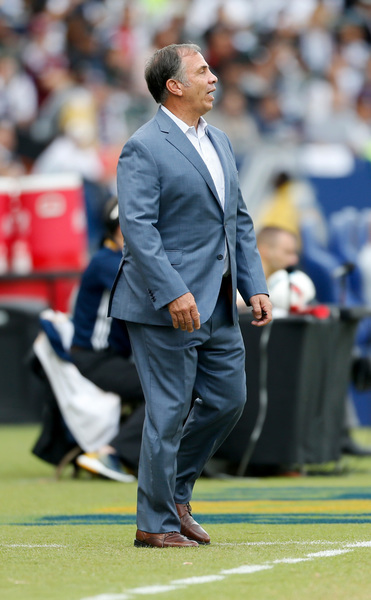
PANAMA CITY, Panama _ In a sport that thrives on structure and discipline, Bruce Arena says he has just one rule.
"Be on time. That's the rule," the coach of the U.S. national team said. "Be on time and be respectful."
Technically that's two rules, but you get the point. With Arena, personal responsibility and character count more than obedience to some arbitrary code of conduct.
"When you step across the line to play, he wants nothing but your everything. Then the rest of it, you can kind of let your hair down and do whatever the heck you want," goalkeeper Tim Howard said. "He's really not that concerned about it. So there's less pressure around the training camp and the meal tables and all that stuff."
And that laissez-faire approach has worked fairly well for the U.S. team, which beat Honduras at home last week, then picked up a huge road point Tuesday when it played Panama to a draw, resuscitating a World Cup qualifying campaign that was on life support just last week.
"We've made a lot of progress," the coach said. "I've been very encouraged by what I've seen over the last 10 days."
Arena's hands-off approach stands in sharp contrast to the hands-on one favored by his predecessor, Jurgen Klinsmann, who preferred to limit free time by keeping his players busy. And though Klinsmann is the second-winningest coach in U.S. history, people close to the team say players ultimately began to chafe under his system after 5 { years.
The point of no return came in November when a flat U.S. team lost its first two qualifiers of the current World Cup cycle, leading to the sacking of Klinsmann and the hiring of Arena, who coached the U.S. to two World Cups in his first eight-year stint with the national team.
The difference was palpable six weeks later, when Arena convened his first national team training camp in 11 years.
"You always get a positive vibe any time there's a change," said Sunil Gulati, the president of U.S. Soccer and the man who hired and fired both Klinsmann and Arena.
That change has been more about attitude and atmosphere than anything else. Under the previous staff, things were so structured players felt the coaches were always looking over their shoulders. Klinsmann also wanted to keep people around the program on their toes by routinely changing everything from schedules to players' positions.
Arena, on the other hand, is as steady and predictable as a Swiss timepiece.
"Bruce has just done a very good job of coming in and being very clear with how we're going to do things, what he wants us to be about," said midfielder Michael Bradley, who served as the U.S. captain under both coaches. "On the field, off the field the group has responded in a really good way."
Arena has turned around struggling teams before, which is one reason why he was hired to do it again. In 1998, he took over a U.S. team that had lost all three of its games in that summer's World Cup and took it to the quarterfinals four years later, still the best-ever performance by an American team.
A decade later he was hired by the Los Angeles Galaxy in midseason, inheriting a club that had Landon Donovan, David Beckham and an infamously noxious locker room. That team finished with a franchise-low eight wins.
A year later the Galaxy made it to the MLS Cup finals, starting a streak that saw them reach the league championship game four times in six seasons.
"I got rid of 19 players out of 24," Arena remembered. "I'm not stupid. I kept Beckham, Donovan and there's somebody else that might have been good. (But) I did get rid of the whole team."
That's a bit more difficult to do with a national team. So instead of changing the players he has changed the environment. He also brought in sports psychologist Tom Perrin, a longtime friend, to change the mentality.
"Common sense. That's basically how we operate," Arena said. "We use, generally, common sense on how we do things. And we keep it simple."
Told that his players say they're having fun playing for him, the coach responded with sarcasm, another Arena trademark.
"We're bringing a clown in for lunch today to make balloons and stuff for the players," he said.
Then just as quickly he turned serious again. A couple of losses, a failure to qualify for the World Cup, and he said Gulati will be letting him go again, just as he did in 2006. The real power for change _ and the power to determine success or failure _ rests with the players, he said. All a coach can do is point them in the right direction, then get out of the way.
"Lead the way. I really believe in that," he said. "It's their team and they've got to take ownership. If it's my job to control them all day, I don't think we have a chance. And I'm basically not interested in doing it. I'll just open a preschool somewhere."